In today’s fast-paced business environment, communication systems are the backbone of operational success. While traditional PBX (Private Branch Exchange) systems have served businesses well for decades, the emergence of IP EPABX technology has revolutionized how companies handle their communication needs. If you’re still relying on an outdated phone system, you might be missing out on significant opportunities for cost savings, efficiency, and growth.
Understanding the transition from traditional PBX to modern IP EPABX systems is crucial for businesses looking to stay competitive. An IP EPABX system uses internet protocol to transmit voice and data over the same network, eliminating the need for separate phone lines and offering unprecedented flexibility and features.
Let’s explore the ten critical signs that indicate it’s time for your business to make this essential upgrade.
10 Signs Your Business Needs to Upgrade from Traditional PBX to IP EPABX
1. Skyrocketing Communication Costs
One of the most obvious signs that you need an upgrade is when your monthly phone bills continue to climb without a corresponding increase in business activity. Traditional PBX systems rely on copper wire infrastructure and analog phone lines, which come with substantial recurring costs for line rental, long-distance calls, and maintenance.
IP EPABX systems dramatically reduce these expenses by routing calls over your existing internet connection. Businesses can save anywhere from 30% to 60% on their monthly communication costs after switching to IP telephony. The technology eliminates the need for separate voice and data networks, reducing infrastructure costs and simplifying management.
Inter-office communication becomes virtually free with IP EPABX, regardless of geographical distance. Whether your team members are in the same building or spread across different cities, they can communicate seamlessly without incurring traditional long-distance charges. This cost efficiency becomes particularly significant for businesses with multiple branches or remote workers.
Many Chennai-based companies have experienced remarkable transformations after implementing IP EPABX solutions. Real-world examples demonstrate how businesses have reduced communication costs by 40% while simultaneously improving service quality and employee productivity.
2. Limited Scalability and Flexibility
Traditional PBX systems are notoriously rigid when it comes to expansion. Adding new phone lines requires physical installation, additional hardware, and often significant downtime. If your business is growing and you find yourself constantly struggling to add new extensions or lines, it’s a clear signal that your current system can’t keep pace with your needs.
IP EPABX systems offer unparalleled scalability. Adding new users is as simple as configuring software settings and connecting a VoIP phone or installing a softphone application on a computer or smartphone. There’s no need for extensive rewiring or hardware modifications. This flexibility is particularly valuable for businesses experiencing rapid growth or seasonal fluctuations in staffing.
The system adapts to your business rather than forcing your business to adapt to technological limitations. Whether you need to add five extensions or fifty, the process is straightforward and can often be completed in minutes rather than days. This agility allows businesses to respond quickly to market opportunities without being constrained by communication infrastructure.
3. Frequent System Downtime and Reliability Issues
Are you experiencing regular system failures, dropped calls, or poor call quality? Traditional PBX systems age like any other hardware, and as they get older, reliability becomes an increasing concern. Components wear out, replacement parts become harder to find, and the risk of catastrophic failure grows.
Modern IP EPABX systems are built with redundancy and reliability in mind. Cloud-based or hybrid solutions can automatically failover to backup systems, ensuring business continuity even during hardware failures or network issues. The distributed nature of IP telephony means that your entire communication system doesn’t depend on a single point of failure.
Additionally, IP EPABX systems come with built-in monitoring and diagnostic tools that alert administrators to potential issues before they become critical. This proactive approach to maintenance minimizes unexpected downtime and ensures that communication channels remain open when your business needs them most.
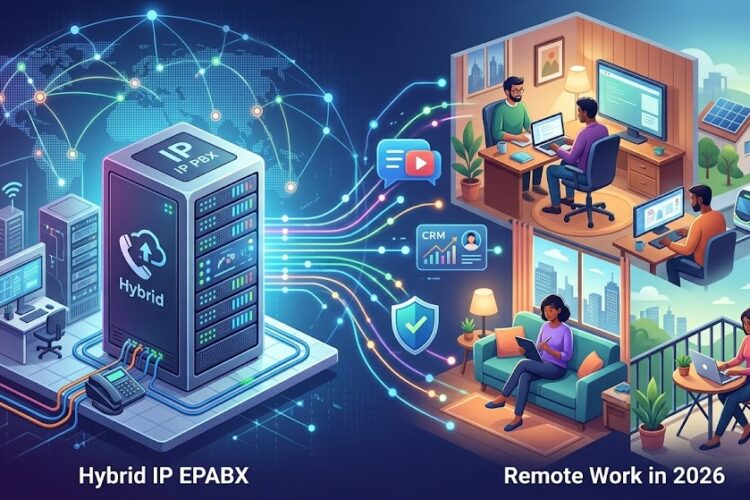
4. Inability to Support Remote Work
The rise of remote and hybrid work models has fundamentally changed how businesses operate. If your traditional PBX system can’t effectively support employees working from home or on the go, you’re severely limiting your organization’s flexibility and potentially missing out on top talent who value workplace flexibility.
IP EPABX systems are inherently designed for distributed workforces. Employees can use their business extensions from anywhere with an internet connection, maintaining the same professional presence whether they’re in the office, at home, or traveling. Features like call forwarding, voicemail-to-email, and mobile integration ensure that employees remain connected and productive regardless of location.
This capability has become particularly crucial in the post-pandemic business landscape, where remote work options have transitioned from a perk to an expectation for many professionals. Organizations that can’t offer seamless communication for remote workers face challenges in recruitment, retention, and overall productivity.
5. Lack of Advanced Features
Traditional PBX systems offer basic calling functions, but they fall short when it comes to the advanced features that modern businesses need. If your current system doesn’t support unified communications, integration with business applications, or advanced call management features, you’re operating with one hand tied behind your back.
IP EPABX systems provide a wealth of sophisticated capabilities that enhance productivity and customer service. These include:
Unified Communications: Integration of voice, video, instant messaging, and presence information into a single platform allows team members to communicate more efficiently and choose the most appropriate channel for each situation.
CRM Integration: Automatic screen pops displaying customer information when calls arrive, click-to-dial functionality from within business applications, and automatic call logging eliminate manual data entry and provide context for every customer interaction.
Advanced Call Routing: Intelligent call distribution based on time of day, caller ID, agent availability, and skills-based routing ensures that customers reach the right person quickly, improving first-call resolution rates.
Analytics and Reporting: Detailed call analytics provide insights into communication patterns, helping managers optimize staffing, identify training opportunities, and measure service quality metrics.
Conference Calling: Built-in audio and video conferencing capabilities eliminate the need for separate conferencing services, reducing costs and simplifying the user experience.
These features aren’t luxury add-ons; they’re essential tools for businesses competing in today’s market. The complete guide to call center solutions with IP EPABX systems demonstrates how these advanced features translate into tangible business benefits.
6. Difficulty Integrating with Modern Business Tools
Today’s businesses rely on a complex ecosystem of digital tools, including CRM platforms, helpdesk software, collaboration applications, and productivity suites. If your phone system operates in isolation from these tools, you’re creating information silos and forcing employees to work harder than necessary.
IP EPABX systems excel at integration. Through APIs and standard protocols, they can connect with virtually any business application, creating a seamless workflow where information flows automatically between systems. When a customer calls, your sales team can instantly see their purchase history, open support tickets, and previous interactions without switching between applications.
This integration extends to collaboration tools as well. Employees can initiate voice or video calls directly from their team chat applications, schedule conference calls from their calendar software, and receive voicemail notifications through email. These integrations eliminate friction from daily workflows and allow employees to focus on productive work rather than managing multiple disconnected systems.
7. High Maintenance Costs and Vendor Dependency
Traditional PBX systems often require specialized technicians for maintenance and repairs, creating vendor lock-in and high service costs. If you find yourself paying premium rates for routine maintenance or waiting days for technicians to resolve simple issues, your current system is costing more than just money—it’s costing you time and operational efficiency.
IP EPABX systems significantly reduce maintenance complexity. Many routine tasks can be handled through web-based administration interfaces, eliminating the need for on-site visits. Software updates can be deployed remotely, and troubleshooting can often be accomplished through remote access rather than requiring physical presence.
The standardized nature of IP telephony also reduces vendor dependency. Unlike proprietary PBX systems that lock you into a single vendor’s ecosystem, IP EPABX solutions typically use open standards, giving you the flexibility to choose compatible equipment from multiple manufacturers. This competition drives down costs and gives you more leverage in vendor relationships.
8. Poor Call Quality and Customer Experience
In business, first impressions matter, and for many customers, their first interaction with your company is a phone call. If your traditional PBX system delivers poor call quality—static, echoes, dropped calls, or long hold times—you’re inadvertently telling customers that their experience doesn’t matter.
Modern IP EPABX systems leverage Quality of Service (QoS) features to prioritize voice traffic over your network, ensuring crystal-clear call quality even during periods of high data usage. Advanced codecs compress voice data efficiently without sacrificing audio quality, and packet loss concealment algorithms mask occasional network imperfections.
Beyond technical quality, IP EPABX systems improve customer experience through intelligent features like interactive voice response (IVR), callback options during high-volume periods, and skills-based routing that connects customers with the most qualified agents. These features reduce wait times, minimize transfers, and increase first-call resolution rates—all critical factors in customer satisfaction.
9. Inability to Access Real-Time Communication Data
Data-driven decision-making has become essential for business success, yet traditional PBX systems provide limited visibility into communication patterns and performance metrics. If you can’t answer basic questions about call volumes, average handling times, or peak usage periods, you’re flying blind when making staffing and operational decisions.
IP EPABX systems generate comprehensive analytics that transform communication from a black box into a strategic asset. Managers can access real-time dashboards showing current call activity, agent availability, and queue status. Historical reports reveal trends in call volumes, identify bottlenecks, and highlight opportunities for improvement.
These insights enable evidence-based decisions about staffing levels, training needs, and process improvements. Marketing teams can track which campaigns generate the most phone inquiries. Sales managers can identify coaching opportunities by reviewing call recordings. Customer service leaders can optimize schedules based on historical call patterns, ensuring adequate coverage during peak periods without overstaffing during slower times.
10. Limited Disaster Recovery Capabilities
Business continuity planning is no longer optional in an era of increasing cyber threats, natural disasters, and unexpected disruptions. If your traditional PBX system is housed in a single location with no backup or redundancy, you’re one disaster away from losing all communication capabilities.
IP EPABX systems offer robust disaster recovery options. Cloud-based deployments automatically replicate data across multiple data centers, ensuring availability even if one location experiences an outage. Hybrid systems can route calls to mobile devices or alternate locations if the primary office becomes inaccessible. Geographic redundancy means that your communication infrastructure doesn’t rely on a single physical location.
During emergencies, employees can continue working from anywhere while maintaining access to the same phone system features they use daily. Customers calling your business number are automatically routed to available agents regardless of their location, ensuring that your business remains operational even when your physical office is not.
Case Study: Chennai Manufacturing Company’s Transformation
To illustrate the real-world impact of upgrading from traditional PBX to IP EPABX, let’s examine the experience of a mid-sized manufacturing company in Chennai that made this transition last year.
The Challenge: The company operated three manufacturing facilities and a central office in Chennai, relying on separate traditional PBX systems at each location. Communication between facilities required external phone calls incurring long-distance charges. Adding new extensions required scheduling technicians weeks in advance. The company spent approximately ₹2.5 lakhs annually on phone system maintenance alone, not including line rental and usage charges.
The aging systems experienced frequent failures, and replacement parts were increasingly difficult to source. Remote sales representatives struggled to stay connected with the office, often missing important calls from clients. The company had no visibility into call metrics, making it difficult to evaluate customer service performance or optimize staffing.
The Solution: After carefully evaluating their needs and consulting with IP EPABX system experts, the company implemented a comprehensive IP EPABX solution connecting all four locations. The system included:
- 150 IP phone extensions across all locations
- Integration with their existing CRM system
- Mobile softphone applications for sales representatives
- Call recording and analytics capabilities
- Automated attendant and skills-based call routing
- Unified communications features including instant messaging and presence
The Results: The transformation exceeded expectations across multiple dimensions:
Cost Savings: Communication costs decreased by 45% in the first year. Inter-office calls became free, eliminating the ₹40,000 monthly expense for calls between facilities. Maintenance costs dropped to less than ₹50,000 annually. The complete payback period for the IP EPABX investment was just 18 months.
Operational Efficiency: Adding new extensions now takes minutes instead of weeks. When the company opened a new sales office, they had phone service operational on day one simply by plugging in IP phones and configuring extensions remotely. Remote sales representatives report improved connectivity and professionalism, as clients can now reach them on their business extensions regardless of location.
Customer Service Improvements: Call analytics revealed that 30% of customer calls were occurring outside business hours. The company implemented an after-hours support rotation using the IP EPABX’s flexible call routing, capturing opportunities they previously missed. First-call resolution improved by 25% due to CRM integration that provides agents with customer context immediately when calls arrive.
Business Continuity: During last year’s Chennai floods, the company maintained full communication capabilities despite the central office being inaccessible for three days. Calls automatically routed to employees working from home, and customers experienced no service disruption.
This manufacturing company’s experience demonstrates the transformative potential of upgrading from traditional PBX to IP EPABX. The benefits extended far beyond simple cost savings, encompassing improved efficiency, enhanced customer service, and greater business resilience.
Understanding the ROI: IP EPABX Cost Calculator
Making the business case for upgrading to IP EPABX requires understanding both the costs and benefits. Here’s a framework for calculating your potential return on investment:
Initial Investment Costs:
- IP EPABX server hardware or cloud subscription: ₹2,00,000 – ₹5,00,000 (or ₹500-1,500 per user monthly for cloud)
- IP phones: ₹3,000 – ₹15,000 per phone depending on features
- Network infrastructure upgrades (if needed): ₹50,000 – ₹2,00,000
- Implementation and configuration: ₹1,00,000 – ₹3,00,000
- Training: ₹25,000 – ₹75,000
Ongoing Cost Reductions:
- Reduced line rental (typically 40-60% savings)
- Eliminated long-distance charges for inter-office calls
- Reduced maintenance costs (50-70% savings)
- Lower costs for adding/moving extensions (80-90% savings)
- Consolidated vendor billing
Productivity Gains:
- Reduced downtime from system failures
- Faster call handling through CRM integration
- Improved remote work capabilities
- Better customer service through advanced routing
- Data-driven optimization of staffing
Example Calculation: A 100-employee company spending ₹2,50,000 monthly on traditional PBX costs (lines, usage, maintenance) typically sees:
- Monthly savings: ₹1,00,000 (40% reduction)
- Annual savings: ₹12,00,000
- Initial investment: ₹8,00,000
- Payback period: 8 months
- Five-year ROI: 650%
This calculation doesn’t even account for the productivity improvements and competitive advantages that come with modern communication capabilities. When you factor in reduced customer churn from better service, increased sales from improved responsiveness, and productivity gains from unified communications, the ROI becomes even more compelling.
The Future of Business Communication
The evolution from traditional PBX to IP EPABX isn’t just about upgrading technology—it’s about fundamentally transforming how your business communicates. The future of business telephony points toward increasingly integrated, intelligent, and flexible communication systems that adapt to your needs rather than constraining your operations.
Artificial intelligence is already being integrated into IP EPABX systems, providing features like real-time transcription, sentiment analysis, and intelligent call routing based on conversation content. Video communication is becoming seamlessly integrated with voice, creating rich multi-modal communication experiences. Internet of Things (IoT) devices are connecting to IP EPABX platforms, enabling innovative applications like facility-wide announcements through IP speakers in manufacturing plants.
Businesses that delay upgrading from traditional PBX aren’t just missing current benefits—they’re also falling behind in the foundation needed for future innovations. Every month spent on outdated technology is a month of unnecessary costs, missed opportunities, and competitive disadvantage.
Taking the Next Step
If you recognize your business in several of these ten signs, it’s time to seriously consider upgrading to IP EPABX. The transition doesn’t have to be overwhelming. Working with experienced providers who understand IP EPABX implementation ensures a smooth migration with minimal disruption to your operations.
Start by conducting a thorough assessment of your current communication needs and pain points. Document your monthly costs for phone services, maintenance, and system management. Survey employees about communication challenges they face. Interview customers or review service metrics to identify areas where your current system falls short.
Next, define your requirements for a new system. Consider not just your current needs but where your business will be in three to five years. Think about remote work capabilities, integration requirements, scalability needs, and desired features. This forward-looking approach ensures that your investment remains valuable as your business evolves.
Research providers carefully, focusing on those with proven experience in your industry and location. Local expertise matters, particularly in Chennai’s unique business environment. Look for providers who offer comprehensive support, from initial planning through implementation and ongoing management.
Request detailed proposals including hardware specifications, implementation timelines, training plans, and total cost of ownership projections. Don’t focus solely on upfront costs; consider ongoing expenses, scalability costs, and the value of features and support.
Plan for a phased migration if appropriate for your business. Many companies successfully transition by implementing IP EPABX at new locations first, or by starting with specific departments before rolling out company-wide. This approach allows you to gain experience and demonstrate ROI before committing to a full-scale transformation.
Conclusion
The signs are clear: if your business is struggling with high costs, limited features, poor scalability, or reliability issues, your traditional PBX system has become more of a liability than an asset. IP EPABX technology offers a compelling alternative that addresses these challenges while providing capabilities that can transform your business communication from a cost center into a strategic advantage.
The question isn’t whether to upgrade, but when. Every day spent on outdated technology represents lost opportunities for cost savings, improved customer service, and enhanced productivity. The businesses thriving in today’s competitive environment are those that recognize communication technology as a critical investment in their future success.
Whether you’re based in Chennai or elsewhere, the principles remain the same: modern businesses need modern communication systems. The power of IP EPABX systems lies not just in cost savings, but in the flexibility, reliability, and advanced capabilities that enable your team to work more effectively and serve customers better.
Don’t wait for your traditional PBX to fail catastrophically or for your competitors to gain an insurmountable advantage. Take action now to assess your needs, explore options, and begin the journey toward modern, efficient, and future-ready business communication. Your employees, customers, and bottom line will thank you.
For businesses ready to explore IP EPABX solutions, consider reaching out to experienced providers who can guide you through the assessment, selection, and implementation process. The transformation from traditional PBX to IP EPABX represents not just a technology upgrade, but a strategic investment in your business’s communication future.