Choosing a business communication system in 2026 feels a bit like choosing between building a custom PC or buying a high-end MacBook. Both will get the job done, but the experience, cost, and “tinker factor” are worlds apart.
If you are navigating the telecommunications landscape in Chennai or Coimbatore, you’ve likely come across two heavyweights: Asterisk (the open-source king) and Branded Hardware (the reliable giants like Matrix, NEC, or Panasonic).
Which one should anchor your office? Let’s dive deep into the pros and cons of open-source Asterisk IP PBX vs branded hardware to help you decide without the headache.
Understanding the Contenders: Asterisk vs. The Big Brands
Before we weigh the pros and cons, let’s define what we are actually looking at.
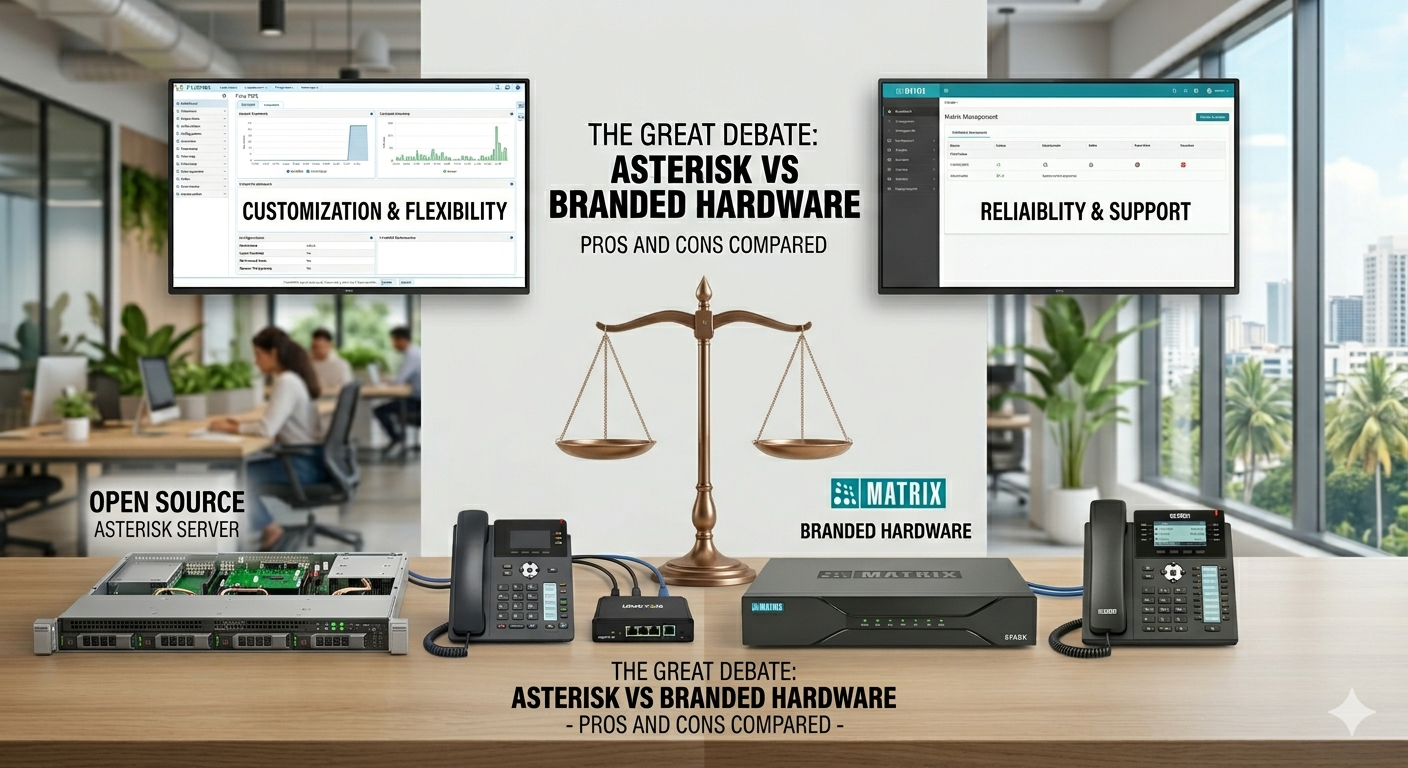
Asterisk is a free, open-source framework that turns a regular computer into a sophisticated communications server. It’s the engine behind popular interfaces like FreePBX. On the flip side, Branded Hardware refers to proprietary “appliance” systems where the software and hardware are designed to work together by a single manufacturer.
The Freedom of Choice: Pros of Open-Source Asterisk
1. Unmatched Cost Efficiency (No License Fees!)
The biggest pain point for growing businesses is “per-user” licensing fees. With a branded system, adding the 21st user often means buying a new license. Asterisk eliminates this. You aren’t paying for the software; you’re paying for the hardware it runs on. For a small business phone system under 50k, Asterisk is often the budget champion.
2. Infinite Customization
Do you want your PBX to talk to your CRM, trigger a door lock, and send a custom SMS alert simultaneously? With Asterisk, if you can code it (or hire someone who can), it’s possible. It offers a level of flexibility that proprietary systems simply cannot match. This is why many VoIP call center solutions rely on Asterisk-based backends.
3. No Vendor Lock-In
When you buy a branded system, you are married to that brand. You must use their proprietary phones, their expansion cards, and their authorized technicians. Asterisk is “hardware agnostic.” You can mix and match Grandstream IP phones with Dinstar gateways without the system throwing a tantrum.
The Reality Check: Cons of Open-Source Asterisk
1. The “Complexity” Tax
Asterisk is powerful, but it isn’t exactly “plug-and-play.” Setting it up requires a solid understanding of Linux and networking. If you don’t have an in-house IT expert, you might find yourself stuck. We often see businesses struggle with troubleshooting echo or voice lag because the DIY configuration wasn’t optimized.
2. Maintenance is on You
There is no 1-800 number for “Asterisk Inc.” If the system goes down, you rely on community forums or your local service provider. While the community is huge, it’s not the same as having a manufacturer-backed warranty. You’ll need a rigorous IP PBX maintenance guide to keep things running smoothly.
The Power of “Plug-and-Play”: Pros of Branded Hardware
1. Reliability and Stability
Branded systems like Matrix EPABX or NEC SL2100 are built for one purpose: telephony. The hardware is “hardened,” meaning it’s designed to run for years in a dusty server room without needing a reboot. The software and hardware are tuned for each other, resulting in fewer bugs.
2. Simplified Support and Security
When you buy a branded system, you get a clear path for updates and security patches. In an era of toll fraud and unauthorized access, having a manufacturer who pushes official security firmware is a massive weight off your shoulders.
3. Professional Feature Sets Out-of-the-Box
While Asterisk can do anything, Branded Hardware comes with the most important things already polished. Features like high-quality IVRs, seamless integration with eSSL biometrics, and robust failover mechanisms are usually just a few clicks away.
The Financial Burden: Cons of Branded Hardware
1. The High Initial and Scaling Cost
Proprietary systems are expensive. You aren’t just paying for the box; you’re paying for the R&D, the brand name, and the support network. As you grow, the cost of upgrading from analog to IP can skyrocket due to mandatory proprietary cards and licenses.
2. Limited Integration
Branded systems are “walled gardens.” Integrating them with third-party software (like a custom-built local CRM) can be a nightmare or require expensive API licenses. They prefer you stay within their ecosystem.
Comparing the Two: Which One Fits Your Business?
Choose Asterisk Open-Source If:
-
You have a skilled IT team or a reliable local partner.
-
You need extreme customization for a call center environment.
-
You want to keep initial capital expenditure low and avoid recurring licenses.
-
You want to reuse existing Fanvil or Flyingvoice IP phones.
Choose Branded Hardware If:
-
You want a “set it and forget it” solution.
-
Your business relies on 99.99% uptime and you need a manufacturer warranty.
-
You prefer a unified ecosystem where IP phones and PBX are the same brand for easier management.
-
You are a factory or large office in Coimbatore looking for on-site service support.
Finding the Middle Ground: The Hybrid Approach
Many modern businesses are moving toward a hybrid model. They use branded gateways, like Dinstar GSM gateways, to handle the physical lines, while using an Asterisk-based PBX to manage the logic. This gives you the reliability of hardware with the flexibility of open-source.
If you are unsure where to start, looking at a complete guide to IP PBX systems can provide a clearer roadmap for your specific infrastructure needs.
Frequently Asked Questions (FAQs)
Is Asterisk really free?
The software is free, but you still need to pay for the server (hardware), the IP phones, and the time/expertise required to configure and maintain it.
Can I use regular analog phones with Asterisk?
Yes, but you will need an FXS gateway to connect analog extensions. This is a common way to save money during a migration.
Which system is more secure?
Branded hardware is generally more secure “out of the box” because it has a limited attack surface. Asterisk is highly secure but only if configured correctly. Poorly configured Asterisk servers are frequent targets for SIP scanners.
What is the typical lifespan of these systems?
Both can last 5–10 years. However, branded hardware often has better lifecycle management, whereas Asterisk systems might need hardware upgrades (like a new server hard drive) more frequently.
Can I move my branded system to the cloud?
It depends on the brand. Many brands now offer cloud-based IP PBX versions, whereas Asterisk can be hosted on any cloud VPS (Virtual Private Server) quite easily.
Final Thoughts: Making the Call
The debate over the pros and cons of open-source Asterisk IP PBX vs branded hardware ultimately comes down to your internal resources.
If you have the technical “muscle,” Asterisk offers a world of freedom and cost savings. If you want a dependable tool that works from day one with professional backing, branded hardware like Matrix or NEC is the safer investment for your office communication.
Whatever you choose, ensure your network infrastructure is ready to handle the voice traffic to avoid the dreaded “can you hear me now?” moments.