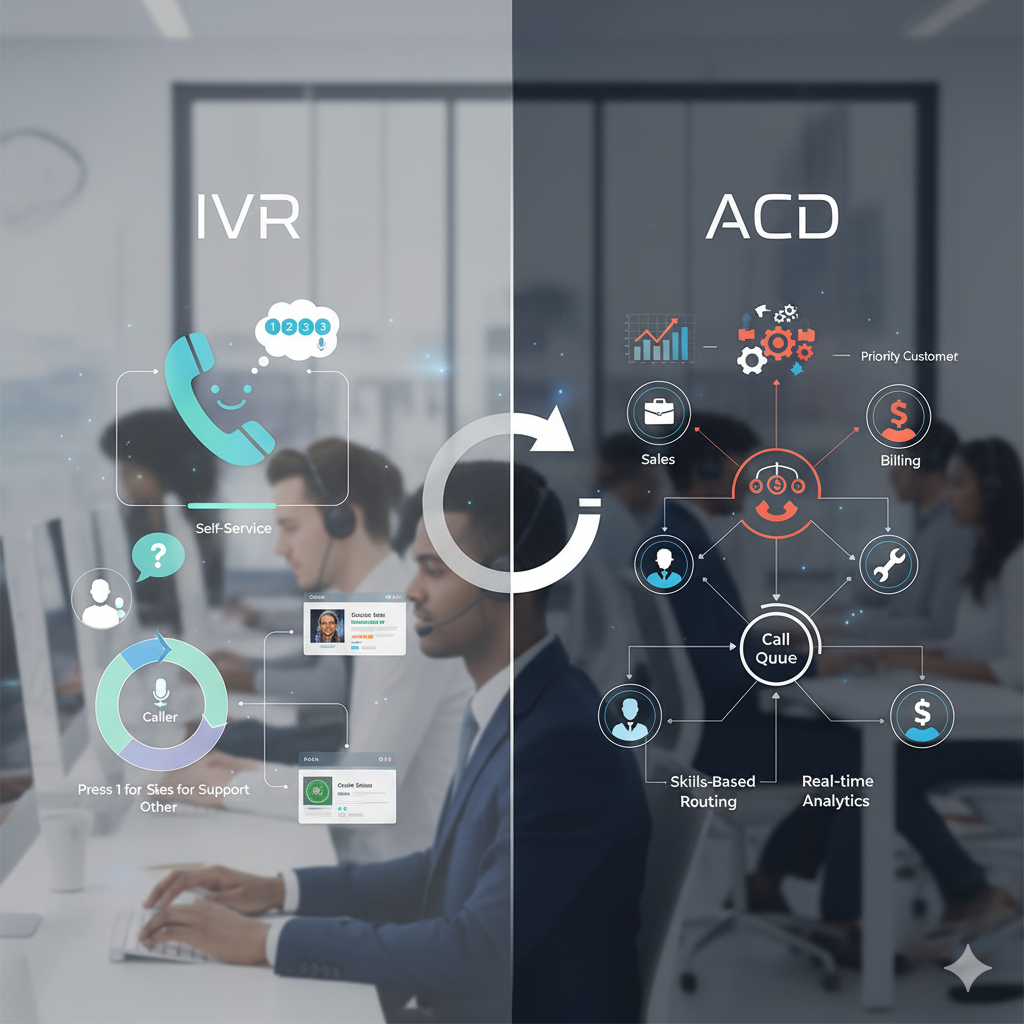
Picture this: You call your bank’s customer service, and within seconds, you’re asked to press numbers for different services. Then, you’re seamlessly connected to the right agent who already knows why you’re calling. That smooth experience? It’s the invisible dance between two powerful technologies—ACD and IVR—working together behind the scenes.
If you’re running a business in Chennai or anywhere else, understanding these technologies isn’t just technical jargon—it’s the key to transforming frustrated customers into loyal advocates. Let’s demystify these backbone technologies of modern call centers and help you make informed decisions for your business.
What’s the Real Difference? (And Why Should You Care?)
Before we dive deep, let’s clear up the confusion that trips up most business owners.
IVR (Interactive Voice Response) is your digital receptionist—the voice that greets callers and guides them through menu options. “Press 1 for Sales, Press 2 for Support.” You’ve heard it a thousand times.
ACD (Automatic Call Distributor) is your intelligent traffic controller—the system that routes calls to the right agent based on sophisticated rules, agent availability, and caller needs.
Think of it this way: IVR is the front door that welcomes guests and asks what they need. ACD is the smart building system that directs them to exactly the right office, on the right floor, with the person who can help them best.
The confusion? Many modern IP EPABX systems integrate both technologies so seamlessly that businesses don’t realize they’re using two distinct systems working in harmony.
IVR: Your 24/7 Digital Front Desk
How IVR Actually Works (Without the Technical Headache)
When a customer calls your business, the IVR system springs into action immediately. It uses pre-recorded messages or text-to-speech technology to present options, captures the caller’s input through their phone keypad or voice commands, and processes their requests.
Here’s what makes modern IVR systems impressive: they can authenticate callers, provide information without human intervention, collect data like account numbers or appointment dates, and route calls based on the gathered information.
The Hidden Pain Points (And How to Avoid Them)
The Menu Maze Nightmare: We’ve all been trapped in IVR hell—pressing buttons endlessly, never reaching a human. One telecommunications study found that 83% of customers feel frustrated when stuck in too many IVR layers.
Solution: Keep your menu structure shallow. The golden rule? No more than three levels deep, and always offer an option to speak with an agent within the first menu.
The “None of These Options Apply” Dilemma: Nothing frustrates callers more than realizing their issue doesn’t fit any of the offered choices.
Solution: Always include a “For all other inquiries” or “Speak to an operator” option in every menu level.
Robotic, Impersonal Experiences: Generic, monotone IVR voices can make customers feel like they’re talking to a machine (because they are), setting a negative tone from the start.
Solution: Invest in professional voice recordings that match your brand personality. Warm, friendly, and clear beats robotic every time.
When IVR Shines Brightest
IVR systems excel in specific scenarios that every growing business encounters:
After-Hours Service: Your IVR never sleeps. It handles basic inquiries, takes messages, and provides information when your team is offline. For businesses transitioning from traditional PBX to IP EPABX, this 24/7 capability becomes a game-changer.
High-Volume, Simple Queries: Account balance checks, store hours, appointment confirmations—these repetitive tasks are perfect for IVR automation, freeing your agents for complex issues.
Self-Service Transactions: Password resets, bill payments, order tracking—when customers want quick answers without waiting for an agent, IVR delivers instant gratification.
Multilingual Support: Serving Chennai’s diverse business community? IVR can offer menu options in Tamil, English, and other languages without hiring multilingual staff for every shift.
ACD: The Intelligent Traffic Controller You Never See
Understanding ACD’s Sophisticated Logic
While IVR is the face of your call system, ACD is the brain that makes smart decisions in milliseconds. When properly configured as part of complete call center solutions, ACD transforms chaotic call volumes into organized, efficient workflows.
Modern ACD systems use multiple routing strategies:
Skills-Based Routing: Matches callers with agents who have specific expertise. A technical support call goes to your tech-savvy agent, while billing questions route to your accounts team.
Time-Based Routing: Automatically adjusts call flow based on time of day, day of week, or business hours. Weekend calls might route differently than weekday calls.
Priority Routing: VIP customers, urgent issues, or high-value prospects jump the queue appropriately. Your biggest client doesn’t wait on hold while agents handle routine inquiries.
Longest Idle Agent: Distributes calls evenly across your team, preventing burnout and ensuring fair workload distribution.
Round Robin: Rotates calls among agents in a fixed sequence, perfect for sales teams where fairness in lead distribution matters.
The Real-World Impact: A Chennai Success Story
Consider a mid-sized manufacturing company in Ambattur that implemented an integrated IP EPABX system with advanced ACD capabilities. Before implementation, customer calls were answered randomly, leading to frequent transfers, frustrated clients, and wasted agent time.
After deploying skills-based ACD routing:
- Average call handling time dropped by 34%
- Customer satisfaction scores increased by 47%
- First-call resolution improved by 52%
- Agent stress levels decreased significantly
The secret? Calls about machine maintenance went directly to technical experts. Billing inquiries reached accounts specialists. New sales prospects connected with dedicated sales agents. Simple, logical, and incredibly effective.
ACD Pain Points That Keep Managers Awake
The Abandonment Rate Crisis: Nothing feels worse than watching callers hang up after waiting on hold. High abandonment rates signal serious problems—and lost business.
Solution: Monitor queue times religiously. Set thresholds that trigger alerts when wait times exceed acceptable limits. Consider callback options that let customers hang up and receive a return call when agents become available.
Inefficient Agent Utilization: Some agents are overwhelmed while others sit idle. This imbalance destroys morale and efficiency.
Solution: Use real-time ACD analytics to rebalance workloads. Modern systems can dynamically adjust routing rules based on current queue conditions.
The Skills-Gap Trap: Routing calls based on agent skills sounds perfect—until you realize some skills are rare, creating bottlenecks while other agents stay idle.
Solution: Cross-train your team. Every agent should have primary expertise plus secondary skills, creating flexibility in your routing strategies.
When to Deploy Each Technology: The Strategic Decision
Your Business Needs IVR When…
You’re Drowning in Repetitive Questions: If your agents spend hours answering the same basic questions—store hours, locations, account balances, order status—IVR can handle these instantly.
After-Hours Calls Are Costing You Business: Missing calls outside business hours means missing opportunities. IVR captures those inquiries, provides basic information, and ensures follow-up.
You Need Better Call Direction: Without IVR pre-screening, agents waste time transferring calls to the right department. IVR sends callers to the correct destination from the start.
Customer Self-Service Is Your Goal: Modern customers often prefer solving simple issues themselves rather than waiting for agents. IVR empowers this independence.
Your Business Needs ACD When…
Call Volume Is Overwhelming Your Team: When multiple calls hit simultaneously, without ACD, chaos ensues. Calls go unanswered, customers get frustrated, and opportunities slip away.
You Have Specialized Teams or Agents: Different agents handle different types of calls—sales, support, technical, billing. ACD ensures callers reach the right expert immediately.
You Need Performance Metrics: ACD systems generate detailed analytics—call volumes, wait times, agent performance, abandonment rates. These insights are gold for continuous improvement.
Fair Workload Distribution Matters: Whether for sales lead fairness or preventing agent burnout, ACD ensures balanced call distribution across your team.
You’re Scaling Your Operations: As your business grows, manual call handling breaks down. ACD scales effortlessly from 5 agents to 500.
The Power Combo: IVR + ACD Integration
Here’s where magic happens: combining both technologies creates an experience greater than the sum of its parts.
A caller reaches your IVR, which collects information (account number, issue type, priority level). This data passes to your ACD system, which uses it for intelligent routing—sending the caller to the perfect agent with relevant context already loaded.
This integration is standard in modern IP EPABX systems for businesses in Chennai, delivering enterprise-level call handling to companies of all sizes.
Best Practices for Exceptional Customer Experience
Design IVR Menus Like a Customer, Not a Technician
Start With Data: Analyze your most common call reasons. Put the top three options first in your menu.
Use Natural Language: Instead of “Press 1 for new customer acquisition,” say “Press 1 for new customers or to open an account.”
Test Relentlessly: Call your own system regularly. Better yet, have friends or family test it and give honest feedback. Fresh perspectives catch issues you’ve become blind to.
Provide Quick Exits: Offer zero as an escape to an operator within every menu. Trapped callers become angry customers.
Update Regularly: Seasonal changes, new services, promotional campaigns—your IVR should reflect your current business reality.
Optimize ACD for Agent Success and Customer Satisfaction
Monitor in Real-Time: Use wallboards or dashboards showing live queue status, agent availability, and wait times. Visual management drives better decisions.
Set Realistic Service Levels: Industry standard is answering 80% of calls within 20 seconds. Set targets based on your business type and customer expectations, then measure relentlessly.
Balance Automation and Human Touch: Use ACD overflow settings to route callers to voicemail or callbacks when wait times become unreasonable, rather than forcing long holds.
Empower Agents with Context: Ensure your ACD passes caller information to agent screens—customer name, account details, previous interactions. Agents who know caller history resolve issues faster.
Create Intelligent Overflow Strategies: When primary agents are busy, have backup plans—secondary agent groups, voicemail with callback, or even routing to mobile phones for critical calls.
Technical Integration Considerations
When implementing these systems as part of your IP EPABX setup, consider these technical best practices:
Network Quality Matters: VoIP-based IVR and ACD require reliable network infrastructure. Poor network quality creates choppy audio, dropped calls, and frustrated customers.
Redundancy Is Non-Negotiable: Call center downtime equals lost business. Implement redundant systems, backup power, and failover capabilities.
Integration with CRM Systems: Your ACD should integrate with customer relationship management software, providing agents with complete customer context automatically.
Recording and Compliance: Modern systems can record calls for quality assurance and compliance. Ensure you understand legal requirements for call recording in your region.
The Cost-Benefit Reality Check
Let’s talk numbers—because technology investments need clear ROI justification.
IVR Investment Returns
A properly implemented IVR system typically costs between ₹50,000 to ₹3,00,000 for small to medium businesses in Chennai, depending on complexity and features. The returns?
Reduced Agent Workload: IVR handling 30-40% of simple inquiries means fewer agents needed for the same call volume. For a business handling 500 daily calls, this could save 2-3 full-time agent positions.
Extended Service Hours: 24/7 availability without staffing night shifts. The value of capturing after-hours inquiries alone often justifies the investment.
Improved First-Call Resolution: Proper call routing means fewer transfers and faster resolution, reducing repeat calls.
ACD Investment Returns
ACD systems, often included in comprehensive call center IP EPABX solutions, deliver returns through:
Reduced Call Abandonment: Every abandoned call is a lost opportunity. Reducing abandonment from 15% to 5% on 1,000 daily calls saves 100 potential customers daily.
Increased Agent Productivity: Optimal call distribution and reduced idle time means handling more calls with existing staff—typically 20-30% productivity gains.
Better Customer Retention: Faster answers, right-agent connections, and improved satisfaction directly impact customer lifetime value.
One Chennai-based e-commerce company calculated their ACD investment paid for itself in just seven months through reduced agent costs and improved conversion rates on sales calls.
Future-Proofing Your Call Center Technology
The telecommunications landscape evolves rapidly. Here’s what’s coming and how to prepare:
AI-Powered IVR: Natural language processing allows conversational IVR—customers speak naturally instead of pressing buttons. “I need to check my account balance” works without navigating menus.
Predictive Routing: Advanced ACD uses AI to predict call reason and best agent match before the call even connects, based on caller history and patterns.
Omnichannel Integration: The future of business telephony includes seamless integration across voice, chat, email, and social media—all managed through unified ACD systems.
Cloud-Based Flexibility: Cloud-hosted IVR and ACD systems eliminate hardware maintenance, enable remote agents, and scale instantly with business needs.
Making Your Decision: A Practical Framework
Still uncertain which technology your business needs? Ask yourself these questions:
About Your Call Volume:
- Do you receive more than 50 calls daily? (ACD becomes valuable)
- Are 30%+ of calls simple, repetitive inquiries? (IVR adds immediate value)
About Your Team:
- Do you have specialized agents for different functions? (ACD essential)
- Are agents constantly transferring calls? (IVR pre-routing needed)
About Your Customers:
- Do customers call outside business hours? (IVR provides 24/7 access)
- Are wait times frequently exceeding 2 minutes? (ACD optimizes distribution)
About Your Growth:
- Are you planning to scale operations in the next 12-24 months? (Both technologies scale better than adding reception staff)
- Do you need detailed call analytics for decision-making? (ACD provides comprehensive data)
If you answered “yes” to multiple questions in any category, that technology should be your priority. Most growing businesses ultimately need both, implemented strategically as call volumes and complexity increase.
Taking Action: Your Next Steps
Understanding ACD and IVR is the first step. Implementation is where theory meets reality.
Start with Assessment: Analyze your current call patterns, pain points, and customer complaints. Data-driven decisions always outperform guesswork.
Choose the Right Partner: Technology is only as good as its implementation. Work with experienced providers who understand your industry and business size. For Chennai-based businesses, local expertise in IP EPABX systems ensures both technical competence and ongoing support.
Plan for Training: Your agents need to understand these systems to maximize their potential. Budget time and resources for comprehensive training.
Start Small, Scale Smart: Begin with core functionality, prove the value, then expand features. Trying to implement everything at once invites chaos.
Measure Everything: Define success metrics before implementation—call abandonment rates, average handling time, customer satisfaction scores, first-call resolution. Track these religiously and adjust accordingly.
The Bottom Line
ACD and IVR aren’t just technical acronyms—they’re strategic tools that directly impact your bottom line through improved customer experience, operational efficiency, and agent productivity.
IVR empowers customers with self-service options and intelligent routing. ACD ensures every call reaches the perfect agent at the optimal time. Together, they transform call centers from cost centers into competitive advantages.
The businesses thriving in Chennai’s competitive landscape aren’t just answering phones—they’re strategically managing every customer interaction through smart technology deployment.
Whether you’re experiencing communication cost challenges or recognizing signs you need to upgrade your traditional PBX, understanding and implementing ACD and IVR technologies positions your business for sustainable growth.
The question isn’t whether you need these technologies—it’s how quickly you can implement them to stay ahead of competitors who already have. Your customers are calling. Are you ready to deliver the exceptional experience they expect?
Ready to transform your business communication with integrated ACD and IVR solutions? Discover how modern IP EPABX systems can revolutionize your customer experience while reducing costs. Contact our Chennai-based experts for a customized assessment of your communication needs.