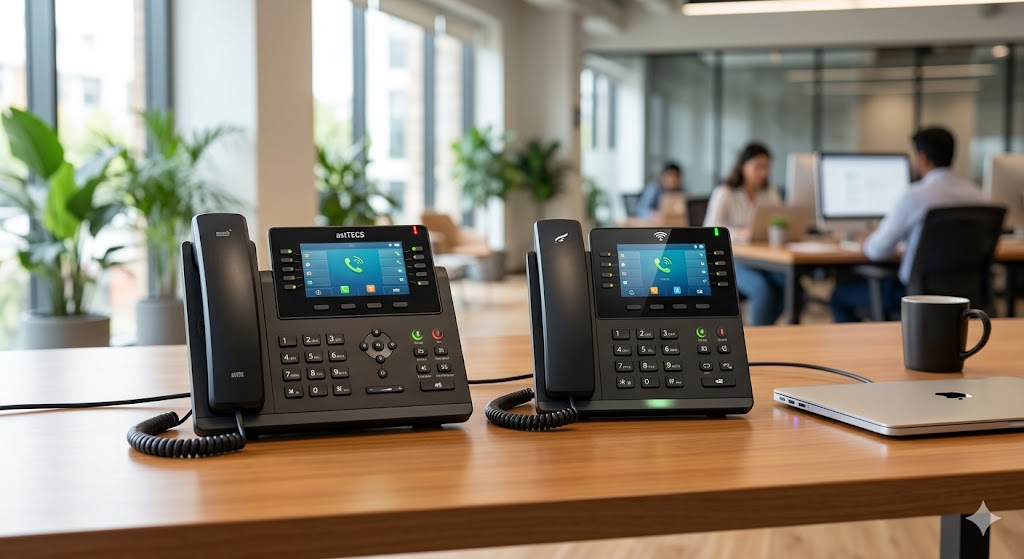
In the rapidly evolving landscape of 2026, the traditional office desk phone has undergone a massive transformation. For businesses in Chennai and Coimbatore, the question is no longer whether to switch to VoIP, but which hardware offers the most “bang for the buck.” When we talk about Best Budget-Friendly VoIP Hardware: astTECS vs. Flyingvoice, we are looking at two titans of the industry that have mastered the balance between high-end features and mid-range pricing.
Selecting the right hardware is a foundational step in your IP-PBX system installation. If the hardware is flimsy, your crystal-clear voice data won’t matter. Today, we dive deep into a head-to-head comparison to help you decide which brand deserves a spot on your employees’ desks.
Why Budget-Friendly Doesn’t Mean “Cheap”
When small to medium enterprises (SMEs) search for budget options, there is often a fear of compromised security or poor call quality. However, the modern VoIP market has matured. Both astTECS and Flyingvoice offer hardware that supports High-Definition (HD) voice, robust encryption, and Power over Ethernet (PoE).
The goal is to find a solution that integrates seamlessly with your existing network infrastructure maintenance. A budget-friendly phone should reduce your Total Cost of Ownership (TCO) without increasing your IT support tickets.
The astTECS Advantage: Local Powerhouse and Integration
astTECS has built a formidable reputation in India by offering end-to-end communication solutions. Their hardware is specifically designed to work in harmony with their own IP-PBX software, though it remains highly compatible with open-standard SIP servers.
1. Built for Indian Enterprise Conditions
astTECS hardware is known for its durability. In environments where power fluctuations or dust might be a factor, these phones hold up remarkably well. For businesses looking for astTECS IP phones in Coimbatore, the local support and spare parts availability make it a very safe bet.
2. Advanced Features at Entry-Level Prices
Even their basic models often include:
-
Multi-line support (usually 2 to 4 SIP accounts).
-
Backlit LCD screens for easy navigation.
-
Programmable keys for BLF (Busy Lamp Field) and speed dialing.
The Flyingvoice Edge: Wireless Innovation
Flyingvoice has carved out a niche by focusing on what many others ignored: built-in Wi-Fi. In an era where office layouts are flexible and cabling can be expensive, Flyingvoice offers a unique value proposition.
1. The Death of Ethernet Cables
Many Flyingvoice models come with integrated Wi-Fi and even built-in routers. This is a game-changer for startups or retail outlets where running new CAT6 cables isn’t feasible. If you are looking at Flyingvoice IP phones cost in Coimbatore, you have to factor in the savings you get by not needing an extensive wired network setup.
2. Compact and Aesthetic Design
Flyingvoice phones tend to have a slightly more modern, sleek aesthetic compared to the utilitarian build of older astTECS models. They look great in high-end reception areas or executive suites.
Detailed Feature Comparison
To truly understand the Best Budget-Friendly VoIP Hardware: astTECS vs. Flyingvoice, we must look at the technical specifications that affect daily office life.
HD Voice Quality
Both brands support the G.722 codec, which provides wideband audio. This makes voices sound more natural and reduces listener fatigue during long meetings. However, astTECS often includes superior noise-cancellation technology in their handsets, which is vital for loud open-office plans.
Ease of Deployment
Flyingvoice excels in “Zero Touch” provisioning. Their redirection service allows IT managers to configure phones remotely. While astTECS also supports auto-provisioning, it is most efficient when paired with an astTECS IP-PBX.
Security Protocols
Security is non-negotiable. Both brands offer:
-
TLS/SRTP for voice encryption.
-
HTTPS-based web management.
-
VPN support (OpenVPN) for remote workers.
If your business handles sensitive data, ensuring your hardware is part of a secure IP telephony setup is critical.
Impact on Call Center Operations
For businesses running a customer support hub, the choice of hardware impacts agent productivity. When setting up a high-performance call center infrastructure, you need phones that can handle high call volumes without lagging.
astTECS is often the preferred choice here because of its deep integration with CRM-linked IP-PBX systems. Their phones are built to trigger screen pops and handle complex IVR routing smoothly.
On the other hand, if your call center agents are working from home or in a hybrid setup, the Flyingvoice Wi-Fi-enabled phones allow them to set up their “office” anywhere in the house with a stable internet connection. This flexibility is a key part of modern IP-PBX systems for hybrid work.
Maintenance and Long-Term Reliability
No piece of hardware is “buy and forget.” You must consider the IP-PBX maintenance guide for your specific brand.
astTECS Maintenance
-
Pros: Local service centers in major cities like Chennai and Coimbatore.
-
Cons: Firmware updates might require a bit more manual oversight if not using an astTECS server.
Flyingvoice Maintenance
-
Pros: Excellent remote management via their cloud platform.
-
Cons: Hardware repair might take slightly longer as parts are often imported, though local dealers like Hitech Solutions mitigate this risk significantly.
Cost-Benefit Analysis for 2026
When calculating the budget, don’t just look at the sticker price of the phone. Look at the infrastructure costs.
| Feature | astTECS | Flyingvoice |
| Average Unit Price | Lower | Mid-Range |
| Cabling Cost | Standard (requires Ethernet) | Low (Wi-Fi options) |
| Life Expectancy | 5-7 Years | 4-6 Years |
| Ideal For | High-volume offices, Factories | Startups, Hybrid Work, Retail |
If you are a small office, you might find that a VoIP PBX for small business paired with astTECS phones gives you the most stable experience for the lowest initial investment.
Integrating with Existing Systems
One major pain point for businesses is making new hardware talk to old systems. If you are still using some analog lines, you will need a Dinstar FXS/FXO gateway to bridge the gap. Both astTECS and Flyingvoice phones work perfectly with these gateways.
Furthermore, if your business relies on mobile connectivity for sales teams, integrating a Dinstar GSM gateway allows your desk phones to route calls through SIM cards, saving massive amounts on long-distance charges.
Future-Proofing with AI and Cloud
The world is moving toward cloud telephony trends like AI and WebRTC. Your hardware needs to be ready. Both brands are moving toward supporting Opus (a highly adaptable audio codec) and better integration with AI chatbots for customer support.
By choosing either astTECS or Flyingvoice, you aren’t just buying a phone; you are buying an entry point into a unified communication ecosystem.
Why Choose astTECS?
Choose astTECS if you want a “battle-tested” brand with deep roots in Indian enterprise. Their synergy with Matrix EPABX systems and other local favorites makes them a reliable choice for traditional office setups.
Why Choose Flyingvoice?
Choose Flyingvoice if you value agility and modern features like built-in Wi-Fi. They are the perfect solution for businesses that want to avoid the “spaghetti of wires” and need a quick, step-by-step IP-PBX setup.
Final Thoughts on Hardware Selection
The Best Budget-Friendly VoIP Hardware: astTECS vs. Flyingvoice debate eventually comes down to your specific office layout. If you have a wired building, astTECS offers unbeatable value and longevity. If you are in a rented space or a modern co-working environment, Flyingvoice’s wireless capabilities will save you more in installation labor than you’ll spend on the phones themselves.
Before making a final purchase, consider a professional site audit. Knowing your default gateway IP and network capacity is just the start—you need to ensure your bandwidth can handle the concurrent HD streams these phones are capable of producing.
Frequently Asked Questions (FAQs)
Q1: Can I mix astTECS and Flyingvoice phones on the same network?
Yes. Both brands use the SIP (Session Initiation Protocol), which is the universal language of VoIP. You can have an astTECS phone at reception and Flyingvoice phones in the cabins without any compatibility issues, provided your IP-PBX server is properly configured.
Q2: Do these budget phones support video calling?
Most entry-level budget models from both brands are audio-only. However, both have “Executive” models that support video. If video is a priority, ensure your network infrastructure can handle the significantly higher data load.
Q3: Is it better to buy a Cloud-based system or On-premise for these phones?
It depends on your scale. Cloud-based IP-PBX is better for small teams or multi-location businesses. On-premise is better for large factories or hotels that want absolute control over their data and no monthly subscription fees.
Q4: How do I handle repairs if a phone stops working?
For businesses in Tamil Nadu, you can contact an authorized EPABX service provider in Coimbatore or Chennai. They offer AMC (Annual Maintenance Contracts) that cover both your server and your hardware endpoints.
Q5: Do these phones work with 5G networks?
While the phones themselves connect via Ethernet or Wi-Fi, your office router can be connected to a 5G gateway. This is one of the growing cloud telephony trends of 2026, providing high-speed backup internet for your VoIP system.