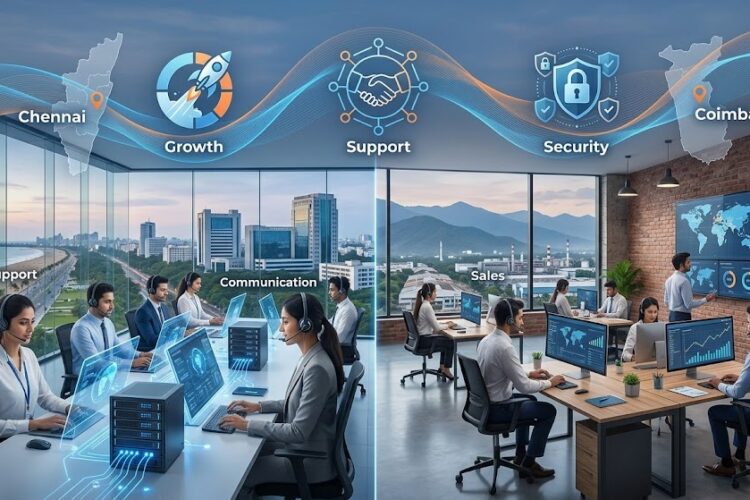
Every business owner faces this critical moment: your customer calls are increasing, complaints about missed calls are mounting, and your small team is drowning in phone inquiries. You know you need a proper call center solution, but the question that keeps you awake at night is: should you build it in-house or outsource it?
This isn’t just a financial decision—it’s about your company’s growth trajectory, customer satisfaction, and long-term sustainability. Let me walk you through a comprehensive analysis that will help you make this crucial choice with confidence.
The Real Pain Point: Why This Decision Matters More Than You Think
Imagine this scenario: You’re a growing e-commerce business in Chennai. Last year, you handled 200 calls daily with three receptionists. Now you’re getting 800 calls daily, and your team is crumbling under pressure. Customers are complaining on social media about unanswered calls, and you’re losing sales to competitors who answer faster.
Sound familiar? This is the breaking point where businesses must choose between building their own complete call center solutions with IP EPABX systems or handing the reins to an outsourcing partner.
The wrong choice could cost you thousands of rupees monthly—or worse, damage your brand reputation permanently.
Understanding the True Cost of Ownership: Beyond the Obvious Numbers
When most businesses compare costs, they look at monthly fees and think they’re done. That’s like buying a car and only considering the sticker price while ignoring fuel, maintenance, insurance, and depreciation.
Let’s break down what Total Cost of Ownership (TCO) really means for both models.
In-House Call Center: The Hidden Investment Iceberg
Infrastructure Costs (The Big Initial Shock)
Setting up an in-house call center isn’t just about buying phones. If you’re establishing a modern IP EPABX system for your office, you’re looking at:
- Hardware Investment: ₹3-8 lakhs for a quality IP EPABX system capable of handling 20-50 concurrent calls
- Workstations: ₹30,000-50,000 per agent station (computer, headset, desk, chair)
- Office Space: ₹300-600 per sq ft monthly in Chennai (minimum 1,000 sq ft for a 20-seat operation)
- IT Infrastructure: Servers, networking equipment, backup systems—₹2-5 lakhs
- Software Licenses: CRM, call recording, analytics tools—₹50,000-2 lakhs annually
Staffing Costs (The Ongoing Burden)
This is where the numbers get really interesting:
- Call Center Agents: ₹15,000-25,000 per month per agent
- Supervisors: ₹35,000-50,000 per month (1 supervisor for every 10 agents)
- Technical Support: ₹30,000-60,000 per month for IT personnel
- HR and Training Staff: ₹25,000-40,000 per month
- Facility Manager: ₹40,000-70,000 per month
For a modest 20-agent call center, you’re looking at ₹4-6 lakhs monthly just in salaries, before considering benefits, EPF, and other statutory requirements.
The Costs Nobody Talks About
Here’s where in-house operations get expensive in ways that don’t show up in initial budgets:
- Employee Attrition: Call centers in India face 30-45% annual turnover. Each replacement costs ₹40,000-80,000 in recruitment and training
- Idle Time: You pay for agents during low-volume hours. If your peak hours are 10 AM-4 PM, your night shift agents are still on your payroll
- Technology Upgrades: Modern IP EPABX and unified communications systems require updates every 3-5 years
- Compliance and Quality: Recording systems, data security, GDPR compliance tools—₹1-3 lakhs annually
- Sick Leaves and Absenteeism: You need buffer staff to maintain service levels
Outsourced Call Center: The All-Inclusive Package
The Transparent Cost Structure
Outsourced solutions typically work on a simple per-minute or per-hour model:
- Per-Hour Pricing: ₹150-400 per hour per agent, depending on complexity and language requirements
- Per-Minute Pricing: ₹4-12 per minute of talk time
- Monthly Packages: Fixed seats with unlimited calls—₹25,000-50,000 per agent per month
What’s Actually Included
The beauty of outsourcing is that one fee typically covers:
- Trained agents ready to work
- All technology infrastructure
- Call recording and analytics
- Supervisor oversight
- Quality monitoring
- Backup staff for absences
- Technology upgrades at no extra cost
The Hidden Value Propositions
Outsourcing partners absorb costs you might not even think about:
- They handle recruitment and training costs
- They manage attrition without impacting your operations
- They provide 24/7 coverage without triple-shift salaries
- They offer scalability without long-term commitments
- They maintain compliance and security certifications
The Real Numbers: A Side-by-Side Comparison
Let’s run actual numbers for a mid-sized business requiring 20 agents during peak hours, handling 5,000 calls monthly:
In-House Setup (Year 1)
Initial Investment:
- IP EPABX System: ₹5,00,000
- Infrastructure & Workstations: ₹8,00,000
- Office Setup & Renovation: ₹3,00,000
- Total Initial: ₹16,00,000
Monthly Operational:
- Salaries (20 agents + 2 supervisors + support staff): ₹5,50,000
- Office Rent & Utilities: ₹1,20,000
- Internet & Telephony: ₹40,000
- Software Licenses: ₹30,000
- Maintenance & Miscellaneous: ₹50,000
- Total Monthly: ₹7,90,000
Year 1 Total Cost: ₹16,00,000 + (₹7,90,000 × 12) = ₹1,10,80,000
Outsourced Setup (Year 1)
Initial Investment: ₹0 (maybe ₹50,000 for integration)
Monthly Operational:
- 20 agents × ₹35,000 per agent = ₹7,00,000
- Integration & Management: ₹50,000
- Total Monthly: ₹7,50,000
Year 1 Total Cost: ₹50,000 + (₹7,50,000 × 12) = ₹90,50,000
First Year Savings with Outsourcing: ₹20,30,000
But wait—the story gets more interesting in years 2-5.
Scalability: Where the Decision Gets Really Interesting
The Growing Business Scenario
Let’s say your business grows 40% year-over-year (congratulations!). You now need 28 agents instead of 20.
In-House Scaling Costs:
- New workstations: ₹2,40,000
- Additional office space renovation: ₹2,00,000
- Upgraded IP EPABX system capacity: ₹1,50,000
- Recruitment & training for 8 agents: ₹3,20,000
- Additional monthly operational costs: ₹2,20,000
You’re looking at ₹9,10,000 upfront plus ₹2,20,000 additional monthly costs. And this assumes you have physical space available—many businesses must relocate entirely, adding months of disruption and hundreds of thousands in relocation costs.
Outsourced Scaling Costs:
- Call your provider
- Request 8 additional agents
- They’re operational within 2-3 weeks
- Additional monthly cost: ₹2,80,000
Scaling Investment Difference: In-house requires ₹9,10,000 upfront. Outsourced requires just a phone call.
The Seasonal Fluctuation Reality
Now imagine you’re in retail or education—industries with massive seasonal variations. During festival season, you need 40 agents. Rest of the year? Just 15 will do.
In-House Challenge: You either maintain 40 agents year-round (paying ₹1,58,00,000 annually for agents you don’t need 8 months of the year) or face constant hiring/firing cycles that destroy morale and your employer brand.
Outsourced Solution: Scale up to 40 agents for 4 months, scale down to 15 for 8 months. You pay only for what you use.
Annual savings from this flexibility alone: ₹52,50,000
This is why companies with understanding modern business communication needs are increasingly exploring flexible solutions.
The Hybrid Model: The Best of Both Worlds?
Here’s where savvy businesses are finding their sweet spot. What if you didn’t have to choose just one?
What a Hybrid Model Looks Like
Smart companies are building strategic hybrid operations:
Core In-House Team (5-10 agents):
- Handle complex, high-value customer interactions
- Manage VIP accounts
- Process sensitive information
- Build deep product knowledge
- Serve as quality benchmarks
Outsourced Overflow Team (15-30+ agents):
- Handle routine inquiries
- Manage volume spikes
- Provide 24/7 coverage
- Handle multilingual support
- Absorb seasonal variations
Real-World Hybrid Example
A Chennai-based financial services company implemented this brilliantly:
- In-house team: 8 senior agents handling loan applications and complex account issues using a transformed IP EPABX communication system
- Outsourced team: 20 agents handling account inquiries, payment reminders, and first-level support
Results:
- 35% cost reduction compared to fully in-house
- 50% faster response times
- 28% improvement in customer satisfaction
- Flexibility to scale outsourced team 300% during tax season
Their cost breakdown:
- In-house operations: ₹2,80,000 monthly
- Outsourced operations: ₹5,60,000 monthly
- Total: ₹8,40,000 monthly
Compare this to ₹12,90,000 for a fully in-house 28-agent operation. Annual savings: ₹54,00,000.
When Hybrid Makes Perfect Sense
The hybrid model is ideal when:
- You handle both routine and specialized interactions
- Data security requires some operations on-premise
- You want to maintain direct control over key customer relationships
- You need flexibility for growth without massive investment
- You’re building proprietary processes worth keeping in-house
Making the Decision: A Framework That Actually Works
Let’s get practical. Here’s how to decide what’s right for YOUR business:
Choose In-House When:
1. You Have Unique, Complex Requirements
If your product is highly technical, requires deep expertise, or involves proprietary processes that take months to learn, in-house makes sense. Think specialized B2B software, medical devices, or financial advisory services.
2. Data Security is Non-Negotiable
Handling sensitive customer information like medical records, financial details, or legal matters? The control of an in-house operation with a secure IP EPABX system might justify the cost.
3. You Have Stable, Predictable Volume
If you consistently handle 8,000-10,000 calls monthly with minimal variation, the economies of scale start favoring in-house operations after year 2-3.
4. You Have Capital and Can Wait for ROI
In-house operations typically break even in 18-30 months. If you have ₹20-40 lakhs available and can wait for returns, this investment might make sense.
5. Your Brand Depends on Customer Experience Excellence
Some luxury brands find that the control and brand immersion of in-house teams justify the premium cost.
Choose Outsourced When:
1. You’re in Growth Mode
If you’re scaling rapidly or your volumes are unpredictable, outsourcing provides flexibility without the financial risk.
2. Cash Flow is King
Startups and SMEs benefit enormously from outsourcing’s pay-as-you-go model. No capital expenditure, no long-term commitments.
3. You Need 24/7 Coverage
Running three shifts in-house triples your costs. Outsourcers spread this cost across multiple clients.
4. Your Focus Should Be Elsewhere
If running a call center isn’t your core competency, why build that expertise? Focus on your product while experts handle customer service.
5. You Need Multilingual Support
Outsourcing partners have ready access to agents fluent in multiple languages without the recruitment challenge.
Choose Hybrid When:
You Want Control and Flexibility
The hybrid model works brilliantly when you want to maintain direct control over critical interactions while gaining flexibility for routine operations and volume management.
The Technology Factor: How Modern Systems Change Everything
Here’s something that dramatically affects this decision: modern communication technology has leveled the playing field.
How businesses are reducing communication costs by up to 40% with IP EPABX systems means in-house operations are now more viable than ever for mid-sized businesses.
Cloud-Based IP EPABX: The Game Changer
Modern cloud-based IP EPABX systems offer:
- Reduced Upfront Investment: ₹2-3 lakhs instead of ₹5-8 lakhs
- Subscription-Based Pricing: ₹15,000-30,000 monthly instead of large capital expenditure
- Instant Scalability: Add or remove lines with a few clicks
- Remote Work Capability: Agents can work from anywhere
- Built-in Analytics: No additional software costs
This middle path between traditional in-house and outsourcing is reshaping the economics. If you’re considering moving from traditional PBX to IP EPABX, the cost dynamics change significantly.
Integration Capabilities
Modern systems integrate seamlessly with:
- CRM platforms
- Help desk software
- E-commerce platforms
- Inventory management systems
- Analytics dashboards
This integration means even small in-house teams can deliver outsourcer-level efficiency.
The 3-Year Total Cost Projection: The Numbers That Matter
Let’s project three years out for our 20-agent requirement, accounting for 25% growth:
In-House Total (3 Years)
- Initial setup: ₹16,00,000
- Year 1 operations: ₹94,80,000
- Year 2 (with growth): ₹1,08,45,000
- Year 3 (with growth): ₹1,18,29,500
- Technology refresh: ₹4,00,000
- 3-Year Total: ₹3,41,54,500
Outsourced Total (3 Years)
- Initial integration: ₹50,000
- Year 1 operations: ₹90,00,000
- Year 2 (with growth): ₹1,01,25,000
- Year 3 (with growth): ₹1,10,87,500
- 3-Year Total: ₹3,02,62,500
3-Year Savings with Outsourcing: ₹38,92,000
But here’s the critical insight: After year 3, in-house operations become increasingly cost-effective as you’ve absorbed the initial investment. By year 5, if your volume remains stable, in-house might actually be cheaper.
Quality Considerations: Beyond Just Cost
Let’s address the elephant in the room: quality concerns.
In-House Quality Advantages
- Direct oversight and control: You set the standards and monitor directly
- Company culture alignment: Agents breathe your brand values daily
- Deep product knowledge: Time to develop genuine expertise
- Immediate feedback loops: Make changes instantly based on customer feedback
Outsourced Quality Strategies
- SLA-based guarantees: Contracts specify quality metrics with penalties
- Dedicated team models: Your business gets the same agents consistently
- Regular training programs: Professional outsourcers invest heavily in training
- Quality monitoring systems: Advanced analytics and recording systems
The truth? Quality differences are shrinking. Top outsourcing partners now deliver service levels matching or exceeding in-house teams, especially for routine interactions.
Making Your Final Decision: The Actionable Checklist
Here’s your decision-making framework:
Calculate Your Numbers:
- Current call volume and growth projections
- Available capital for initial investment
- Monthly operational budget capacity
- Expected ROI timeline
Assess Your Requirements:
- Complexity of customer interactions
- Data security and compliance needs
- Hours of operation required
- Seasonal volume variations
- Language and skill requirements
Evaluate Your Capacity:
- Management bandwidth for call center oversight
- Office space availability
- Technical expertise for system maintenance
- HR capacity for recruitment and training
Consider Your Growth Stage:
- Rapid growth mode (favor outsourcing)
- Stable operations (consider in-house)
- Uncertain future (favor flexibility)
- Industry seasonal patterns (hybrid or outsourced)
The Bottom Line: What Really Matters
Here’s what 15 years in the business communication industry has taught me: the best solution isn’t about choosing the cheapest option—it’s about choosing what aligns with your business strategy.
If you’re a startup or growing business, outsourcing gives you runway without burning capital. You can test, iterate, and scale without massive commitment.
If you’re an established business with stable volumes and specific quality requirements, investing in an in-house setup with modern IP EPABX technology might deliver better long-term value.
If you’re somewhere in between—like most businesses—the hybrid model offers the control you want with the flexibility you need.
Moving Forward: Your Next Steps
Whatever you decide, start with these actions:
- Audit your current costs: Track every rupee you’re spending on customer communication today
- Project your growth: Be realistic about where you’ll be in 12, 24, and 36 months
- Request proposals: Get quotes from both IP EPABX system providers and outsourcing partners
- Start small: Consider a pilot program before committing fully
- Build flexibility: Ensure whatever solution you choose can scale with you
Remember: this decision isn’t permanent. Many businesses start with outsourcing, build volume and expertise, then transition to hybrid or in-house operations. Others go the reverse direction. The key is choosing what’s right for where you are today while keeping options open for tomorrow.
The call center solution that helps you deliver exceptional customer service while managing costs effectively isn’t just a vendor relationship—it’s a strategic business decision that impacts your growth trajectory for years to come.
Choose wisely, but don’t let the decision paralyze you. Even an imperfect choice implemented well beats perfect planning without action. Your customers are calling—make sure you’re ready to answer.