The Ultimate Call Center Outsourcing Cost Comparison Guide: What Your Business Really Pays in 2025
Running a business in today’s competitive landscape means making tough decisions about where to invest your resources. One question that keeps many business owners awake at night is whether to build an in-house call center or outsource customer support operations. The answer isn’t always straightforward, and the financial implications can make or break your bottom line.
If you’ve ever wondered why your monthly customer service costs seem to spiral out of control, or if you’re considering outsourcing but feel overwhelmed by the pricing models and hidden fees, you’re not alone. Let’s dive deep into the real costs of call center outsourcing versus maintaining an in-house operation, so you can make an informed decision that aligns with your business goals.
The Hidden Price Tag of In-House Call Centers
Before we explore outsourcing options, let’s talk about what it truly costs to run an in-house call center. Many business owners drastically underestimate these expenses, focusing only on agent salaries while overlooking the infrastructure that makes modern customer service possible.
Infrastructure Investment: More Than Just Desks and Phones
Setting up a functional call center requires significant upfront capital. You’ll need a robust IP PBX system that can handle multiple concurrent calls, route customers efficiently, and integrate with your existing business systems. The initial hardware investment alone can range from ₹3,00,000 to ₹15,00,000 depending on your scale and requirements.
But that’s just the beginning. Modern call centers need sophisticated IP-based EPABX systems that support features like call recording, IVR menus, and real-time analytics. If you’re starting from scratch, you’ll also need to invest in office space, workstations, computers, headsets, and backup power systems to ensure uninterrupted service.
The Real Cost of Hiring and Training
Recruitment is expensive and time-consuming. The average cost to hire a call center agent in India ranges from ₹25,000 to ₹50,000 when you factor in job postings, screening, interviews, and background checks. Using a hiring system solvability assessment framework can streamline this process, but it doesn’t eliminate the costs entirely.
Once hired, agents need comprehensive training before they can handle customer interactions effectively. Training programs typically last 2-4 weeks and cost between ₹15,000 to ₹30,000 per agent. This includes product knowledge, communication skills, software training, and quality assurance protocols. During this period, you’re paying salaries without generating revenue from these employees.
Employee turnover in call centers averages 30-45% annually, meaning you’ll continuously repeat this expensive cycle. Every time an agent leaves, you lose the investment you made in their training and face productivity gaps until a replacement is fully onboarded.
Ongoing Operational Expenses That Add Up
Monthly operational costs extend far beyond salaries. Agent compensation in India ranges from ₹15,000 to ₹35,000 per month, depending on experience and location. Add statutory benefits (PF, ESI, gratuity) which increase costs by 15-20%, and your per-agent monthly expenditure quickly reaches ₹20,000 to ₹45,000.
Don’t forget about supervisors, quality analysts, team leaders, and IT support staff. For every 10-15 agents, you need at least one supervisor, adding another layer of expense. Then there’s office rent, utilities, internet connectivity, and maintenance of your IP PBX infrastructure.
Technology maintenance is another significant expense. Your IP EPABX system requires regular updates and maintenance to prevent downtime. Factor in software licenses for CRM systems, workforce management tools, and quality monitoring platforms, which can cost ₹50,000 to ₹2,00,000 monthly depending on your agent count.
Understanding Call Center Outsourcing Models and Pricing
Outsourcing providers offer several pricing models, each with its own advantages and considerations. Understanding these models is crucial for accurate cost comparison.
Per-Minute Billing: Pay for Usage
This model charges based on actual talk time, typically ranging from ₹1.50 to ₹4.00 per minute for domestic calls. It’s ideal for businesses with fluctuating call volumes or seasonal peaks. You only pay for active customer interactions, making it cost-effective during slow periods.
However, this model can become expensive during high-volume periods. A single agent handling calls for 6 hours daily at ₹2.50 per minute can cost approximately ₹45,000 monthly (assuming 300 minutes of talk time daily). Be cautious of providers who set unrealistic average handle time (AHT) targets, as rushing through calls compromises service quality.
Per-Hour Pricing: Predictable Costs
Hourly rates typically range from ₹150 to ₹400 per agent hour, depending on complexity and language requirements. This model provides better cost predictability than per-minute billing and doesn’t penalize longer, more thorough customer interactions that build loyalty.
For an 8-hour shift, you’re looking at ₹1,200 to ₹3,200 per agent per day. Multiply that by 25 working days, and monthly costs range from ₹30,000 to ₹80,000 per dedicated agent. This includes the agent’s time, infrastructure, and basic management oversight.
Dedicated Agent Model: Full-Time Support
Many outsourcing providers offer dedicated agents who work exclusively for your business. Monthly rates range from ₹25,000 to ₹60,000 per agent, depending on skill requirements, working hours, and support complexity.
This model works well when you need consistent, brand-aligned support. Your agents become familiar with your products, customers, and company culture. However, you’re paying for the full-time resource regardless of call volume, similar to an in-house setup but without the infrastructure burden.
Shared Agent Model: Cost-Effective for Lower Volumes
Shared agents handle calls for multiple clients, making this the most economical option for businesses with lower volumes. Costs typically start at ₹10,000 to ₹25,000 monthly for a specified number of call hours or interactions.
The tradeoff is less brand consistency and potentially longer wait times during peak hours. This model suits businesses with straightforward support needs and limited budgets, but may not deliver the personalized service that complex B2B relationships require.
The Real Numbers: Comprehensive Cost Comparison
Let’s break down what you’d actually spend for a 10-agent call center operation across different approaches.
In-House Call Center: Total Cost Breakdown
One-Time Setup Costs:
- IP PBX system and hardware: ₹5,00,000 to ₹8,00,000
- Workstations, computers, and peripherals: ₹3,00,000 to ₹5,00,000
- Office renovation and furniture: ₹2,00,000 to ₹4,00,000
- Software licenses and systems: ₹1,50,000 to ₹3,00,000
- Total Initial Investment: ₹11,50,000 to ₹20,00,000
Monthly Recurring Costs:
- Agent salaries (10 agents): ₹2,00,000 to ₹4,50,000
- Statutory benefits and insurance: ₹30,000 to ₹70,000
- Supervisors and support staff (2): ₹80,000 to ₹1,50,000
- Office rent and utilities: ₹50,000 to ₹1,50,000
- Internet and telephony: ₹20,000 to ₹40,000
- IP PBX maintenance and updates: ₹15,000 to ₹30,000
- Software subscriptions: ₹25,000 to ₹50,000
- Training and development: ₹20,000 to ₹40,000
- Contingency and miscellaneous: ₹30,000 to ₹50,000
- Total Monthly Cost: ₹4,70,000 to ₹9,30,000
Annual Cost (First Year): ₹68,00,000 to ₹1,31,60,000
Outsourced Call Center: Total Cost Breakdown
Setup Costs:
- Integration with existing systems: ₹25,000 to ₹75,000
- Training materials and documentation: ₹10,000 to ₹30,000
- Total Initial Investment: ₹35,000 to ₹1,05,000
Monthly Recurring Costs (10 Dedicated Agents):
- Agent costs (10 agents at ₹35,000 avg): ₹3,50,000
- Management and reporting: ₹30,000 to ₹50,000
- Technology platform access: ₹15,000 to ₹25,000
- Quality assurance: ₹20,000 to ₹35,000
- Total Monthly Cost: ₹4,15,000 to ₹4,60,000
Annual Cost (First Year): ₹50,15,000 to ₹56,25,000
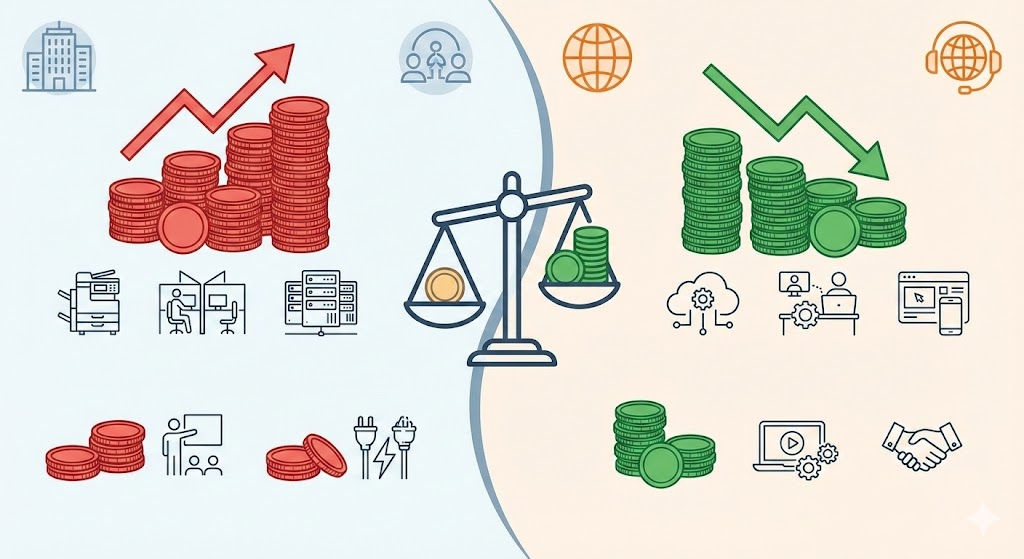
The financial advantage of outsourcing becomes immediately apparent. In the first year alone, outsourcing can save ₹18,00,000 to ₹75,00,000 compared to building an in-house operation. That’s capital you can reinvest in product development, marketing, or business expansion.
Beyond the Numbers: Hidden Costs and Considerations
While direct costs are important, several hidden factors significantly impact your total cost of ownership.
Scalability and Flexibility
With an in-house operation, scaling up requires recruiting, training, and providing infrastructure for additional agents—a process that takes 4-8 weeks minimum. Scaling down means dealing with severance packages, underutilized infrastructure, and team morale issues.
Outsourcing providers can typically scale operations up or down within 1-2 weeks. Need 20 extra agents for a product launch or holiday season? Done. Want to reduce capacity during slow months? No problem. This flexibility prevents overstaffing during lean periods and understaffing during growth phases.
Technology Obsolescence
IP telephony systems evolve rapidly. The IP EPABX system you install today might need significant upgrades in 3-5 years. Outsourcing providers continuously invest in the latest technology, ensuring you benefit from cutting-edge features without capital expenditure.
They also handle the complexity of securing IP telephony systems against toll fraud and unauthorized access—threats that can cost businesses thousands in fraudulent charges if not properly managed.
Management Overhead and Opportunity Cost
Running a call center demands significant management attention. Someone needs to handle scheduling, quality monitoring, performance reviews, conflict resolution, and compliance issues. For business owners and executives, this diverts focus from core business activities.
Consider the opportunity cost: what else could your leadership team accomplish with the time they’d spend managing customer support operations? Often, that time is worth far more than the cost difference between in-house and outsourced solutions.
Making the Right Choice for Your Business
The decision isn’t purely financial. Several factors should influence your choice.
When In-House Makes Sense
Some businesses genuinely benefit from in-house operations. If your product requires deep technical expertise that’s difficult to transfer, in-house might be necessary. Companies handling highly sensitive data or operating in heavily regulated industries may prefer the control of internal operations.
Businesses with stable, predictable volumes and long-term growth plans might justify the initial investment. If you’re already operating at scale (50+ agents) and have dedicated management resources, the per-agent cost differential narrows.
When Outsourcing Is the Smart Move
For most small to medium businesses, outsourcing offers compelling advantages. If you’re a startup or growing company, avoiding massive upfront capital investment is crucial. That ₹15-20 lakhs saved can fund product development or marketing campaigns with higher ROI.
Companies with fluctuating call volumes benefit enormously from outsourcing’s flexibility. Seasonal businesses, those launching new products, or companies expanding into new markets can scale support without financial risk.
If your core competency isn’t customer support operations, let specialists handle it. Your energy is better spent on product innovation, sales, and strategic growth rather than managing call center metrics and schedules.
Quality Considerations: Don’t Sacrifice Customer Experience
The cheapest option isn’t always the best. Poor customer service damages your brand and drives customers to competitors. When evaluating outsourcing providers, look beyond pricing to understand their call center metrics and quality standards.
Ask about their average handling time (AHT), first call resolution (FCR) rates, and customer satisfaction scores. Understand their approach to quality assurance, agent training, and performance management. Request references from similar businesses and conduct trial periods before committing long-term.
Ensure they use modern technology like unified communications platforms that integrate with your existing business systems. The ability to access real-time dashboards, call recordings, and comprehensive reports is essential for maintaining quality oversight.
Negotiating Better Outsourcing Contracts
Understanding cost structures empowers better negotiations. Many providers offer volume discounts, long-term contract incentives, or hybrid models that blend different pricing approaches.
Don’t accept the first proposal. Request detailed breakdowns of what’s included versus what costs extra. Clarify expectations around peak hour coverage, holiday support, and quality metrics. Ensure contracts include clear SLAs (Service Level Agreements) with penalties for non-compliance.
Consider starting with a smaller pilot program before committing to full-scale outsourcing. This allows you to evaluate service quality, integration smoothness, and cultural fit without significant risk.
Future-Proofing Your Customer Support Strategy
The contact center industry is evolving rapidly. Cloud telephony, AI, and WebRTC technologies are transforming how businesses handle customer interactions. Whether you choose in-house or outsourced support, ensure your solution can adapt to these technological shifts.
Look for providers investing in AI-powered chatbots for handling routine queries, freeing human agents for complex issues. Cloud-based IP PBX systems offer flexibility and disaster recovery capabilities that traditional on-premise systems can’t match.
The Bottom Line: Calculate Your True Cost
Every business is unique, and the right choice depends on your specific circumstances, growth trajectory, and strategic priorities. However, for most small to medium businesses, outsourcing delivers significant cost savings while providing superior flexibility and access to expertise.
Before making a decision, calculate your comprehensive costs including initial setup, monthly operations, hidden expenses like recruitment and training, and opportunity costs of management time. Factor in your growth plans and volume fluctuations over the next 2-3 years.
The cheapest option today might be the most expensive tomorrow if it can’t scale with your business. Similarly, the most expensive enterprise solution might deliver poor ROI if you’re not utilizing its advanced features.
Frequently Asked Questions
What is the average cost of outsourcing a call center?
The average cost varies significantly based on the service model and requirements. For domestic Indian operations, expect ₹25,000 to ₹60,000 per dedicated agent monthly, ₹150-₹400 per hour for hourly billing, or ₹1.50-₹4.00 per minute for usage-based pricing. International outsourcing (Philippines, Eastern Europe) typically costs 20-40% more but may offer language or timezone advantages.
How much does it cost to set up an in-house call center?
Setting up a 10-agent in-house call center typically requires ₹11,50,000 to ₹20,00,000 in initial capital for infrastructure, technology, and setup. Monthly operational costs range from ₹4,70,000 to ₹9,30,000, making the first-year total cost ₹68,00,000 to ₹1,31,60,000. Smaller operations (5 agents) can start with approximately ₹6,00,000 to ₹10,00,000 initial investment.
Is outsourcing cheaper than in-house call center?
Yes, outsourcing is typically 25-50% cheaper than maintaining an in-house call center, especially for small to medium businesses. The savings come from eliminated infrastructure costs, reduced management overhead, no recruitment and training expenses, and flexible scaling without long-term commitments. However, very large operations (100+ agents) may find per-agent costs comparable, making the decision more about control versus flexibility.
What are the hidden costs of call center outsourcing?
Hidden costs in outsourcing include integration fees for connecting provider systems with your business applications, transition costs during the initial setup phase, potential quality issues requiring additional oversight, contract termination fees if you need to switch providers, and costs associated with maintaining brand consistency through additional training and documentation. Always request detailed pricing that accounts for these factors.
How can I reduce call center outsourcing costs?
Reduce costs by optimizing call volumes through self-service options like FAQs and knowledge bases, choosing the right pricing model for your volume patterns, negotiating volume discounts for long-term contracts, implementing effective IVR and ACD systems to route calls efficiently, providing comprehensive training materials to reduce agent learning curves, and regularly reviewing performance metrics to identify inefficiencies. Starting with a shared agent model and graduating to dedicated agents as volume grows can also optimize costs.
What factors affect call center outsourcing pricing?
Key pricing factors include the number of agents required, service hours (24/7 vs business hours only), language requirements (multilingual support costs more), complexity of support (technical vs. general customer service), geography (domestic vs. international), technology integration requirements, quality metrics and SLA commitments, and volume of interactions. More specialized support with stringent quality requirements naturally costs more than basic customer service.
Ready to optimize your customer support costs? At Hi-Tech Solutions, we help businesses in Chennai, Coimbatore, and across India design cost-effective communication infrastructure. Whether you’re building an in-house operation or evaluating outsourcing options, our expertise in IP PBX systems and unified communications can help you make informed decisions. Contact us today for a customized cost analysis and solution recommendation.