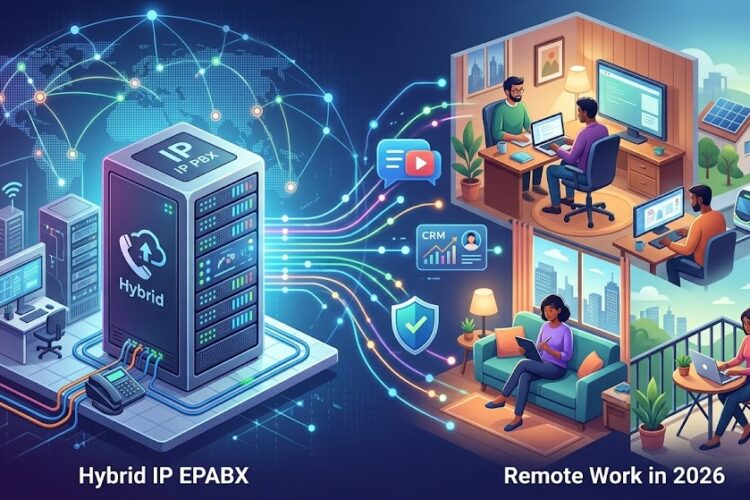
Let’s be honest: communication is the lifeline of any business. But for many companies in India, the traditional phone system has become less of a lifeline and more of an anchor. You know the drill. You miss a critical sales call because you are stuck at a desk. Your operational costs spike just to add a single new phone line for a new hire. The annual maintenance contract for that bulky, dusty EPABX server room equipment feels like a never-ending money pit.
If these scenarios sound painfully familiar, you are not alone. These are the exact pain points driving the massive shift towards more agile, intelligent communication solutions. While traditional on-premise systems served their purpose, they were designed for a different era of work. Today, your team is on the move, your customers expect instant responses, and your business needs to scale rapidly.
This is where the conversation needs to shift from hardware to software, from rigid infrastructure to flexible services. The solution to your communication headaches isn’t a bigger box in a closet; it is leveraging the power of the internet. This comprehensive guide will walk you through the evolution of business telephony, why the cloud is the answer, and how partnering with the right cloud telephony service providers Coimbatore can transform your operations from a cost center into a competitive advantage.
Why Your Old Phone System is Costing You Customers
To understand where we are going, we need to briefly acknowledge where we have been. If you currently use a PBX or EPABX system, you understand its core function: routing calls internally and externally. But the limitations are becoming harder to ignore.
The High Cost of “On-Prem”
On-premise systems require significant capital expenditure (CapEx). You are buying expensive hardware, paying for proprietary phones, and forking out for complex installations. Then comes the operational expenditure (OpEx)—maintenance contracts, emergency repairs, and the sheer hassle of managing it all. If you need to add a user or open a new branch office, it often requires a technician visit and more hardware. This inflexibility is a major bottleneck in a fast-paced market.
Missed Opportunities and Missed Calls
Perhaps the biggest pain point is the lack of mobility. If your office phone rings and your team is out at a client meeting, that call is often missed or sent to a voicemail that might not be checked for days. In a competitive city like Coimbatore, where relationship-building is key, a missed call can easily become a missed client. Your business shouldn’t stop just because your team isn’t sitting at their desks.
How Cloud Telephony Solves These Problems
Cloud telephony, often referred to as a hosted PBX or virtual phone system, changes the game entirely. It moves your phone system from your office closet to the cloud. There is no bulky hardware to maintain on your premises, only the phones or software apps you use to connect. For businesses looking to streamline, understanding the fundamentals is key. If you are new to these concepts, you might find it helpful to read our guide on What is an IP EPABX System? A Beginner’s Guide to see the technological lineage.
The core difference is that instead of paying for physical phone lines (PRI or analog), you are using SIP (Session Initiation Protocol) trunks to make and receive calls over the internet. This fundamental shift unlocks a world of features that were previously only available to large corporations with huge IT budgets.
The Must-Have Features of Modern Cloud Systems
When you switch to a cloud-based system, you aren’t just getting a phone line; you are getting a powerful communication platform.
Crystal Clear Voice Quality
With a stable internet connection, voice quality over modern cloud systems is often superior to traditional lines. Advanced codecs ensure that calls are clear, crisp, and free from the static and interference that can plague older copper lines.
True Mobility: Take Your Office With You
This is the killer feature. With a cloud system, your office phone number is no longer tied to a physical location. A sales executive in Coimbatore can be on the road, answering calls on the office number through a mobile app. A customer in Mumbai calls your main line, and it rings on a laptop in a co-working space. The customer experience is seamless, and your team is always reachable.
Intelligent Call Management
Forget simple call forwarding. Cloud systems offer advanced features like:
-
Auto Attendant: A professional, automated receptionist that greets callers and routes them to the right department, 24/7.
-
IVR (Interactive Voice Response): Allows callers to self-serve by pressing buttons for common inquiries, freeing up your staff’s time.
-
Call Queuing: Manages high call volumes professionally, playing music or announcements while callers wait, so you never drop a hot lead.
-
Call Recording: Automatically record calls for quality assurance, training, and compliance purposes.
Seamless Integration with Your Business Tools
Modern telephony doesn’t live in a silo. It integrates with the tools you already use—your CRM (like Salesforce or Zoho), your helpdesk software, and your email. Imagine an incoming call that automatically pops up the customer’s file on your screen before you even pick up the phone. This level of integration boosts efficiency and personalizes the customer experience.
A Complete Guide to Switching: Hardware, Software, and Your Business
Transitioning to a cloud-based system might seem daunting, but it is a straightforward process when broken down into steps. It’s about aligning your technology with your business goals.
Step 1: Audit Your Current Communication Needs
Before you look for solutions, look inward. How many calls do you receive per day? What are your peak hours? Do you have remote workers? Do you need a toll-free number? Do you rely heavily on faxes (which can also be handled via email with cloud gateways)? Understanding your traffic patterns and team structure is the first step.
Step 2: Assess Your Network Infrastructure
Cloud telephony relies on the internet. Before making the switch, ensure your internet connection has sufficient bandwidth and, crucially, is stable. A wired connection for critical office devices is always recommended over Wi-Fi for calls. If you have multiple employees making calls simultaneously, you need to ensure your upload speed can handle the load.
Step 3: Choosing the Right Hardware
One of the beauties of cloud telephony is choice. You are not locked into one type of device.
-
IP Phones: These look like traditional desk phones but plug directly into your network. They are a familiar interface for many office workers.
-
Softphones: This is software installed on a computer or smartphone. It turns your device into a phone, complete with a keypad and all calling features. This is ideal for remote workers or staff who are often on the move.
-
ATAs (Analog Telephone Adapters): If you want to keep your existing analog phones, you can use an ATA to connect them to your network, bridging the old and the new.
For offices that aren’t ready to go completely wireless and want to retain the feel of a traditional office, setting up physical handsets is easy. You can follow our detailed Step-by-Step Guide to Setting Up an IP EPABX System for Your Office which, while focused on IP EPABX, provides excellent context on network setup and phone configuration that applies to hosted systems as well.
Step 4: The Migration Process
A good service provider will manage the number porting process for you. This means you can keep your existing landline or mobile numbers. The transition can often be scheduled during off-peak hours (like a weekend) to minimize disruption. Once the numbers are active on the new system, your provider should offer training sessions to ensure your team knows how to use the new features.
Why Coimbatore Businesses Are Making the Switch
Coimbatore is a unique business ecosystem. It is a city of entrepreneurs, from the bustling textile units and engineering workshops to the growing IT and service sectors. The business culture here values relationships, reliability, and smart investments.
For a textile exporter dealing with international buyers, the ability to have a virtual office that operates across time zones is invaluable. For a manufacturing unit, ensuring that a supply chain partner can always get through to the procurement team, even if they are on the factory floor, is critical for operations. For a growing startup in the city, projecting a professional image with an auto-attendant and zero dropped calls can make them look as established as their competitors in Bengaluru or Mumbai.
The need is clear: a system that offers enterprise-grade features without the enterprise-level cost and complexity. This is precisely why the demand for reliable cloud telephony service providers Coimbatore is surging. Businesses are looking for local partners who understand their specific challenges—like the need for Tamil language support in IVRs or reliable connectivity in specific industrial zones—and can offer tailored solutions.
Keeping Your System Running Smoothly
Moving to the cloud doesn’t mean you can ignore maintenance entirely, but the nature of it changes. Instead of worrying about hardware failure, your focus shifts to optimizing your system and training your users. Even in a cloud-based setup, the principles of good system administration remain important. For tips on keeping your network and devices in top shape, our <a href=”https://ippbxchennai.in/ip-pbx-maintenance-guide/”>IP PBX Maintenance Guide</a> offers timeless advice on security, updates, and traffic monitoring that applies to hosted and hybrid systems.
Common maintenance tasks include:
-
User Management: Quickly adding new hires, resetting passwords for the softphone app, or removing departed employees.
-
Feature Optimization: Reviewing your IVR menu to ensure it’s still intuitive. Are callers getting lost? Do you need to add a new option for a new service?
-
Call Flow Analysis: Checking reports to see if calls are being abandoned in the queue. Maybe you need to adjust your queue settings or add more people to a hunt group during peak times.
-
Security: Ensuring all user apps are updated and using strong passwords to prevent “toll fraud”—unauthorized users making expensive calls through your system.
The Future is Already Here
The conversation about business telephony has moved on from “Should we switch?” to “How quickly can we implement the new system?” The technology is mature, reliable, and more affordable than ever. It aligns perfectly with the modern, distributed, and digital-first way of doing business.
By adopting cloud telephony, you are not just buying a phone service; you are investing in agility, professionalism, and a better experience for both your team and your customers. You are removing the friction from communication and allowing your business to flow naturally, whether your team is in the office, at a site in Ganapathy, or at a trade show in another country. The old days of being chained to a desk phone are over. It’s time to free your business communications and watch your productivity soar.
Frequently Asked Questions
How is cloud telephony different from an IP EPABX system?
An IP EPABX system is a hybrid. It uses IP (Internet Protocol) internally but often still connects to the outside world via traditional phone lines. The hardware is on your premises. Cloud telephony, on the other hand, hosts the entire “PBX” software and hardware in the provider’s data center. You simply connect your phones or apps to it via the internet. You own the endpoints (phones), but you rent the powerful “brain” in the cloud.
What happens to my cloud phone system if the internet goes down?
This is a common concern, and good providers have redundancy built-in. Many systems offer a failover option. If your main internet connection fails, calls can be automatically routed to a pre-set mobile number or another office branch. This ensures you never miss an important call, even during an outage.
Can I really keep my existing business phone numbers?
Absolutely. Number portability is a standard feature. Your new service provider will handle the paperwork with your old operator to transfer (“port”) your numbers to their network. The process can take a few days to a couple of weeks, but you can use temporary numbers during the transition to ensure your service is never interrupted.
Is cloud telephony secure?
Reputable providers invest heavily in security. Data centers are protected physically and digitally. Calls can be encrypted. However, security is a shared responsibility. You must ensure your own network is secure and that your employees use strong passwords for their accounts, just as you would with any other business software.