Gemini said
When you are looking to bridge the gap between your traditional analog phone system and the modern world of Voice over IP (VoIP), you will inevitably stumble upon two technical acronyms: FXS and FXO. They might sound like alphabet soup, but these small hardware components are the gatekeepers of your business connectivity.
Choosing the wrong one isn’t just a minor technical glitch; it’s the difference between having a dial tone and staring at a silent handset. If you are currently navigating the complexities of modern business communication, understanding these gateways is the first step toward a seamless transition.
The Hidden Language of Your Phone System
To understand these gateways, we first need to look at the “ports” they represent. In the telecommunications world, communication is a handshake between a provider and a user. One side must provide the service (the dial tone), and the other side must receive it.
-
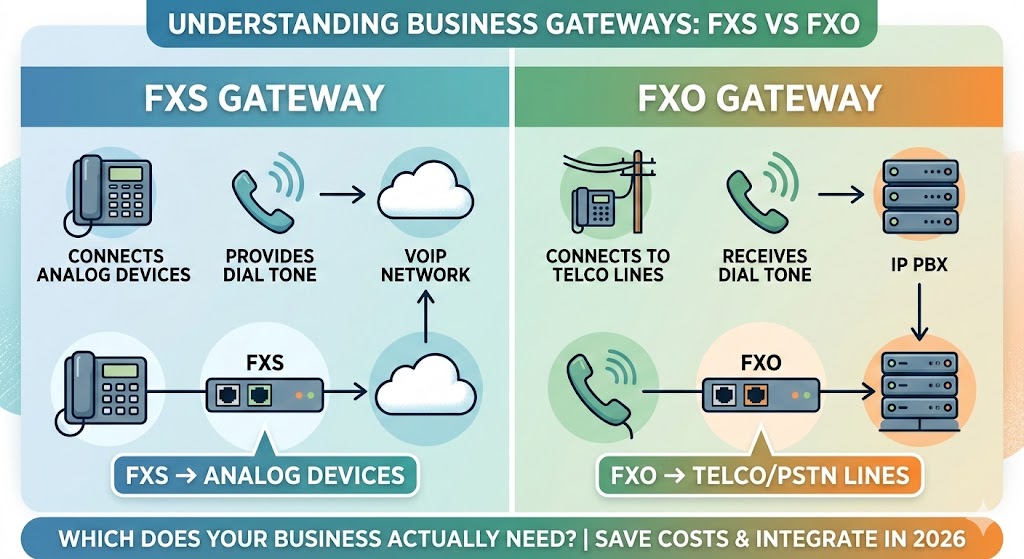
FXS (Foreign Exchange Station): This is the port that actually delivers the dial tone, provides the power, and sends the ringing voltage to the device. Think of the wall jack in your home; that is an FXS interface.
-
FXO (Foreign Exchange Office): This is the port that receives the service. It’s the connector on the back of your office phone or your fax machine.
The confusion usually arises when we talk about Gateways. A gateway’s job is to translate analog signals into “packets” of data that the internet can understand.
FXS vs. FXO Gateways: Which Does Your Business Actually Need?
The “Which one do I need?” question is best answered by looking at what you are trying to connect.
If your business is located in a tech-heavy hub like Tamil Nadu, you might be looking for professional EPABX solutions in Chennai or Coimbatore to streamline your hardware. The gateway you choose depends entirely on your existing infrastructure.
When to Choose an FXS Gateway
An FXS gateway is used when you have analog devices (like old-fashioned telephones or fax machines) that you want to connect to a modern VoIP system or an IP-PBX.
Imagine you have a warehouse full of sturdy analog phones that still work perfectly. You don’t want to throw them away and buy 50 new IP phones. An FXS gateway acts as the translator. It plugs into your internet network on one side and provides “analog” jacks for your old phones on the other.
When to Choose an FXO Gateway
Conversely, an FXO gateway is used when you want to connect your modern IP-PBX system to traditional analog phone lines (POTS lines) provided by your local telecom company.
Why would you do this? Reliability. Many businesses keep a few analog lines as a backup in case the internet goes down. By using an FXO gateway, your high-tech IP system can “grab” a traditional analog line to make an emergency call. This is often a critical part of a complete guide to IP EPABX systems for businesses that cannot afford a single minute of downtime.
Solving the Connectivity Pain Points
Most business owners face a specific set of frustrations when managing their telephony. Let’s look at how the right gateway solves these “pain points.”
The “High Cost of Replacement” Pain Point
Buying new hardware is expensive. If you are migrating to a new system, the cost of replacing every single handset can be astronomical. An FXS gateway allows for “Legacy Integration.” You keep your old hardware while gaining the features of a modern IP-PBX system.
The “Internet Outage” Fear
If your business relies 100% on the cloud, a fiber-optic cable cut means your phones are dead. An FXO gateway allows you to integrate a local PSTN (Public Switched Telephone Network) line. Even if the internet is out, your FXO gateway routes calls through the old-school copper wires, keeping your customer support line active.
The Fax Machine Dilemma
Despite living in 2026, many industries—legal, medical, and construction—still rely on faxing. Fax machines are notoriously finicky with VoIP. An FXS gateway with T.38 support is often the only reliable way to keep your fax machine working in a digital office environment.
Diving Deeper: Technical Differences That Matter
While we’ve covered the basics, the implementation of these gateways requires a bit of strategy.
Integration with IP-PBX
When setting up your office, you might be following a step-by-step guide to setting up an IP EPABX system. During this process, you’ll notice that the IP-PBX is the “brain.”
-
An FXO Gateway connects to the IP-PBX via the network and allows it to talk to the outside world via analog lines.
-
An FXS Gateway connects to the IP-PBX and allows it to “talk” to your internal analog handsets.
The Role of GSM Gateways
In some regions, analog lines are being phased out entirely. In these cases, businesses often look toward Dinstar GSM gateways to bridge the gap. While FXS/FXO deals with physical copper wires, GSM gateways deal with cellular signals. However, the logic remains the same: it’s all about providing a “trunk” or a path for the call to travel.
Strategic Advantages for Modern Offices
Cost Savings and ROI
One of the biggest advantages of these gateways is the ability to leverage call center outsourcing cost comparisons. By using gateways to blend VoIP and analog, you can route long-distance calls over the internet (cheap) while keeping local calls on analog lines (reliable), significantly lowering your monthly overhead.
Scalability
As your business grows, you don’t always want to rewire the whole building. Gateways are modular. Need 4 more analog extensions? Just add a 4-port FXS gateway. It’s much simpler than a full IP EPABX lifecycle management overhaul.
Disaster Recovery
We touched on this earlier, but it deserves its own section. A robust communication strategy includes “failover.” If you are using cloud telephony trends like AI and 5G, having an FXO gateway connected to a physical landline is the ultimate insurance policy. If the cloud “vanishes,” the FXO gateway takes over.
Security Considerations for Gateways
Anytime you bridge the internet with a physical phone line, security becomes a priority. Hackers often target gateways to make “toll fraud” calls.
Using an unconfigured gateway is like leaving your front door wide open. You must ensure that your gateway supports secure protocols and that you are securing IP telephony to prevent toll fraud. This includes changing default passwords, restricting IP access, and monitoring call logs for unusual activity at 3:00 AM.
How to Choose: A Quick Checklist
If you are still undecided, ask yourself these three questions:
-
Do I want to connect a traditional landline from a provider (like BSNL or Airtel) to my IP system? * Result: You need an FXO Gateway.
-
Do I want to connect an old analog phone or a fax machine to my new IP system?
-
Result: You need an FXS Gateway.
-
-
Am I building a completely new office with no old equipment and no landlines?
-
Result: You likely don’t need either! You can go full IP with VoIP PBX for small businesses.
-
Why the Local Context Matters (Chennai & Coimbatore)
In industrial hubs like Coimbatore, the electrical environment can be “noisy.” Analog lines are prone to interference. If you are looking for EPABX dealers in Coimbatore, you’ll want to ensure the gateways you buy have high-quality echo cancellation and surge protection.
Similarly, for businesses in Chennai’s IT corridors, the density of signals makes the choice between cloud vs. on-premise IP PBX a vital one. Gateways often act as the “hybrid” middle ground that lets you enjoy the best of both worlds.
Frequently Asked Questions
Can I plug an FXS port into an FXO port?
Yes, and in fact, that is how a phone call works! An FXS port (the wall jack) always connects to an FXO port (the phone). If you try to connect FXS to FXS or FXO to FXO, the system will not work and you could potentially damage the hardware due to voltage mismatches.
How many ports do I need?
Gateways typically come in 4, 8, 16, or 32-port configurations. For FXS, count your analog handsets. For FXO, count the number of physical phone lines coming from your service provider.
Does using a gateway reduce voice quality?
If you use high-quality gateways from reputable Matrix EPABX distributors, the difference is negligible. However, poor-quality internet or cheap gateways can lead to echo. Always ensure your gateway supports high-definition codecs.
Is an FXO gateway the same as a VoIP trunk?
No. A VoIP trunk (SIP Trunk) is a virtual connection over the internet. An FXO gateway is a physical piece of hardware that connects to a physical copper wire. Many businesses use both for redundancy.
What happens to these gateways during a power cut?
FXS gateways need power to provide the “ring voltage” to your analog phones. If the gateway loses power, the analog phones connected to it will die. This is why having a UPS for your network rack is vital in IP PBX maintenance.
Final Thoughts on Your Telephony Evolution
Choosing between FXS and FXO gateways doesn’t have to be a headache. It’s simply a matter of identifying where the “service” is coming from and where it needs to go.
By integrating these gateways, you are not just keeping old tech alive; you are building a resilient, hybrid communication network that can handle the demands of a modern business. Whether you are dealing with NEC EPABX solutions or setting up a local call center, the right gateway is the foundation of your success.