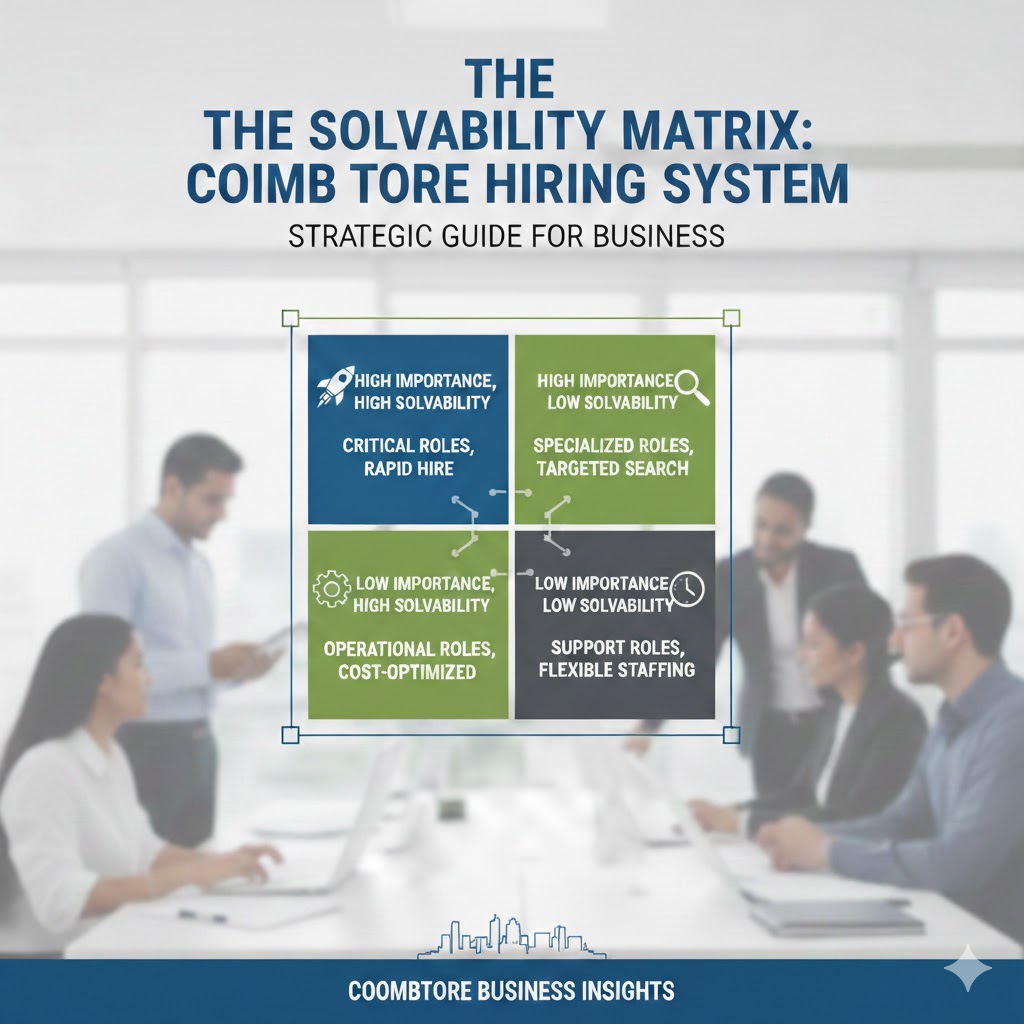
Picture this: You’re a growing business in Coimbatore’s thriving industrial landscape, struggling to fill critical positions while your competitors seem to effortlessly attract top talent. Your HR team is overwhelmed, recruitment costs are spiraling, and you’re not sure which positions to prioritize. Sound familiar? You’re not alone, and there’s a strategic solution that successful organizations worldwide are using to revolutionize their hiring approach.
The hiring system importance solvability matrix isn’t just another HR buzzword—it’s a powerful decision-making framework that helps Coimbatore businesses strategically allocate recruitment resources, prioritize positions, and build teams that drive real growth. Whether you’re managing a manufacturing unit, running a technology startup, or operating a service business in Coimbatore, this framework will transform how you approach talent acquisition.
What Exactly Is the Hiring System Importance Solvability Matrix?
Think of the hiring system importance solvability matrix as your recruitment GPS. Just as modern IP EPABX systems help businesses prioritize and route communications efficiently, this matrix helps you prioritize and route your hiring efforts where they’ll have maximum impact.
The framework operates on two critical dimensions:
Importance: How critical is this position to your business operations and strategic goals? A production manager in a Coimbatore textile unit might be mission-critical, while an administrative assistant, though valuable, may have less immediate strategic impact.
Solvability: How realistically can you fill this position given your current resources, market conditions, and organizational constraints? Can you attract qualified candidates in Coimbatore’s competitive job market? Do you have the budget, time, and infrastructure to recruit successfully?
By plotting every open position on a matrix with these two axes, you create a visual map that reveals where to focus your energy, which roles to tackle first, and which positions might need creative solutions.
Why Coimbatore Businesses Need This Framework Now More Than Ever
Coimbatore’s business landscape is experiencing unprecedented transformation. The city’s evolution from a traditional textile hub to a diversified industrial and IT center has created intense competition for skilled talent. Manufacturing units need specialized technicians, IT companies are hunting for developers, and service businesses require customer-facing professionals—all from the same talent pool.
Here’s the reality: traditional hiring approaches—posting jobs and hoping for the best—simply don’t work anymore. The best candidates have multiple offers. The talent market moves fast. Your competition is getting smarter about recruitment. You need a systematic approach that ensures you’re not just hiring, but hiring strategically.
Consider a mid-sized manufacturing company in Coimbatore that recently implemented this matrix. They were trying to fill twelve positions simultaneously, spreading their recruitment team thin. By mapping positions on the importance-solvability matrix, they discovered that three roles were both highly important and highly solvable—these became their immediate focus. Four positions were important but difficult to solve, requiring creative strategies like internal training programs. The remaining roles could wait or be approached differently. Within three months, they filled their critical positions and developed long-term strategies for the challenging ones.
The Four Quadrants: Understanding Your Hiring Landscape
When you plot positions on your matrix, four distinct quadrants emerge, each requiring a different strategic approach:
High Importance, High Solvability: Your Quick Wins
These are your golden opportunities—critical positions that you can realistically fill. A skilled maintenance technician for your IP PBX system might fall here if you have competitive compensation and Coimbatore has available talent.
Action Strategy: Move fast and decisively. These positions should receive immediate attention, adequate budget allocation, and your best recruiters. Don’t overthink—execute. Create compelling job descriptions, leverage your networks, and make competitive offers quickly. These wins build momentum for your entire recruitment program.
High Importance, Low Solvability: Your Strategic Challenges
These positions keep you awake at night—you absolutely need them, but they’re incredibly difficult to fill. Perhaps you need an expert in cloud telephony systems but there’s limited local talent, or you’re competing with deep-pocketed competitors for the same candidates.
Action Strategy: Get creative. Consider developing internal talent through training programs. Explore contract-to-hire arrangements. Look beyond Coimbatore to nearby cities or even remote workers. Partner with educational institutions to create pipeline programs. Sometimes, you might need to redefine the role or adjust expectations. One Coimbatore IT firm solved their senior developer shortage by hiring promising junior developers and investing in intensive training—creating loyalty while filling the gap.
Low Importance, High Solvability: Your Opportunistic Hires
These roles aren’t urgent, but if the right candidate appears, you could fill them easily. Maybe you’d eventually like another customer service representative, and qualified candidates are abundant in Coimbatore.
Action Strategy: Stay passive but opportunistic. Keep job postings live on low-cost platforms. Accept referrals. If an exceptional candidate appears, move forward. But don’t invest significant time or resources actively recruiting. Let these positions fill organically while you focus elsewhere.
Low Importance, Low Solvability: Your Deprioritization Zone
These positions are neither critical nor easy to fill. They’re often nice-to-haves that can wait or be eliminated entirely.
Action Strategy: Delay, delegate, or delete. Seriously question whether you need these roles at all. Can existing team members absorb these responsibilities? Can you outsource? Should this position exist? Many Coimbatore businesses discover that positions in this quadrant were never truly necessary—they were legacy roles or wishful thinking.
Building Your Matrix: A Practical Implementation Guide for Coimbatore Businesses
Creating your hiring system importance solvability matrix isn’t complicated, but it requires thoughtful analysis. Here’s how successful Coimbatore organizations approach it:
Step One: List All Open and Anticipated Positions
Start with complete visibility. Include currently open positions, roles you know you’ll need soon, and positions that team leaders have mentioned wanting. For a growing business, this might include everything from EPABX system technicians to sales managers to administrative staff.
Don’t self-censor at this stage. If someone’s mentioned needing it, write it down. You’ll evaluate later.
Step Two: Assess Importance Through Multiple Lenses
For each position, ask these critical questions:
Strategic Impact: Does this role directly contribute to your primary business objectives? A production supervisor in a manufacturing unit has direct impact. An additional HR coordinator might not.
Revenue Influence: Will this position help generate or protect revenue? Sales roles and client-facing positions typically score high here.
Operational Criticality: What happens if this position remains unfilled? If operations grind to a halt, importance is high. If things continue relatively smoothly, it’s lower.
Time Sensitivity: How urgently do you need this role filled? Positions supporting new product launches or addressing critical gaps score higher.
Team Impact: Does this role enable other team members to be more effective? A skilled IT administrator who maintains your IP-based EPABX system enables everyone to communicate effectively.
Score each position on a scale of 1-10 for importance. Be honest and ruthless. Not everything can be a 10. Force yourself to differentiate.
Step Three: Evaluate Solvability Realistically
Solvability assessment requires honest evaluation of your capabilities and market realities:
Talent Availability: Are qualified candidates available in Coimbatore and surrounding areas? Some specialized roles like GSM gateway technicians might have limited local talent pools.
Competitive Positioning: Can you offer compensation and benefits that attract candidates away from competitors? Be realistic about where you stand in Coimbatore’s market.
Organizational Readiness: Do you have clear job descriptions, efficient interview processes, and decision-making authority? Bureaucratic hiring processes reduce solvability.
Timeline Constraints: Can you move quickly enough to secure candidates? In hot job markets, delays kill deals.
Budget Availability: Do you have approved budget and flexibility to make competitive offers when needed?
Employer Brand: Are you an employer of choice in Coimbatore, or do you need to work harder to attract candidates?
Again, score 1-10 for solvability. A score of 8+ means you’re confident you can fill this role within reasonable timeframes with available resources.
Step Four: Plot and Analyze
Create your matrix—importance on one axis, solvability on the other. Plot each position. The visual pattern that emerges is revealing.
You might discover that you’ve been obsessing over low-importance positions while critical roles languish. You might find that several “impossible” roles are actually more solvable than you thought with the right approach. The matrix makes the invisible visible.
Real-World Applications: How Coimbatore Companies Use the Matrix
Let’s explore how different types of Coimbatore businesses apply this framework:
Manufacturing Sector Example
A medium-sized automotive parts manufacturer in Coimbatore was expanding production capacity. They needed maintenance technicians, quality control specialists, production supervisors, and an operations manager.
Using the matrix, they discovered:
- High Importance, High Solvability: Maintenance technicians (local technical schools produced qualified candidates regularly)
- High Importance, Low Solvability: Operations manager (required rare combination of automotive expertise and operational leadership)
- Low Importance, High Solvability: Additional quality control specialists (could manage with current team in short term)
- Low Importance, Low Solvability: Specialized robotics programmer (nice-to-have for future automation)
They immediately recruited maintenance technicians, promoted an internal supervisor to operations manager with executive coaching support, delayed quality control hiring, and eliminated the robotics position from current planning.
Service Business Example
A growing call center operation in Coimbatore needed customer service representatives, team leaders, trainers, and IT support staff.
Their matrix revealed:
- High Importance, High Solvability: Customer service representatives (abundant talent pool in Coimbatore)
- High Importance, Low Solvability: Experienced trainers (required unique blend of industry knowledge and training skills)
- Low Importance, High Solvability: Additional team leaders (could promote from within eventually)
- Low Importance, Low Solvability: Dedicated IT support (could outsource to IP PBX maintenance providers)
They launched aggressive representative recruitment, contracted with a training consultant for immediate needs while developing internal trainers, planned leadership development for future team leaders, and partnered with a local IT services company.
Technology Startup Example
A software company in Coimbatore needed developers, a product manager, sales representatives, and administrative support.
Matrix analysis showed:
- High Importance, High Solvability: Junior developers (strong pipeline from local engineering colleges)
- High Importance, Low Solvability: Senior product manager (required experience rare in local market)
- Low Importance, High Solvability: Sales representatives (could hire once product stabilized)
- Low Importance, Low Solvability: Executive assistant (founder could manage own schedule for now)
They hired junior developers and invested in mentorship, recruited a product manager from Bangalore with remote work flexibility, delayed sales hiring until product-market fit improved, and eliminated the assistant role.
Common Pitfalls and How to Avoid Them
Even with a solid framework, businesses make predictable mistakes. Here’s how to avoid them:
Mistake One: Static Assessment
The matrix isn’t a one-time exercise. Market conditions change. Your business evolves. A position that was low importance six months ago might be critical today as strategy shifts. Review and update your matrix quarterly, or whenever significant business changes occur.
Mistake Two: Ignoring Culture Fit in Solvability
A position might seem highly solvable based on talent availability, but if you have unique cultural requirements or values, solvability drops. Factor in your actual ability to find candidates who fit your organization, not just candidates with the right skills.
Mistake Three: Overestimating Your Employer Brand
Many Coimbatore businesses assume they’re more attractive to candidates than they really are. Get honest feedback from recent hires and candidates who declined offers. Your solvability assessments should reflect reality, not wishful thinking.
Mistake Four: Analysis Paralysis
The matrix is a decision-making tool, not an excuse for endless analysis. Once you’ve plotted positions and identified priorities, act decisively. Perfect information never exists in recruitment.
Mistake Five: Neglecting Communication
If your team doesn’t understand why certain positions are prioritized while others wait, you’ll face internal resistance. Share your matrix and reasoning with stakeholders. Transparency builds buy-in.
Integrating the Matrix with Modern Recruitment Technology
Just as businesses in Coimbatore are modernizing their communications with IP EPABX systems, they’re also leveraging technology for recruitment. The matrix works even better when combined with modern tools:
Applicant Tracking Systems (ATS): Tag positions with their matrix quadrant in your ATS. This ensures everyone on your hiring team understands priorities and approaches positions appropriately.
Analytics Platforms: Track time-to-fill, cost-per-hire, and other metrics by quadrant. This data validates your solvability assessments and helps refine future matrices.
Communication Tools: Use modern communication systems to coordinate recruitment teams. When everyone can collaborate efficiently through platforms like cloud telephony, recruitment processes move faster.
Social Media and Job Boards: Allocate advertising spend based on matrix position. High importance, high solvability roles might get premium job board placement. Low importance positions might rely on organic social media.
Measuring Success: Key Metrics for Your Matrix-Driven Hiring
How do you know if your matrix-based approach is working? Track these metrics:
Time-to-Fill by Quadrant: High importance, high solvability positions should fill faster than before. If they’re not, investigate why.
Cost-per-Hire by Quadrant: You should spend more on difficult-to-solve critical positions and less on easier roles. Ensure resources align with priorities.
Quality of Hire: Are the people you’re hiring through this approach performing well? Track performance ratings, retention rates, and manager satisfaction.
Stakeholder Satisfaction: Are hiring managers happier with recruitment outcomes? Are they getting critical positions filled faster?
Resource Efficiency: Is your HR team less overwhelmed? Are they able to give appropriate attention to the right positions?
Advanced Strategies: Taking Your Matrix to the Next Level
Once you’ve mastered the basics, consider these advanced applications:
Dynamic Weighting
Not all importance factors are equal for every business. A sales-driven organization might weight revenue influence heavily. An operations-focused manufacturer might prioritize operational criticality. Customize your importance scoring to reflect your unique strategic priorities.
Scenario Planning
Create multiple matrices for different business scenarios. What if revenue grows 50% next year? What if you enter a new market? What if a key competitor enters Coimbatore? Scenario-based matrices help you anticipate and prepare for talent needs under different futures.
Integration with Succession Planning
High importance positions with low internal bench strength should trigger succession planning initiatives. If losing your operations manager would be catastrophic and you can’t easily hire a replacement, you need to develop internal successors urgently.
Market Intelligence Gathering
For high importance, low solvability positions, invest in ongoing market research. Build relationships with potential candidates even before positions open. Create talent pipelines that improve solvability over time.
The Future of Strategic Hiring in Coimbatore
Coimbatore’s business environment will continue evolving rapidly. The competition for talent will intensify as more companies recognize the city’s advantages. The businesses that thrive will be those that approach hiring strategically rather than reactively.
The hiring system importance solvability matrix provides that strategic foundation. It forces discipline in thinking about priorities. It ensures resources go where they’ll have maximum impact. It creates alignment between talent acquisition and business strategy.
Just as modern businesses wouldn’t operate without efficient communication systems like IP PBX platforms, successful organizations increasingly won’t operate without strategic frameworks for talent acquisition.
Taking Action: Your Next Steps
Understanding the hiring system importance solvability matrix is valuable. Implementing it transforms your business. Here’s how to start:
Week One: List all current and anticipated positions. Gather input from department heads and team leaders about hiring needs.
Week Two: Score positions for importance. Have difficult conversations about what truly matters strategically versus what’s merely nice to have.
Week Three: Assess solvability honestly. Research market conditions for each role. Evaluate your competitive position and organizational readiness.
Week Four: Create your matrix, identify priorities, and develop action plans for each quadrant. Share with stakeholders and begin execution.
Ongoing: Review quarterly, adjust as conditions change, track metrics, and refine your approach based on results.
The journey to strategic hiring begins with a single step. Your Coimbatore business has unique challenges and opportunities in talent acquisition. The hiring system importance solvability matrix gives you a clear, actionable framework to navigate them successfully.
Your competitors are getting smarter about recruitment. Your market is getting more competitive. The talent landscape is evolving rapidly. The question isn’t whether you need a strategic approach to hiring—it’s whether you’ll implement one before your competition does.
The matrix is your roadmap. The time to start is now.
Frequently Asked Questions About the Hiring System Importance Solvability Matrix
Q: How often should we update our hiring system importance solvability matrix?
You should review and update your matrix at least quarterly. However, trigger immediate updates when significant business changes occur—new strategic initiatives, market disruptions, major competitor actions, or substantial budget changes. The matrix is a living tool, not a static document. Some fast-growing Coimbatore businesses review monthly during expansion phases.
Q: Can small businesses with limited HR resources effectively use this framework?
Absolutely. In fact, small businesses often benefit most because they have fewer resources to waste on unfocused hiring efforts. The matrix helps you concentrate limited time and budget where it matters most. A small Coimbatore manufacturer might only have one person handling recruitment—the matrix ensures that person focuses on the right priorities. Start simple with just your top 5-10 positions if creating a comprehensive matrix feels overwhelming.
Q: What if everything seems high importance? How do we differentiate?
This is common but must be addressed. Force ranking helps—if you could only fill three positions this quarter, which would they be? Ask what happens operationally if each position remains unfilled for six months. Consider revenue impact, strategic alignment, and risk. Sometimes you need input from senior leadership to make tough prioritization calls. Remember, saying everything is important is the same as saying nothing is important.
Q: How do we improve solvability for critical positions that seem impossible to fill?
Several strategies work: (1) Expand your geographic search beyond Coimbatore to nearby cities or even remote candidates, (2) Consider contract-to-hire or consultant arrangements as stepping stones, (3) Develop internal talent through training and promotion, (4) Adjust compensation to be truly competitive, (5) Improve your employer brand through better communication about your culture and opportunities, (6) Partner with educational institutions to create talent pipelines, (7) Redefine the role to make it more accessible to available talent pools.
Q: Should we share our matrix with job candidates?
Generally no—the matrix is an internal strategic tool. However, you can share the thinking behind your urgency and approach for specific roles. Candidates appreciate transparency about why a position exists and its importance to the organization. Just avoid revealing competitive salary information or detailed strategic plans that should remain confidential.
Q: How does this matrix work with diversity and inclusion hiring goals?
The matrix complements diversity initiatives well. Once you’ve identified priority positions (high importance, high solvability), you can apply targeted diversity recruitment strategies to those roles for maximum impact. Some organizations create diversity-specific solvability assessments—evaluating how easily they can attract diverse candidates for each role based on their employer brand among different communities, partnership with diverse professional organizations, and inclusive job descriptions.
Q: What if hiring managers disagree with our importance or solvability assessments?
Healthy debate improves the matrix. Create a collaborative process where hiring managers provide input on importance from their operational perspective while HR provides solvability assessments based on market knowledge. When disagreements persist, escalate to senior leadership for final decisions. Document your reasoning—whether you prioritize a role or not, explaining why builds understanding.
Q: Can we use this framework for contractor and freelancer decisions, or just full-time employees?
The matrix works for any talent acquisition decision. Plot contractor positions alongside full-time roles. A specialized EPABX installation consultant might be high importance, high solvability as a contractor but low solvability as a full-time hire. The framework helps you choose the right employment arrangement for each need.
Q: How do we handle positions that move between quadrants as conditions change?
This is expected and valuable. When a position moves from low to high importance due to strategic shifts, your matrix helps you recognize this change and adjust resource allocation accordingly. Conversely, if a critical role becomes easier to fill because market conditions improve or you enhance your employer brand, celebrate the solvability improvement and move confidently forward. Track these movements—they reveal important trends about your business and market.
Q: What tools or software can help us maintain and update our matrix?
You can start with simple spreadsheets or presentation software that most Coimbatore businesses already use. Plot positions on a 2×2 grid in PowerPoint or Google Slides, or create a scored list in Excel. As you mature, some applicant tracking systems allow custom tagging and categorization that can support matrix-based workflows. The tool matters less than consistent usage and regular updates. Many successful organizations use nothing more sophisticated than a shared Google Sheet with quarterly review reminders.