
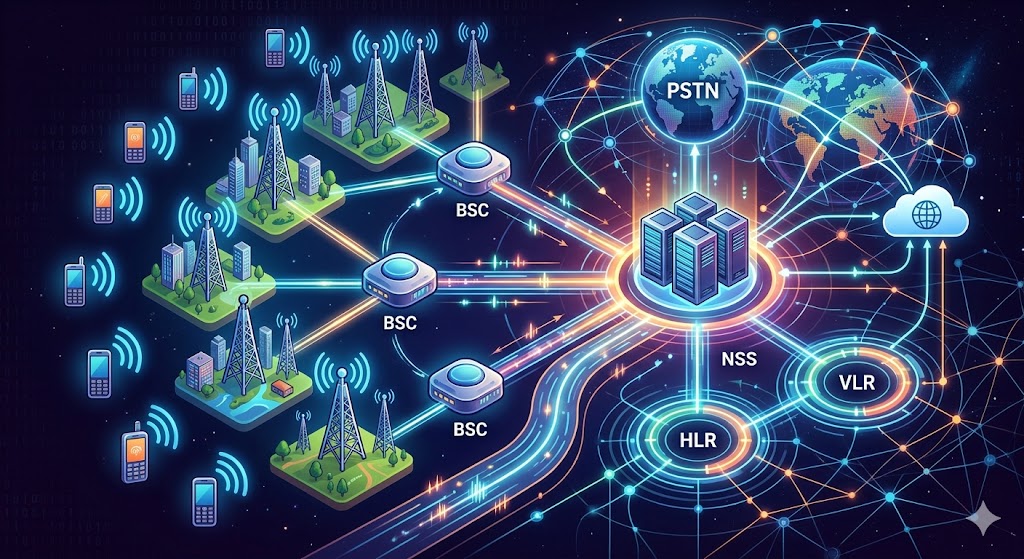
The world of mobile communication feels like magic. You press a button, and within seconds, you are talking to someone thousands of miles away. But beneath that seamless experience lies a complex, rigid, and brilliantly engineered structural design. To understand how your business stays reachable, we must look past the sleek smartphones and into the heart of the cellular world.
Understanding the Foundation of Global Communication
At its core, the Global System for Mobile communications (GSM) isn’t just a set of wires; it is a sophisticated ecosystem designed to handle voice and data across vast distances. When we talk about The Architecture of Connectivity: Deep Diving into the GSM Network Map, we are essentially looking at a city of invisible signals.
The network is divided into several functional entities, each with a specific job. If one part of this map fails, the entire conversation drops. For businesses in India, understanding this map is crucial, especially when integrating modern solutions like an IP-based EPABX system complete guide to bridge the gap between traditional cellular networks and office internal lines.
The Mobile Station: Your Entry Point to the Map
The journey begins with the Mobile Station (MS). This consists of two parts: the hardware (your phone) and the Subscriber Identity Module (SIM). The SIM card is the “passport” of the GSM network. it contains your International Mobile Subscriber Identity (IMSI), which allows the network to know exactly who you are and what services you are allowed to access.
Without a properly functioning MS, you cannot interface with the rest of the architecture. For companies managing large fleets of devices, ensuring hardware health is as vital as the network itself. This is why many IT managers refer to an IP phone maintenance Coimbatore complete guide to keep their hardware in peak condition for constant connectivity.
The Base Station Subsystem (BSS)
Think of the BSS as the “boots on the ground.” This part of the architecture manages the radio connection between your mobile phone and the core network. It is composed of two main elements:
The Base Transceiver Station (BTS)
This is the physical tower you see on rooftops or hills. Its primary job is to handle the radio interface. Each BTS covers a specific geographical area known as a “cell.”
The Base Station Controller (BSC)
The BSC is the brain of the BSS. It manages multiple BTS towers at once. It handles “handoffs”—the process where your call is passed from one tower to another as you drive down a highway—without the call dropping. This level of coordination is what makes mobile communication mobile.
The Network and Switching Subsystem (NSS)
This is where the real “map” of connectivity becomes interesting. The NSS is responsible for call processing and subscriber management. It acts as the central exchange that routes calls to the correct destination.
Mobile Switching Center (MSC)
The MSC is the heart of the GSM network. It performs the switching functions of the network and provides connections to other networks, such as the Public Switched Telephone Network (PSTN). If you are looking to connect your office landlines to this mobile world, you would likely look into GSM gateway dealers Chennai Coimbatore to allow your internal system to “talk” to the GSM architecture.
Home Location Register (HLR) and Visitor Location Register (VLR)
-
HLR: This is a permanent database that contains details of every subscriber authorized to use the GSM network.
-
VLR: This is a temporary database. When you travel to a new city, the VLR in that area stores your data so the local towers know how to handle your requests without constantly asking the HLR back home.
Bridging the Gap: GSM Meets IP Technology
While the GSM network map is designed for mobility, modern businesses often need to integrate these mobile signals into their fixed office environments. This is where the “Architecture of Connectivity” evolves into Unified Communications.
By using an IP PBX system with CRM Chennai Coimbatore, businesses can route GSM calls directly into their customer management software. This allows a sales representative to see exactly who is calling from a mobile device and access their entire history instantly.
Why the Transition to IP is Inevitable
Traditional GSM-only systems can be limiting for a growing business. There are at least 10 signs upgrade traditional PBX to IP EPABX that most managers ignore until their communication costs skyrocket. The modern GSM network map now frequently intersects with data-heavy IP networks, allowing for HD voice and seamless video conferencing.
The Role of Security in the GSM Map
With millions of signals flying through the air, security is a massive concern. The GSM architecture uses encryption and authentication to ensure that your calls aren’t intercepted. However, as we move toward IP-integrated systems, security must be handled on both the cellular and the data side.
Experts often recommend securing IP telephony prevent toll fraud unauthorized access to ensure that your “connectivity map” doesn’t have any open backdoors for hackers.
Operations and Support Subsystem (OSS)
The OSS is the control room. It’s where network engineers monitor performance, manage traffic congestion, and fix bugs. Without the OSS, the network would eventually collapse under its own weight. It ensures that the “Architecture of Connectivity” remains stable even during peak hours, like New Year’s Eve or major sporting events.
For smaller-scale “networks” within a building, a similar level of oversight is needed. Regular upkeep, as detailed in an IP PBX maintenance guide, serves as the OSS for your business’s private communication map.
Practical Applications of the GSM Map in Business
How does this deep dive help you? Understanding that the GSM network is a series of interconnected “nodes” allows you to build a better internal network.
-
Cost Efficiency: By using GSM gateways, you can turn expensive mobile-to-landline calls into cheaper mobile-to-mobile calls.
-
Remote Work: Because the GSM map is global, an IP phone system backup recovery guide ensures that even if your office loses power, your GSM-connected mobile staff stays online.
-
Scalability: Modern systems allow you to add “cells” to your business network just like a carrier adds towers.
Future-Proofing Your Connectivity
The GSM network map is currently evolving into 5G and beyond, where the line between “cellular” and “internet” is almost non-existent. For businesses in India, staying ahead of this curve is vital. Whether you are looking for IP phone dealers Chennai or exploring VoIP PBX for small business complete guide 2025, the goal is the same: stay connected, stay fast, and stay secure.
Common Questions About GSM Architecture
What is the most important part of the GSM network?
The Mobile Switching Center (MSC) is often considered the most vital component, as it acts as the primary routing hub for all voice and data traffic within the network.
How does GSM differ from IP-based systems?
GSM is traditionally a circuit-switched network designed for voice, while IP-based systems (like VoIP) are packet-switched and designed for data. However, modern technology allows these two to work together seamlessly. You can learn more about this in the difference between PBX and EPABX systems complete guide.
Why do my calls drop when I’m moving?
This usually happens during a “handoff” failure within the Base Station Subsystem (BSS). If the new tower (BTS) doesn’t have enough capacity or the signal is blocked, the connection is lost.
Can I connect my office phone system to the GSM network?
Yes, by using GSM Gateways or IP-PBX systems, you can integrate mobile SIM cards directly into your office phone setup. This is a popular choice for businesses looking for complete guide to IP EPABX systems in Chennai.
Is the GSM network map secure?
GSM uses several security protocols, including A3 for authentication and A5 for encryption. While very secure, it is always wise to add extra layers of security if you are routing these calls through an internet-based system.
