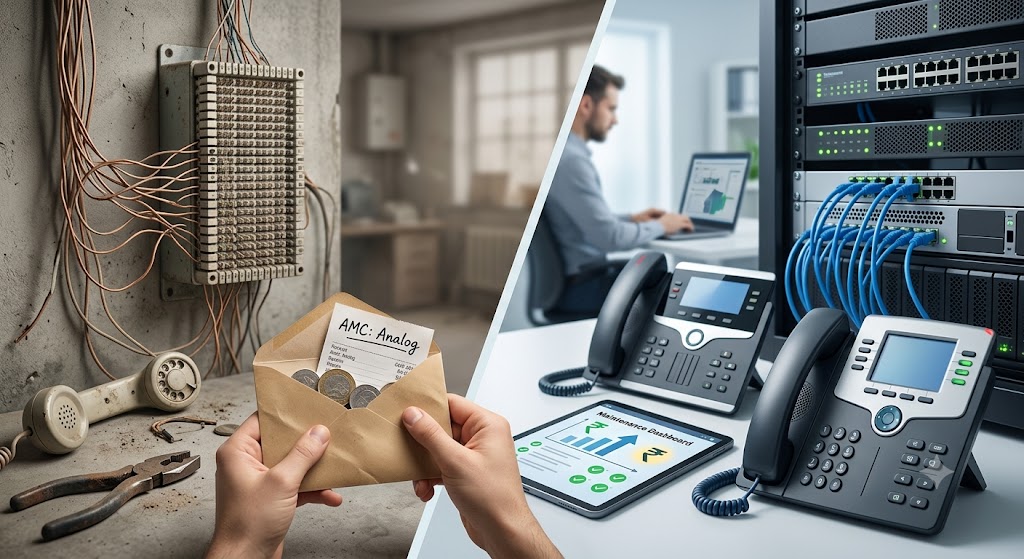
If you’ve ever opened an AMC invoice for your office’s old analog phone system and felt your stomach drop, you’re not alone. Across Coimbatore and Chennai, business owners are quietly tallying up what their “reliable old phone setup” actually costs them every year — and the number is usually a lot higher than they expected.
This isn’t about whether analog systems “work.” They do. The real question is whether they work economically. And once you start comparing maintenance costs line by line, the answer becomes obvious fairly quickly.
Why Maintenance Costs Sneak Up on Analog Users
Analog EPABX systems were built in an era when phone lines were copper, technicians carried toolkits full of specialized parts, and “downtime” simply meant waiting a few days for a repair visit. That model hasn’t aged well, a point we explored in depth in our piece on the evolution of business telephony from analog to digital.
Aging Hardware Means Rising Repair Bills
Analog systems depend on physical components — relays, motherboards, copper wiring — that degrade over time. Spare parts for older models are increasingly hard to source, and many manufacturers have simply stopped producing them. This scarcity drives up repair costs, and technicians familiar with legacy systems are becoming rarer (and pricier) by the year.
Frequent Site Visits Add Up
Unlike IP systems, which often allow remote diagnostics, analog faults usually require an on-site technician visit. Each visit comes with a service charge, travel cost, and labor time — costs that compound quickly if your system faults more than once or twice a year. If your office is still relying on an outdated setup, our guide on signs it’s time to upgrade from traditional PBX to IP EPABX is worth a read.
Where IP Systems Change the Cost Equation
IP PBX systems shift the maintenance model from “physical repair” to “software-driven management,” and that shift alone eliminates a huge chunk of recurring expense.
Remote Monitoring Reduces On-Site Visits
Most IP EPABX platforms allow administrators or vendors to monitor system health remotely. Many issues — call routing errors, extension misconfigurations, firmware glitches — can be resolved without anyone stepping into your office. This alone can cut technician visit costs dramatically, similar to what we explored when looking at how hidden costs build up when businesses stick with legacy phone infrastructure.
Lower Long-Term Component Costs
IP systems rely on standardized networking hardware — switches, routers, IP phones — which are mass-produced, widely available, and far cheaper to replace than proprietary analog parts. When something does need replacing, you’re not waiting weeks for a rare component; you’re ordering a part that’s in stock almost everywhere, much like the equipment covered in our overview of IP phones from Asttecs, Grandstream, and FlyingVoice.
Software Updates Instead of Hardware Overhauls
Many issues that would require a full hardware repair on an analog system can simply be patched via firmware or software updates on an IP system. This is a quiet but significant saver — and it’s part of why many businesses see meaningfully lower costs over a multi-year horizon, something we break down further in our piece on how businesses are measuring ROI when upgrading to IP telephony.
Breaking Down the Real Numbers
Let’s get specific, because vague comparisons don’t help anyone making a budgeting decision.
Annual Maintenance Contracts (AMC)
Analog AMC contracts in Coimbatore and Chennai typically run higher per extension because technicians need to physically inspect wiring, check relay boards, and replace aging parts proactively. IP systems, by contrast, often have lower AMC rates because much of the “maintenance” is software-based monitoring rather than hands-on labor. For a closer look at what these contracts typically include, see our detailed EPABX maintenance guide.
Downtime Costs
This is the cost most businesses forget to calculate. When an analog system goes down, you’re often looking at a multi-day wait for parts or technician availability — during which calls are missed, customers get frustrated, and revenue opportunities slip away. IP systems generally recover faster because issues can often be diagnosed and resolved remotely, sometimes within hours.
Scalability Costs
Adding extensions to an analog system usually means running new wiring, installing additional cards, and sometimes upgrading the entire chassis — all of which carry installation and material costs. IP systems scale by simply adding licenses or IP phones to the existing network, which is why growing businesses increasingly lean toward platforms designed to expand without major rework, as covered in our guide on scalable IP PBX solutions that grow alongside a business.
A Realistic Look at Total Cost of Ownership
It’s tempting to compare just the upfront installation price, but that’s an incomplete picture. The real comparison has to include:
Initial installation cost, annual maintenance, downtime-related losses, scalability expenses, and electricity/infrastructure costs (IP systems often consolidate hardware, reducing power consumption compared to bulky analog cabinets).
When you stack these together over a 5-year window, IP systems usually come out ahead — not marginally, but substantially. This is especially true for businesses that have already made the jump and documented their savings, similar to the patterns seen in our breakdown of how upgrading to IP telephony has reduced communication costs for businesses by significant margins.
Industry-Specific Considerations
Manufacturing and Factory Setups
Factories with extensive analog wiring face higher costs when upgrading, but the maintenance savings post-transition are often greater too, since industrial environments are tougher on aging copper infrastructure. We’ve discussed this in detail when covering the cost considerations of upgrading from analog to IP EPABX systems for factories in Coimbatore.
Call Centers and High-Volume Offices
For call centers, downtime isn’t just inconvenient — it’s directly tied to revenue. Every missed call is a missed lead or an unresolved customer issue. The lower fault rates and faster remote resolution of IP systems make a measurable difference here, something explored further in our analysis of call center cost comparisons and in our guide to setting up high-performance call center infrastructure.
Small and Mid-Sized Offices
Smaller offices sometimes assume IP systems are “too much” for their needs, but the opposite is often true — smaller offices benefit the most from reduced AMC costs relative to their size. Our piece on small business phone systems and IP PBX setups under reasonable budgets in Coimbatore covers this in more depth.
What About Hybrid Setups?
Not every business needs to rip out their analog system overnight. Hybrid IP-analog setups allow a phased transition — keeping some analog extensions while gradually shifting core infrastructure to IP. This approach can ease the financial transition while still capturing some of the maintenance savings IP systems offer, though it’s worth understanding the trade-offs clearly before deciding, as we’ve outlined in our comparison of IP PBX versus traditional EPABX systems and our piece on hybrid IP EPABX setups redefining remote work.
The Human Side of the Cost Equation
There’s a cost that doesn’t show up on any invoice: staff frustration. When phone systems are unreliable, employees waste time troubleshooting, repeating calls, or working around dropped lines. That’s lost productivity, and it adds up just as much as any AMC bill — something we’ve examined when looking at how modern phone systems are increasing employee productivity and improving internal communication for distributed teams.
Making the Switch Without the Sticker Shock
If cost has been the main hesitation, it’s worth getting a clear, itemized installation estimate rather than relying on assumptions. Pricing varies significantly based on the number of extensions, brand, and features required, and a proper breakdown — like the one in our guide on EPABX system installation costs in Coimbatore — makes the decision far less abstract. If you’re also weighing whether to go with open-source Asterisk or branded hardware, that comparison is worth reading before you finalize a vendor.
Frequently Asked Questions
Are IP PBX systems always cheaper to maintain than analog systems?
In most cases, yes — particularly over a multi-year period. Analog systems have higher repair costs due to scarce parts and labor-intensive troubleshooting, while IP systems benefit from remote diagnostics and standardized, affordable components.
How much can a business realistically save annually by switching to IP?
Savings vary by business size and call volume, but many businesses report meaningfully lower AMC costs and fewer downtime-related losses within the first year of switching.
Is it expensive to maintain a hybrid analog-IP system?
Hybrid setups can cost more to maintain than a fully IP system, since you’re still managing some analog infrastructure, but they remain cheaper than a fully analog setup and offer a gentler transition path.
Do IP systems require specialized technicians, like analog systems do?
Less so. While initial setup benefits from expert configuration, ongoing maintenance is often handled remotely, reducing dependency on rare, specialized analog technicians.
What’s the biggest hidden cost businesses overlook when comparing the two?
Downtime. Analog faults often take longer to resolve due to part availability and on-site visit requirements, and the resulting lost business calls can outweigh the actual repair bill itself.
The Bottom Line
When you look past the upfront installation number and into the real, ongoing cost of keeping a phone system running, IP systems consistently come out ahead — fewer site visits, cheaper components, faster fault resolution, and better scalability. For businesses in Coimbatore and Chennai weighing this decision, the maintenance cost comparison alone is often reason enough to make the move.