Navigating the world of telecommunications hardware can often feel like trying to learn a new language. You hear terms like “SIP trunking,” “VoIP,” and “Analog handoffs” thrown around like confetti. But if you are currently looking to bridge the gap between your traditional telephony and a modern IP-based system, two acronyms will inevitably dominate your search: FXS and FXO.
Choosing the wrong one isn’t just a minor technical hiccup; it’s the difference between a dial tone and dead silence. Especially when dealing with high-performance hardware like DINSTAR, understanding the specific role of each port is vital for your office infrastructure.
In this deep dive, we’ll demystify these gateways, explore the DINSTAR lineup, and help you determine exactly which solution will keep your business conversations flowing.
Understanding the Basics: What Do These Acronyms Actually Mean?
Before we look at specific hardware, we have to understand the “handshake” of telephony. In every phone call involving an analog line, there is a Provider and a User.
The Role of FXS (Foreign Exchange Subscriber)
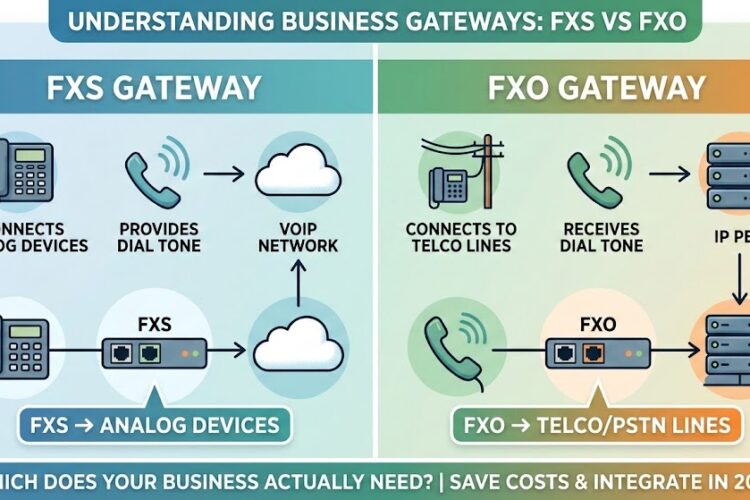
The FXS port is the “Provider.” Think of the wall jack in your home. It provides the dial tone, the battery power, and the ringing voltage. If you have an analog phone (the kind with a physical cord and a keypad), it needs to plug into an FXS port to come to life.
In the context of a DINSTAR gateway, an FXS Gateway is used when you want to connect your old-school analog phones or fax machines to a modern VoIP PBX. It “tricks” the analog phone into thinking it’s plugged into a traditional wall jack, while actually converting those signals into data packets for the internet.
The Role of FXO (Foreign Exchange Office)
The FXO port is the “Receiver.” This is the port found on the back of an analog phone or a fax machine. It receives the dial tone and the power from the FXS port.
When we talk about a DINSTAR FXO Gateway, we are talking about a device that allows your modern IP-PBX to connect to traditional PSTN (Public Switched Telephone Network) lines provided by your local telecom company. It allows your digital system to “plug into” the analog lines you already pay for.
The Pain Points: Why This Choice Matters for Your Business
Choosing between these two isn’t just about technical specs; it’s about solving real-world frustrations. Many businesses in Chennai and Coimbatore face specific hurdles when upgrading their systems.
-
The Hardware Graveyard: You’ve invested thousands in high-quality analog handsets over the years. Throwing them away feels like a waste.
-
The “Internet is Down” Fear: If your office relies entirely on the cloud, a fiber cut means your business vanishes. Having a backup through local analog lines is a common safety net.
-
The Legacy Fax Machine: Despite the rise of email, many industries (legal, medical, manufacturing) still rely on faxing. Modern VoIP often struggles with faxing unless it has a dedicated gateway.
By choosing the right DINSTAR gateway, you eliminate these pain points by creating a Professional EPABX solution in Chennai or Coimbatore that respects both your past investments and your future growth.
Deep Dive: When to Choose a DINSTAR FXS Gateway
If your goal is Internal Modernization, the FXS gateway is your best friend.
Scenario 1: Preserving Analog Devices
Imagine a large hotel or a multi-story office building. There are hundreds of analog phones in rooms or on desks. Replacing all of them with IP phones would be a budgetary nightmare. By using DINSTAR FXS Gateway dealers in Chennai and Coimbatore, you can keep those phones and simply route them through a central gateway that talks to your IP-PBX.
Scenario 2: Reliable Faxing
VoIP is designed for voice, which can handle slight “jitters” in data. Faxing, however, is data-sensitive. An FXS gateway provides the stable T.38 protocol support needed to ensure your faxes actually go through without failing halfway.
Technical Advantages of DINSTAR FXS
DINSTAR’s FXS series (like the DAG1000 or DAG2000) are known for:
-
High Density: Options ranging from 1 to 128 ports.
-
Echo Cancellation: Ensuring that your analog calls sound as crisp as digital ones.
-
Long-Line Support: Vital for large campuses where the phone is far from the gateway.
Deep Dive: When to Choose a DINSTAR FXO Gateway
If your goal is External Connectivity, the FXO gateway is the essential bridge.
Scenario 1: PSTN Failover
Even if you use SIP trunks for your primary calling, what happens if the internet goes out? An FXO gateway allows you to keep a few traditional BSNL or Airtel analog lines active. If the digital path fails, the system automatically reroutes calls through the analog lines. This is a core part of a robust IP phone system backup and recovery guide.
Scenario 2: Local Number Retention
Sometimes, a business has used a specific analog phone number for 20 years. That number is on every billboard and business card. If you can’t “port” that number to a digital provider yet, an FXO gateway allows you to “inject” that analog line into your new IP system.
Technical Advantages of DINSTAR FXO
The DINSTAR FXO series is designed to handle the “noise” of traditional lines:
-
Busy Tone Detection: Ensuring calls are disconnected properly so lines aren’t “hung.”
-
Caller ID Support: Passing through the analog caller ID to your digital handsets.
-
Lightning Protection: Essential for regions like Coimbatore where power surges can travel through phone lines.
Comparative Analysis: FXS vs. FXO at a Glance
To make this easier for your IT team, here is a quick breakdown of the differences.
| Feature | FXS Gateway | FXO Gateway |
| Primary Goal | Connects Analog Phones to IP-PBX | Connects Analog Lines (PSTN) to IP-PBX |
| Provides Dial Tone? | Yes | No (Receives it) |
| Typical User | Hotels, Hospitals, Schools | Businesses needing PSTN backup |
| Connection Point | Plugs into the Phone/Fax | Plugs into the Wall Jack/Service Provider |
| DINSTAR Model Range | DAG1000/2000 (FXS) | DAG1000/2000 (FXO) |
For a more detailed look at how these fit into a broader infrastructure, check out our Complete Guide to IP EPABX Systems in Chennai.
Integrating Gateways into Your Existing Infrastructure
The beauty of the DINSTAR ecosystem is that you don’t have to choose just one. Many high-performance setups use a “Hybrid” approach.
The Hybrid Setup
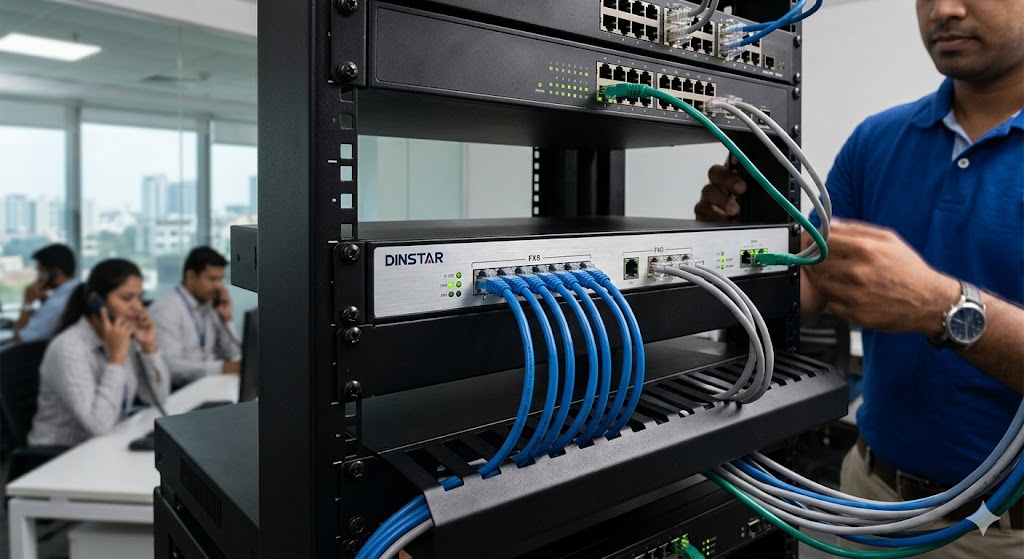
In a hybrid environment, you might use a Matrix EPABX solution alongside DINSTAR gateways. You would use FXO ports to bring in your outside lines and FXS ports to support your remaining analog extensions.
This architecture is particularly effective for High-performance call center infrastructure, where uptime is non-negotiable. If the SIP trunk (VoIP) lags, the FXO gateway takes over. If you need a cheap extension for the breakroom, the FXS gateway handles it.
Security Considerations
Whenever you bridge analog and digital, security is paramount. DINSTAR gateways offer robust encryption and IP whitelisting. This is a critical step in securing IP telephony and preventing unauthorized access. Without proper configuration, an FXO gateway can be a “backdoor” for toll fraud. Always ensure your gateway is behind a firewall and uses strong authentication.
How to Choose: The “Right Infrastructure” Checklist
Still unsure? Ask yourself these four questions:
1. What am I plugging into the gateway?
-
If it’s a device (phone, fax, intercom), you need FXS.
-
If it’s a service line from a provider, you need FXO.
2. How many ports do I need?
DINSTAR offers scalable solutions. Don’t buy a 32-port gateway if you only have 4 analog faxes. However, always leave 20% room for growth.
3. Do I need a GSM backup as well?
Sometimes, even analog lines fail. In those cases, you might want to look at DINSTAR GSM Gateway dealers to add a cellular path to your communication mix.
4. Is local support available?
Infrastructure is only as good as the people who can fix it. Whether you are looking for EPABX service providers in Coimbatore or Chennai, ensure your dealer understands the DINSTAR configuration nuances.
The Future of Your Connectivity
As we move further into 2026, the lines between analog and digital continue to blur. We are seeing a massive shift toward Hybrid IP EPABX redefining remote work. In this new era, your office isn’t just a building; it’s a network.
Whether you choose an FXS gateway to keep your reliable old hardware alive or an FXO gateway to ensure you’re never disconnected from the traditional grid, you are making a move toward a more resilient business.
Frequently Asked Questions (FAQs)
Can I use an FXS gateway to receive a dial tone from my service provider?
No. An FXS gateway provides a dial tone. To receive a dial tone from a traditional wall jack or service provider, you must use an FXO gateway.
Why is my DINSTAR FXO gateway not disconnecting calls?
This is a common “pain point” usually caused by incorrect “Busy Tone” detection settings. Analog lines signal a hang-up differently across regions. You may need to calibrate the gateway to match the specific frequency used by your telecom provider in Chennai or Coimbatore.
Is there a device that has both FXS and FXO ports?
Yes, DINSTAR offers hybrid gateways (e.g., the DAG2000-8S8O) which feature both port types in a single chassis. This is ideal for small offices that need to connect a couple of analog phones and a couple of PSTN lines.
Does using a gateway reduce voice quality?
If configured correctly with high-quality codecs (like G.711 or G.729), the difference is indistinguishable to the human ear. DINSTAR gateways include advanced jitter buffers and echo cancellation to maintain high-performance audio.
Can I connect my DINSTAR gateway to a Cloud PBX?
Absolutely. Most DINSTAR gateways are fully compatible with major cloud platforms like 3CX, Asterisk, and FreePBX. You simply point the gateway to the IP address of your cloud server.