Remember the last time you missed an important client call because you were stuck in traffic on the OMR? Or the frustration of paying insane phone bills for calls to your branch in Coimbatore?
For decades, business communication was a necessary evil. We tolerated crackling lines, limited extensions, and shocking bills because “that is just how phones work.”
Not anymore.
How VoIP Technology is transforming business communication is not just a trending topic on LinkedIn; it is a fundamental shift in how modern enterprises operate. From a startup in T. Nagar to a manufacturing plant in Ambattur, Voice over Internet Protocol (VoIP) is tearing down the silos of traditional telephony.
If you are still relying on an old copper-line EPABX, you aren’t just missing out on cost savings—you are actively losing productivity and customers.
Let us dive deep into this transformation, the technology behind it, and how you can leverage it without an IT degree.
The Pain Points: Why Old Phone Systems Make You Lose Money
Before we look at the solution, let us acknowledge the pain. You might recognize these scenarios:
-
The “Extension Full” Nightmare: You hire a new salesperson, but there is no physical port left on your old EPABX machine. You need to buy expensive hardware just to add a single desk.
-
The “Work From Home” Fail: When the pandemic hit or when an employee needs to work remotely, your office phone becomes a brick. They cannot take their desk extension home.
-
The Bill Shock: You call a vendor in the US. Your PSTN line charges you per minute. By the end of the month, your phone bill rivals your rent.
-
The Lost Client: A potential customer calls, hears 10 rings, and hangs up because your old system has no proper queuing or fallback.
These are not technical glitches; they are business leaks. How VoIP Technology is transforming business communication patches these leaks instantly.
H3: What Exactly is VoIP? (No Jargon, Please)
Let us keep it simple. Traditional phone systems (like a classic EPABX) use circuit switching. You open a dedicated “pipe” for the call. No one else can use that pipe until you hang up.
VoIP uses packet switching. It breaks your voice into tiny digital packets, shoots them over your internet connection, and reassembles them at the other end.
Think of it like this:
-
Traditional PBX: Taking a taxi alone. You pay for the whole car, and traffic jams (congestion) stop you.
-
VoIP: Riding the Metro. You share the bandwidth, it is incredibly cheap per “seat,” and you have multiple routes to reach the destination.
When you implement a modern IP PBX system, you are essentially installing a super-computer for your phone lines. It handles routing, recording, and auto-attendants seamlessly.
H3: The Top 5 Ways VoIP is Revolutionizing Chennai Businesses
Let us look at the specific areas where the transformation is most visible for Indian businesses.
H4: 1. The Death of “Per Minute” Billing (Unlimited Potential)
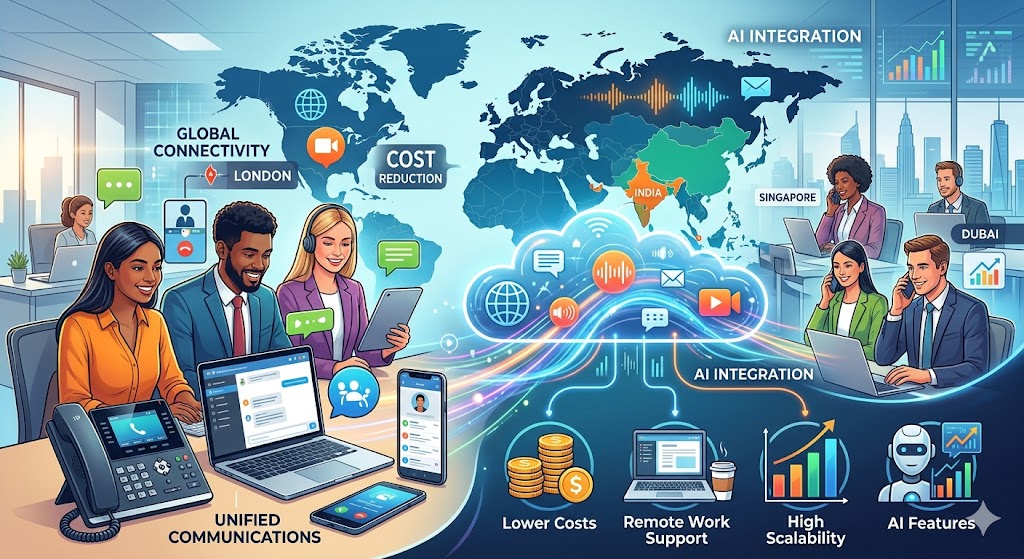
The most immediate relief is cost. With a Cloud-based IP PBX, your internal calls between branches (Chennai to Coimbatore, or even Chennai to New York) become free. You are just using your data connection.
For external calls, VoIP providers offer SIP trunks at a fraction of the cost of traditional ISDN/PRIs. We are talking about reducing communication costs by 40-60% instantly.
Pro Tip: If you have high outgoing call volumes (like a call center or sales team), check out our detailed guide on Cloud Telephony 2025 Trends to see how AI is further reducing costs.
H4: 2. Mobility: The Office Follows You Home
The hybrid work model is here to stay. You cannot chain your employees to a desk phone anymore.
With a VoIP phone system:
-
An employee can install a softphone (an app) on their mobile or laptop.
-
When a customer calls their desk extension, the phone rings in their home office.
-
When they dial out, the customer sees the office caller ID, not their personal mobile number.
This maintains professionalism. Imagine your receptionist saying, “Please hold while I transfer you to Ramesh,” and Ramesh is sipping chai at a cafe in Bessy. The customer never knows the difference. This is the power of modern IP PBX systems for hybrid work.
H4: 3. Unified Communications: Beyond Just Voice
VoIP is not just about making calls. How VoIP Technology is transforming business communication is visible in the “Unified Communications” (UC) suite.
Your business phone system now integrates with:
-
Video Conferencing: Zoom-like quality built into your phone dialer.
-
CRM Integration: When a client calls, their record pops up on the salesperson’s screen automatically.
-
Live Chat: Website chat routing to the same sales extension.
We have written extensively about IP PBX systems with CRM, which is a game-changer for real estate and financial firms where knowing the client before you pick up the phone is crucial.
H4: 4. Scalability: Growing Without Breaking the Bank
Remember the hardware limitations of old EPABX systems?
With VoIP, scaling is digital. Need to add 50 people for a festive season sales drive? Log into your admin panel, buy 50 licenses, plug in the IP phones (or download the app), and you are done. You don’t need a technician to visit your office, and you don’t need to run new copper wires.
You can start small. For example, if you have just 20 employees, you can check the IP PBX price for 20 users to see how affordable entry-level systems have become.
H4: 5. Advanced Features That Wow Customers
Customers judge your business by how you handle their call. VoIP gives you enterprise-level features without the enterprise price tag.
-
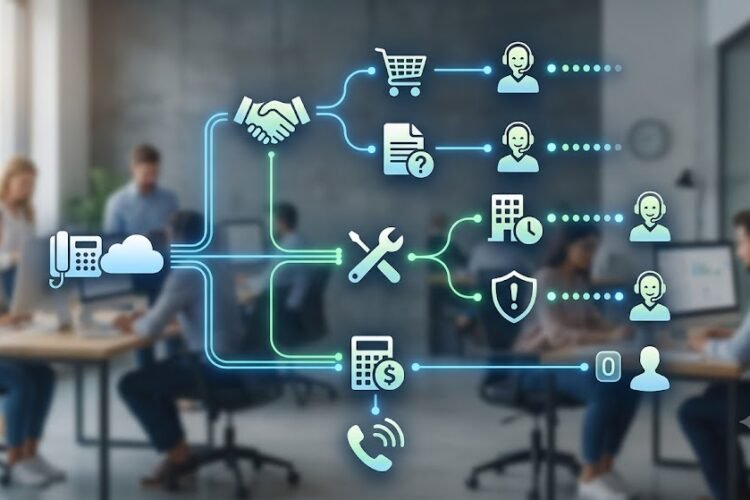
IVR (Interactive Voice Response): “Press 1 for Sales, Press 2 for Support…” This is standard now, but VoIP makes it drag-and-drop simple.
-
Call Queuing: No more busy signals. Customers wait in line, listen to music, and are served in order.
-
Auto-Attendant: A digital receptionist that never needs a tea break.
If you are setting up a support center, understanding ACD vs IVR is vital to routing calls efficiently.
H3: Real-World Scenario: The “Stuck in Traffic” Fix
Let us paint a picture.
Scenario: Raj owns a logistics company in Coimbatore with a warehouse in Chennai. His old EPABX system means the Chennai warehouse has a different phone number. If the Chennai manager is on the road, he misses calls. If Raj is driving, he misses the transfer.
VoIP Solution:
Raj implements a Cloud based phone system for business. He sets up a “Ring Group.” When a customer calls the main number, all extensions ring simultaneously—Raj’s mobile, the Chennai manager’s laptop, and the office landline. Whoever picks up first solves the problem.
Furthermore, using GSM Gateways, they integrate SIM cards for when the primary internet fails, ensuring 99.9% uptime.
H3: Addressing the Elephant in the Room: “But My Internet is Bad”
This is the most common objection we hear from business owners in Chennai, particularly in industrial estates like Ambattur or Guindy.
“VoIP only works if you have fiber optic internet. We don’t.”
This is a myth—or rather, an old truth. Modern Hybrid IP PBX systems solve this elegantly.
H4: The Hybrid Advantage
You do not have to throw away your analog phones or rely 100% on the internet.
-
Hybrid System: Connects to the internet (VoIP) AND traditional telephone lines (PSTN/GSM).
-
Failover: If your internet goes down, the call automatically routes through a 4G SIM card in a Dinstar GSM gateway or falls back to the copper line.
You can learn more about how to protect your calls during downtime in our guide on Securing IP Telephony.
Moreover, with the rollout of 5G and affordable leased lines in Chennai, voice quality over VoIP is often superior to analog. There is no static, no cross-talk, just HD voice.
H3: VoIP vs. Traditional EPABX: A No-Nonsense Comparison
Let us put them head-to-head so you can see why How VoIP Technology is transforming business communication is inevitable.
| Feature | Traditional EPABX (Old School) | VoIP / IP EPABX (The Future) |
|---|---|---|
| Hardware | Huge cabinets, specific wiring, limited ports. | Small server or Cloud (zero hardware). |
| Moves/Adds/Changes | Requires technician visit. Costs money. | Admin login. Drag and drop. Free. |
| Remote Work | Impossible. | Native. Works from any internet connection. |
| Inter-Branch Calls | Expensive (STD rates). | Free (Data only). |
| Scalability | Buy expensive cards/ports. | Buy software licenses. |
| Disaster Recovery | If the machine dies, phones die. | Failover to mobile apps. Redundant servers. |
If you want the full technical breakdown, read our article on IP PBX vs Traditional PBX. The conclusion is simple: upgrading is not a luxury; it is a necessity to stay competitive.
H3: Getting Started: How to Migrate Without Disrupting Your Business
Switching phone systems sounds scary. You think, “What if we lose our phone number? What if we have downtime for a week?”
It does not work that way. A professional migration is seamless.
Step 1: Assessment
You need to know what you have. Are you using analog phones? Do you have good structured cabling? We have a guide on Network Infrastructure Maintenance to help you prepare.
Step 2: Choose the Right Hardware
You don’t need to buy $500 phones for everyone.
-
For Managers: Grandstream IP phones or Fanvil IP phones (excellent HD voice).
-
For Factory Floors: IP Speakers for public address and paging.
-
For Warehouses: Ruggedized cordless IP phones.
Step 3: Pilot Testing
Install the system for 5 power users first (Sales, Reception, MD). Run it parallel to your old system for a week.
Step 4: Full Cutover & Training
Port your main number to the VoIP provider. Train staff on the app.
H3: The Role of Gateways in a VoIP Transformation
One piece of hardware that often confuses business owners is the “Gateway.” You do not strictly need one if you go 100% pure IP, but they are magical for transitioning.
-
FXO Gateway: Connects your new VoIP system to old analog lines from BSNL/ACT. Good for backup.
-
FXS Gateway: Connects your old analog phones to the new VoIP system. Use your old handsets to save money.
-
GSM Gateway: Inserts 4G/5G SIM cards into your phone system. Perfect for rural areas or as a primary cheap route for mobile calls.
We have a detailed breakdown of FXS vs FXO Gateways if you want to get technical. Understanding these will save you thousands of rupees in hardware replacement costs.
H3: Security: Is VoIP Safe from Hackers?
With the rise of “Toll Fraud” (hackers breaking into your PBX to make international calls on your dime), security is a valid concern.
How VoIP Technology is transforming business communication includes better security protocols than analog lines.
-
Encryption: Modern IP PBXs use SRTP and TLS to encrypt your calls.
-
Firewalls: VoIP can sit behind your corporate firewall.
-
Access Lists: You can block calls from countries you never do business with.
For financial firms, we recommend reading about End-to-end encryption for financial firms. For everyone else, simply changing the default passwords on your Matrix EPABX or Grandstream devices prevents 99% of attacks.
H3: FAQs About VoIP Transformation
Q1: Do I need to buy expensive new phones for every desk?
A: Not necessarily. You can use softphones (apps on existing computers/mobiles) or use FXS Gateways to connect your existing analog phones. However, for the best experience (HD voice, programmable keys), a basic IP phone like those from Asttecs or FlyingVoice is recommended.
Q2: Can I keep my old landline number?
A: Yes. In almost all cases, you can “port” (transfer) your existing landline number to your VoIP provider. There is a simple documentation process, but you keep the number your clients know.
Q3: Is VoIP reliable during a power cut?
A: If your office has a power cut, your traditional phone (depending on the exchange) might still work, but your internet is down. A good Hybrid IP PBX will automatically failover to a 4G SIM card in a GSM gateway. You can also use mobile apps; as long as your employee has mobile data, they can still work.
Q4: I have a small office with 10 people. Is it worth it?
A: Absolutely. Small businesses gain the most. You get enterprise features (Auto-attendant, call recording, conferencing) for a fraction of the cost. Check out our guide: Is IP EPABX worth it for small business?
Q5: What happens if my internet is slow?
A: VoIP only needs about 100kbps per call. If you have a basic broadband connection (10 Mbps+), you can run 50 calls simultaneously. You can prioritize voice traffic using QoS (Quality of Service) settings on your router. We also recommend a wired connection over Wi-Fi for stability, which we discuss in our troubleshooting guide for Echo and voice lag.
Q6: Can I integrate VoIP with my CCTV or Security system?
A: Yes. Modern IP Speakers and intercoms can integrate perfectly. If someone rings the gate intercom, it can ring the receptionist’s IP phone, who can unlock the door remotely. Learn about Integrating CCTV with business phone systems.
H3: The Future is Already Here
We are currently seeing the convergence of AI and VoIP. Imagine a system that listens to your customer calls, automatically logs sentiment (happy/angry), and suggests responses to your agent in real-time.
How VoIP Technology is transforming business communication is moving from “connecting calls” to “connecting data.” The phones of tomorrow will be AI assistants that schedule meetings, take messages intelligently, and route complex issues to the right human without menus.
If you are still running an old EPABX system that beeps and crackles, you are running your business with one hand tied behind your back.
H3: Conclusion: Your Next Step
You have read the facts. You understand the pain points. You know that How VoIP Technology is transforming business communication is not science fiction—it is happening right now in offices all over Chennai, Coimbatore, and Tamil Nadu.
The transition is easier than you think. Whether you want a Cloud-based solution with zero hardware, or a powerful On-premise IP PBX for maximum control, the technology is mature, affordable, and reliable.
Stop losing money on outdated phone bills. Stop missing calls because your staff is stuck in traffic. It is time to transform.
Ready to cut your phone bills by 50% and empower your remote teams?
We are here to help. Whether you need a simple EPABX system for a small office or a complex call center infrastructure, our team at Hitech Solutions has the expertise.
-
Call us today for a free communication audit.
-
Check out our deals on Dinstar GSM Gateways and Grandstream IP Phones.
-
Read our complete guide on IP EPABX Lifecycle Management to see how we support you for years.
The future of business communication is clear, flexible, and intelligent. Pick up the phone (preferably an IP phone) and make the switch.