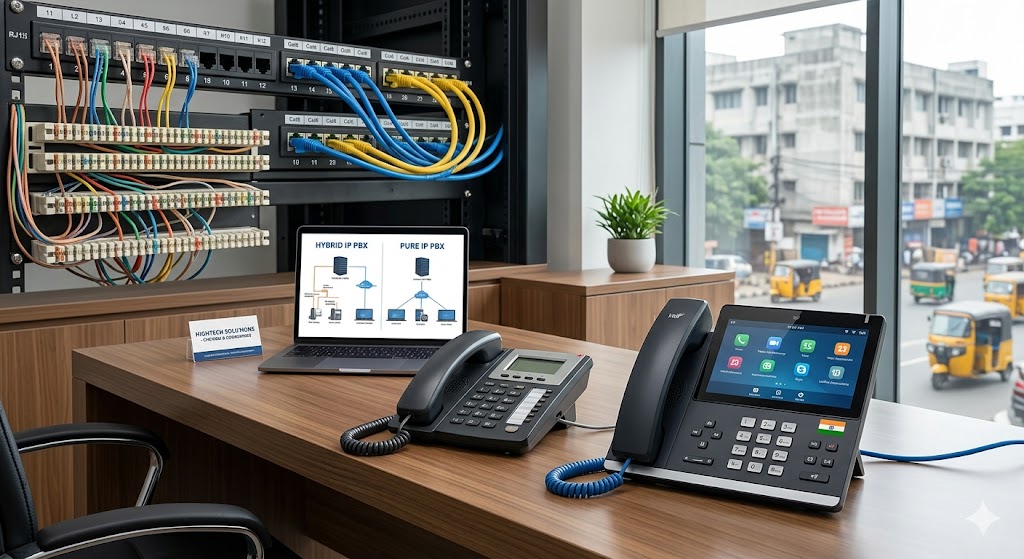
Imagine you are standing in your office’s server room, staring at a massive “spaghetti” of copper wires. These are the legacy of years of traditional telephony—solid, reliable, but undeniably old-school. Now, your business is growing, and you need the advanced features of modern Voice over IP (VoIP): video conferencing, mobile integration, and automated attendants.
The big question hits: Do you rip it all out and start over, or do you find a way to make the old work with the new?
In the world of business telecommunications, this is the classic showdown between Hybrid IP PBX and Pure IP PBX. If you are operating a business in a city like Chennai or Coimbatore, where many office buildings still feature extensive analog cabling, the decision isn’t just about technology—it’s about your budget, your building’s physical limits, and your future scalability.
Understanding the Core: What is the Difference?
Before we dive into the “which is better” part, we need to define our contenders.
What is a Hybrid IP PBX?
A Hybrid system is the ultimate “bridge.” It is designed to support both traditional analog/digital phones and modern IP-based phones. It essentially has two brains: one that talks to the old copper wires and one that talks to the internet. This allows you to keep your existing desk phones while adding VoIP features where you need them most.
What is a Pure IP PBX?
A Pure IP system lives entirely on your data network (LAN). Every phone is an IP phone, and every signal is a digital packet. There are no ports for old-fashioned analog wires here. It is the “gold standard” for new offices, but it requires a robust Ethernet infrastructure to function.
The Infrastructure Challenge: Why Your Wiring Matters
The primary pain point for most businesses isn’t the software; it’s the cost of cabling. Re-wiring an entire building with Cat6 Ethernet cables can cost thousands of dollars and cause days of downtime.
Hybrid PBX: The Savior of Legacy Wiring
If your office is already wired for analog phones, a Hybrid IP PBX is often the most logical choice. It allows you to:
-
Avoid Construction: No need to drill holes or run new cables through ceilings.
-
Phased Upgrades: You can keep 80% of your staff on analog phones and give your sales team high-end IP phones for better CRM integration.
-
Redundancy: If the internet goes down, many hybrid systems can still route calls through traditional PSTN lines.
If you’re wondering how this actually works in a real-world scenario, checking out a complete guide to IP EPABX systems in Chennai can provide more localized context on hardware availability.
Pure IP PBX: The “Clean Slate” Approach
A Pure IP system requires every workstation to have an Ethernet port. If your office only has old telephone jacks (RJ11), a Pure IP system simply won’t work without a total overhaul. However, if you are moving into a brand-new space or already have a high-speed data network at every desk, Pure IP is the most future-proof path.
Comparing Performance and Features
Flexibility vs. Simplicity
With a Hybrid system, you get incredible flexibility. You can mix and match. For example, many businesses in Coimbatore use Matrix EPABX solutions because they excel at this “best of both worlds” approach. You can maintain your heavy-duty analog extensions in a warehouse while using IP phones in the executive suites.
Conversely, Pure IP systems offer a more “unified” experience. Since everything is digital, features like CRM integration and remote work capabilities are often more seamless. You don’t have to worry about the “translation” lag between analog and digital signals.
Cost Analysis: Short Term vs. Long Term
-
Hybrid Short-Term: Much cheaper if you have existing wiring. You save on hardware (keeping old phones) and labor (no re-wiring).
-
Pure IP Long-Term: Cheaper to maintain. There is only one network to manage (your data network) instead of two separate systems for voice and data.
How to Bridge the Gap: The Role of Gateways
If you love the idea of a Pure IP system but are stuck with analog lines, there is a “middle-man” solution: Gateways.
By using an FXS gateway, you can actually connect your old analog phones to a brand-new IP PBX. This is a popular “hack” for businesses that want to modernize their backend without throwing away perfectly good handsets.
Similarly, if you want to use mobile SIM cards for cheaper calls on your IP system, a GSM gateway can be integrated into either a Hybrid or Pure IP setup to slash monthly bills.
Troubleshooting and Maintenance
Maintenance is where these two paths diverge significantly.
In a Hybrid environment, you are managing two types of hardware. You need to know how to troubleshoot echo or voice lag which can sometimes happen at the junction where analog meets digital.
In a Pure IP environment, your maintenance is almost entirely software and network-based. If your internet is stable, your phones are usually stable. However, you must ensure your network has enough bandwidth to handle “voice traffic” alongside your regular data usage.
For those in Tamil Nadu, specialized PBX maintenance services are essential to keep these complex hybrid setups running smoothly.
The Verdict: Which is Better for Existing Wiring?
Choose Hybrid IP PBX if:
-
Your building has extensive copper/analog wiring that would be expensive to replace.
-
You have a large inventory of working analog handsets.
-
You need “failover” reliability through traditional phone lines.
-
You want a budget-friendly upgrade without massive capital expenditure.
Choose Pure IP PBX if:
-
You are already planning a full office renovation or moving to a new location.
-
Your team is primarily remote or distributed, making cloud-based systems more attractive.
-
You want the absolute latest in AI features, chatbots, and unified communications.
-
You want to simplify your IT infrastructure into a single, unified data network.
Final Thoughts on Scaling Your Business
Choosing between Hybrid and Pure IP isn’t just a technical choice; it’s a strategic one. For most established businesses in Chennai and Coimbatore with existing infrastructure, the Hybrid IP PBX remains the champion of ROI. It respects your past investments while opening the door to the future.
However, if your goal is a “digital-first” workplace with no legacy baggage, Pure IP is the destination. Whichever you choose, ensure you have a solid maintenance checklist to protect your investment.
Frequently Asked Questions (FAQs)
Can I use my old analog phones with a Pure IP PBX?
Not directly. You would need an FXS Gateway to convert the analog signal into digital packets that the IP PBX can understand. While possible, it adds another piece of hardware to manage.
Does a Hybrid IP PBX support remote work?
Yes! Modern Hybrid systems have an “IP side” that supports remote extensions, mobile apps, and softphones, allowing your staff to work from home just like they would with a Pure IP system.
Which system is better for a multi-branch office?
For multi-site connectivity, Pure IP or Cloud PBX is usually superior because it treats all branches as part of one single network, making inter-office calls free and management centralized.
Is there a significant difference in voice quality?
If configured correctly, both offer HD voice quality. However, Pure IP systems are more dependent on your internet bandwidth, whereas Hybrid systems can rely on stable copper lines for voice if the internet fluctuates.
How much can I save by switching to an IP-based system?
Many businesses see a reduction in communication costs by up to 40% primarily through lower international call rates and the elimination of expensive traditional trunk lines.