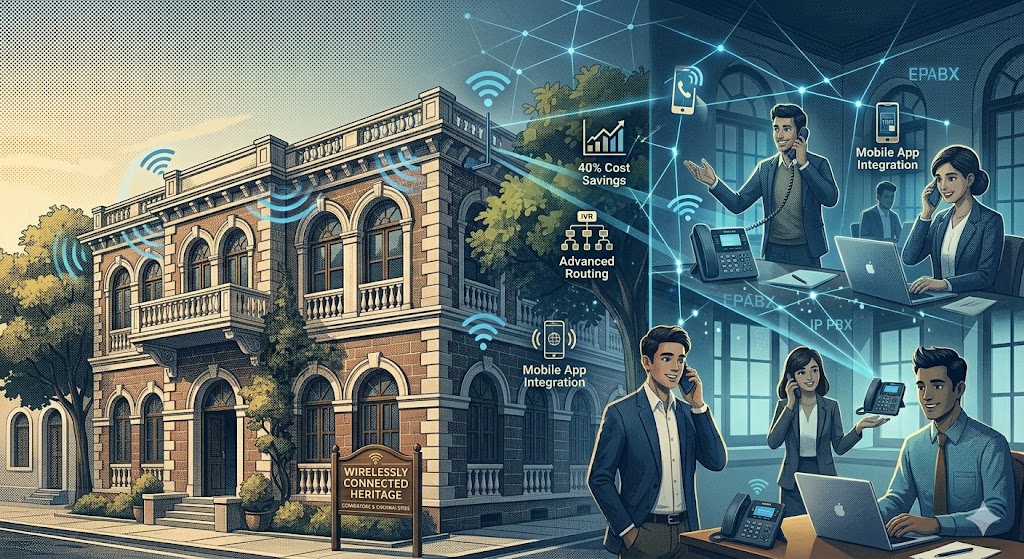
Preserving the soul of a heritage building while injecting it with 21st-century intelligence is a delicate dance. Imagine a colonial-era boutique hotel in the heart of Chennai or a century-old administrative block in Coimbatore. The walls are thick, the plaster is fragile, and the aesthetic is irreplaceable. The mere thought of a technician drilling holes to run cat6 cables or copper wires is enough to give any architect a panic attack.
Yet, communication is non-negotiable. Modern businesses cannot survive on nostalgia alone; they need high-speed connectivity, seamless internal communication, and professional call handling. This is where Wireless IP EPABX solutions for heritage buildings with no cabling step in as the ultimate technological bridge.
By utilizing robust Wi-Fi networks or DECT (Digital Enhanced Cordless Telecommunications) technology, businesses can now deploy a full-scale IP EPABX system without touching a single historic brick.
The “No-Drill” Dilemma: The Pain of Traditional Wiring in Old Structures
If you’ve ever managed an office in an older building, you know the struggle. Traditional PBX systems are hungry for wires. Every extension requires a physical port, and every port requires a cable. In a heritage structure, this leads to three primary pain points:
1. Structural Integrity Risks
Older buildings often use lime mortar or unique stone masonry. Drilling into these surfaces can cause micro-fractures or lead to long-term structural degradation. Many heritage sites are legally protected, meaning any physical modification could result in heavy fines or loss of heritage status.
2. The Aesthetic Nightmare
There is nothing more jarring than seeing a sleek, white plastic conduit running across a hand-carved teak wood ceiling or a 19th-century fresco. Cable management in heritage buildings is rarely “clean.” It’s usually a messy compromise that ruins the ambiance.
3. Prohibitive Installation Costs
The labor required to “hide” wires in a building not designed for them is astronomical. Whether it’s lifting antique floorboards or fishing wires through dead spaces, the man-hours add up. Often, the EPABX system installation cost in a heritage site is triple that of a modern glass-and-steel office.
How Wireless IP EPABX Solutions Solve the Connectivity Crisis
Wireless IP PBX systems eliminate the “physicality” of the phone network. Instead of a spiderweb of wires, the system lives on your data network. Here is how it works for a “no-cabling” environment:
The Power of Wi-Fi IP Phones
Modern IP phone dealers in Chennai now offer handsets that look like traditional desk phones but connect via dual-band Wi-Fi. As long as you have a strong wireless access point nearby, you can place a phone on any desk, plug it into a power outlet, and you’re live.
DECT Technology for Vast Spaces
For larger heritage properties—like sprawling resorts or massive institutional buildings—DECT is the gold standard. It provides a dedicated frequency for voice, ensuring that your calls don’t compete with the guest Wi-Fi. It offers incredible range and crystal-clear audio, even through thick stone walls.
Mobile Integration: The Ultimate Wireless Extension
One of the most effective Wireless IP EPABX solutions for heritage buildings with no cabling isn’t a desk phone at all. It’s a mobile app. By using IP EPABX with mobile app integration, your employees can use their smartphones as office extensions. No hardware, no wires, just pure connectivity.
Key Features That Benefit Heritage Sites
When selecting a wireless solution, it’s not just about losing the wires; it’s about gaining features that traditional systems couldn’t dream of.
1. Multi-Level IVR (Interactive Voice Response)
Even if your building is 100 years old, your customer service shouldn’t feel like it. Implementing a multi-level IVR configuration allows you to route calls professionally, giving the impression of a massive corporate operation from within a historic shell.
2. Hybrid Flexibility
Sometimes, a building has some existing wiring but not enough for a full digital overhaul. A hybrid IP PBX system allows you to keep those few working analog lines while adding wireless IP extensions for the rest of the rooms or offices.
3. Seamless Remote Work
Heritage buildings are often located in high-traffic city centers (like T. Nagar or George Town). If your staff needs to work from home to avoid the commute, a wireless IP system allows them to set up remote extensions effortlessly. The system doesn’t care where the “phone” is; it only cares about the internet connection.
Overcoming the “Thick Wall” Challenge: Wireless Engineering 101
The biggest enemy of a wireless signal is a two-foot-thick granite wall. In heritage buildings, a standard home router won’t cut it. To make Wireless IP EPABX solutions for heritage buildings with no cabling actually work, you need a strategic approach to infrastructure.
Strategic Access Point Placement
Instead of drilling, installers use “non-destructive” mounting techniques. Access points can be hidden behind tapestries, placed on top of wardrobes, or tucked into decorative alcoves. The goal is to create a “mesh” network where signals bounce around obstacles rather than trying to punch through them.
Optimizing Voice Quality
Voice data is sensitive. A tiny delay causes an echo. When we configure Fanvil or Grandstream IP phones, we prioritize “Voice over Data” (QoS). This ensures that even if someone is downloading a large file in the next room, your crystal-clear call with a client remains uninterrupted.
Choosing the Right Brand for Your Historic Office
Not all hardware is created equal. For heritage sites, you need reliability and high-gain antennas. Here are the top contenders:
-
Matrix Comsec: Known for their robust Matrix IP EPABX dealers in Coimbatore, they offer excellent hybrid solutions that bridge the gap between old and new.
-
Grandstream: Their Wi-Fi enabled IP phones are industry leaders for “no-cabling” setups. They are easy to configure with SIP trunks and offer great range.
-
Flyingvoice: Specifically designed for wireless VoIP, these are the go-to for budget-friendly wireless hardware.
Security in a Wireless World
A common concern for heritage-based businesses—especially financial or legal firms—is whether a wireless system is secure. If there are no wires, can someone “sniff” the calls out of the air?
Modern wireless IP systems utilize end-to-end encryption. By using SRTP (Secure Real-time Transport Protocol) and TLS (Transport Layer Security), your voice data is scrambled into a code that is virtually impossible to crack. This makes your wireless phone system significantly more secure than a traditional analog line, which can be easily tapped with a simple physical clip-on device.
Future-Proofing Without the Mess
The beauty of Wireless IP EPABX solutions for heritage buildings with no cabling is that they are infinitely scalable. If you decide to expand your team, you don’t need to call a mason or a carpenter. You simply buy a new IP phone, connect it to the Wi-Fi, and assign it an extension.
This “plug-and-play” nature is the ultimate respect you can show to a heritage building. You are bringing the building into the future while leaving its past untouched. Whether you are running a boutique hotel, a law firm in a colonial bungalow, or a manufacturing plant in an old mill, wireless is no longer a luxury—it’s a structural necessity.
Frequently Asked Questions (FAQs)
1. Will the thick stone walls in my heritage building block the wireless signal?
Thick walls can reduce signal strength, but this is solved by using a “Mesh Wi-Fi” system or DECT technology. By strategically placing nodes in hallways or open areas, the signal can wrap around the building’s architecture without needing to penetrate through thick granite or brick.
2. Is a wireless IP phone as reliable as a wired one?
Yes, provided your network is configured correctly. By implementing QoS (Quality of Service) on your router, you can ensure that voice traffic is always given priority over internet browsing, preventing lag or dropped calls.
3. Can I keep my existing local phone number?
Absolutely. By using a GSM Gateway or a SIP trunk, you can port your existing numbers into the new wireless system. Your customers won’t even know you’ve changed technology—they’ll just notice you sound clearer.
4. What happens if the internet goes down?
Modern IP systems have “failover” protocols. If your primary internet line fails, the system can automatically route calls to your mobile phones or switch to a secondary 4G/5G backup via a GSM Gateway system.
5. How long does it take to install a wireless system?
Since there is no drilling or cabling involved, a wireless IP EPABX system can often be set up in a single day. Most of the work is done through software configuration rather than physical labor.
6. Is it more expensive than a traditional wired system?
While the individual handsets might be slightly more expensive due to the built-in Wi-Fi/DECT technology, the overall cost is usually lower. You save a massive amount on labor, cabling materials, and the potential repair costs associated with damaging a heritage property. Check out our IP PBX price guide for more details.