In the high-stakes world of finance, information isn’t just power—it’s the entire currency. Whether you are managing a boutique investment firm in Coimbatore or a massive fintech hub in Chennai, your communication infrastructure is the primary target for cybercriminals. Every phone call discussing a merger, every voicemail containing sensitive client data, and every internal conference call is a potential vulnerability.
Transitioning to a modern IP-based EPABX system has revolutionized how firms operate, offering unparalleled flexibility. However, without the right safeguards, these internet-connected systems can become “open windows” for data breaches. This is why secure IP PBX systems with end-to-end encryption for financial firms are no longer a luxury—they are a fundamental regulatory and operational necessity.
In this deep dive, we’ll explore how financial institutions can bulletproof their telephony, the role of advanced encryption, and how to maintain a system that is as secure as a bank vault.
The Silent Threat: Vulnerabilities in Standard Business Telephony
Standard VoIP systems, while efficient, often transmit data packets in a way that can be intercepted by sophisticated hackers using “packet sniffing” techniques. For a manufacturing plant, this might be a nuisance; for a financial firm, it’s a catastrophe.
Common Security Risks for Financial Firms:
-
Toll Fraud: Unauthorized users gaining access to your PBX to make expensive international calls.
-
Eavesdropping: Intercepting SIP (Session Initiation Protocol) traffic to listen to private financial discussions.
-
Man-in-the-Middle (MitM) Attacks: Where a hacker inserts themselves between two endpoints to alter or record the conversation.
-
DDoS Attacks: Overwhelming your phone system to shut down client support channels during critical trading hours.
To combat these, firms must look beyond basic features and prioritize securing IP telephony to prevent toll fraud and unauthorized access.
What is End-to-End Encryption (E2EE) in IP PBX?
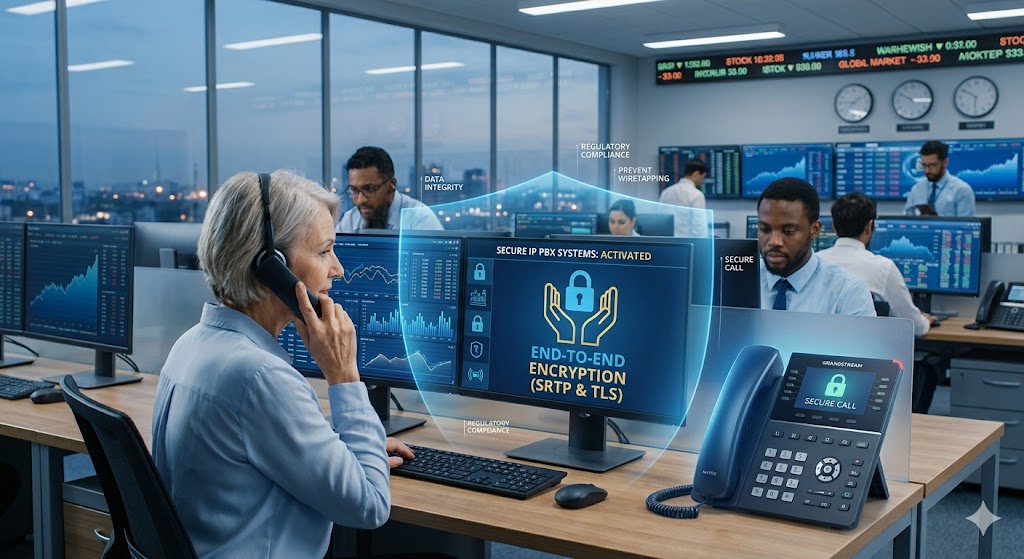
Encryption is the process of scrambling data into an unreadable format that can only be “unlocked” by the intended recipient with a specific key. When we talk about secure IP PBX systems with end-to-end encryption for financial firms, we are referring to two primary protocols:
1. SRTP (Secure Real-time Transport Protocol)
SRTP ensures that the actual voice data—the “media”—is encrypted. Even if a hacker intercepts the data packets, all they will hear is static noise.
2. TLS (Transport Layer Security)
While SRTP protects the voice, TLS protects the signaling. It ensures that the commands (who is calling whom, call setup, etc.) are encrypted, preventing hackers from mapping your internal network hierarchy.
By combining these, a firm creates a complete guide to IP-EPABX systems that meets the rigorous standards of financial regulators globally.
Why “Good Enough” Security Isn’t Enough for Finance
Financial firms operate under a microscope. Between GDPR, local Indian financial regulations, and client confidentiality agreements, a single leaked call can result in millions in fines and irreparable brand damage.
Protecting Hybrid and Remote Teams
The rise of the “anywhere office” means your employees are often calling from home networks or public Wi-Fi. Utilizing a hybrid IP-EPABX to redefine remote work is only safe if those remote extensions are tunneled through encrypted VPNs or use secure mobile app integrations.
Compliance and Auditing
Secure IP PBX systems allow for encrypted call recording. This is vital for “Know Your Customer” (KYC) compliance and dispute resolution. However, these recordings must also be stored in an encrypted environment to remain compliant. Understanding the difference between on-premise IP PBX and Cloud PBX is crucial here, as on-premise systems often give firms more direct control over their encryption keys.
Choosing the Right Hardware for Encrypted Communication
Not all IP phones are created equal. To maintain a secure environment, your hardware must support the latest encryption standards without sacrificing call quality.
Grandstream and Matrix: The Power Players
For firms in Chennai and Coimbatore, brands like Grandstream and Matrix offer enterprise-grade security features. These devices are designed to handle heavy encryption loads without the “voice lag” or “echo” often found in cheaper alternatives.
The Role of Gateways
If you are still using some analog components, you must ensure your gateways are secure. Using a Dinstar GSM gateway or an FXS gateway requires careful configuration to ensure the bridge between analog and digital doesn’t become a weak link.
Implementation Strategy: Building the Fortress
Setting up secure IP PBX systems with end-to-end encryption for financial firms involves a multi-layered approach.
Step 1: Network Segmentation
Never put your office computers and your IP phones on the same VLAN (Virtual Local Area Network). By separating them, you ensure that a virus on a computer cannot easily “hop” over to the phone system to listen to calls.
Step 2: Strong Authentication
Change all default passwords immediately. Use complex, rotating passwords for the web interface of your PBX. If you are using IP PBX for a small office, this is the most common point of failure.
Step 3: Regular Maintenance and Updates
Cyber threats evolve. Your PBX software needs to stay ahead of them. Following a professional IP PBX maintenance guide ensures that security patches are applied as soon as they are released.
The ROI of Security: More Than Just Peace of Mind
Investing in a secure system actually lowers long-term costs. How?
-
Prevention of Toll Fraud: A single hacked PBX can rack up lakhs in international call charges overnight.
-
Lower Insurance Premiums: Many cyber-insurance policies require proof of encrypted communications.
-
Client Trust: In finance, being able to guarantee that “this line is secure” is a powerful selling point.
For firms looking to optimize their budget, comparing best budget-friendly VoIP hardware like Asttecs vs. Flyingvoice can help find a balance between high-end security and cost-efficiency.
Troubleshooting and Performance Optimization
One common complaint with encrypted systems is a slight dip in voice quality due to the processing power required to encrypt/decrypt data.
Avoiding Voice Lag
If you experience issues, it’s often not the encryption but the network. Refer to our guide on troubleshooting echo and voice lag in IP PBX to optimize your router’s Quality of Service (QoS) settings. This ensures that voice packets are always given “VIP” treatment over the network.
Reliable Backups
Security also means availability. If your system goes down, your firm stops making money. Implementing an IP phone system backup and recovery guide ensures that even in a hardware failure, your secure communications can be restored in minutes.
Conclusion: The Future of Financial Telephony
As we move further into 2026, the complexity of cyberattacks will only increase. For financial firms in Chennai, Coimbatore, and beyond, the phone system is the heartbeat of the organization. By deploying secure IP PBX systems with end-to-end encryption for financial firms, you aren’t just buying a phone system; you are building a defensive perimeter around your most valuable asset: your data.
Whether you are looking for NEC SL2100 dealers or exploring cloud-based telephony, always put encryption at the top of your checklist.
Frequently Asked Questions (FAQs)
Does end-to-end encryption slow down my office internet?
Generally, no. Modern IP PBX hardware has dedicated processors for encryption (SRTP/TLS), meaning the impact on your bandwidth and voice quality is negligible on a properly configured network.
Is it possible to encrypt an old analog EPABX system?
Not directly. Analog signals cannot be encrypted in the same way. However, you can use an FXS gateway to connect analog extensions to an IP PBX, where the gateway handles the encryption before the data hits the internet.
Are cloud-based PBX systems secure enough for banks?
Yes, provided they offer “Private Cloud” options and dedicated encryption keys. Many firms prefer on-premise IP PBX for total physical control over the server, but modern cloud providers now offer bank-grade security.
What is the most common way financial phone systems are hacked?
The most common “entry point” is actually weak administrative passwords. Hackers use automated scripts to find PBX systems with default logins, allowing them to redirect calls or listen to voicemails.
How often should I perform a security audit on my IP PBX?
For financial firms, a monthly check of the maintenance checklist is recommended, with a full security audit by a professional service provider every six months.