Your employees spend an average of 4 to 6 hours every single day on the phone — handling customer queries, coordinating with vendors, following up on leads, and managing internal team communication. Now ask yourself this: is your current phone system helping them do all of that faster and smarter, or is it quietly wasting their time?
If you are still running an old analog EPABX or a basic landline setup, the answer is almost certainly: it is slowing them down. And you may not even notice it, because the losses are invisible — a few extra minutes on hold here, a missed transfer there, a call that never reached the right person.
This guide breaks down exactly how modern IP EPABX and VoIP phone systems solve these hidden productivity killers, and why businesses across Chennai and Coimbatore are making the switch right now.
Why Your Phone System Has a Direct Impact on Productivity
Most business owners think of their phone system as infrastructure — like electricity or internet. Something that simply needs to work. But a modern communication platform is far more than that. It is a productivity tool.
When a customer calls your office, what happens? Does the call route to the right person instantly? Does your team have access to call history before they pick up? Can remote employees join the same system seamlessly? Can managers see who is on a call, who is idle, and where call queues are building up?
An outdated system answers “no” to most of these questions. A modern IP EPABX system answers “yes” to all of them.
The difference is not just convenience — it is measurable time saved per employee, per day.
The Hidden Productivity Killers in Legacy Phone Systems
Before we get into what modern systems do right, it helps to understand what old systems do wrong. These pain points are frustratingly common in businesses that have not yet upgraded.
Missed calls with no record. When a call drops or goes unanswered on a traditional system, it is gone. No log, no callback reminder, no alert. That missed call might have been a high-value lead.
Manual call transfers gone wrong. How many times has a customer been transferred to the wrong extension, made to repeat their problem three times, and finally hung up in frustration? With legacy EPABX, blind transfers are the norm — the employee transferring the call has no idea if the other end is free or even available.
No visibility for managers. If you manage a sales team or a customer support team, traditional systems offer zero real-time visibility. You cannot see who is on a call, how long calls are running, or whether your team is actually available during business hours.
Zero integration with your business tools. Your CRM, your ticketing system, your customer database — a legacy phone system does not talk to any of them. Employees have to manually log every call, which takes time and often does not happen at all.
Remote work becomes impossible. Post-pandemic, hybrid work is the new normal. Legacy systems are built for a single office. If your employee is working from home, they are completely cut off from the office phone network.
Sound familiar? These are not small inconveniences. They compound every day, across every employee, draining productivity at a scale that is difficult to quantify — until you switch.
How Modern IP EPABX Systems Fix All of This
A modern IP PBX system routes voice calls over your internet network rather than traditional copper telephone lines. This opens up a completely different set of capabilities that directly translate into how efficiently your team works.
Auto Attendant and IVR: Zero Time Wasted on Routing
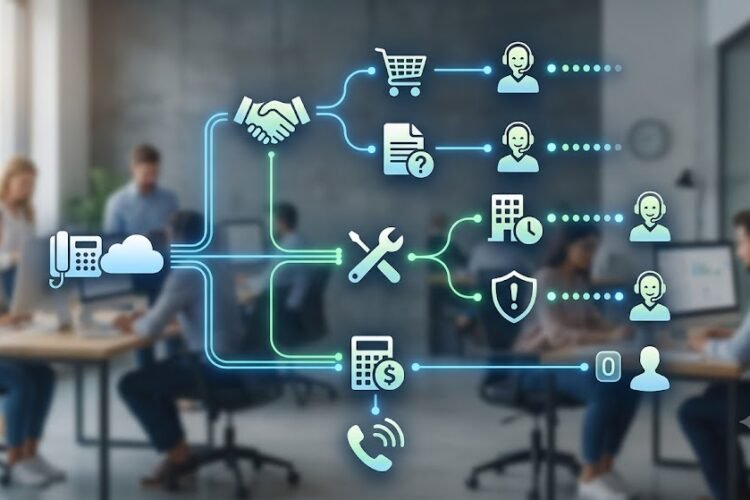
One of the most immediate productivity gains comes from Multi-Level IVR configuration. Instead of a receptionist manually routing every call, callers self-select their department — sales, support, billing, or admin. The call lands exactly where it should, instantly.
This does two things: it frees your front desk staff from acting as a human switchboard all day, and it ensures customers reach the right person on the first attempt. No frustrating holds, no wrong transfers.
Automatic Call Recording for Better Accountability
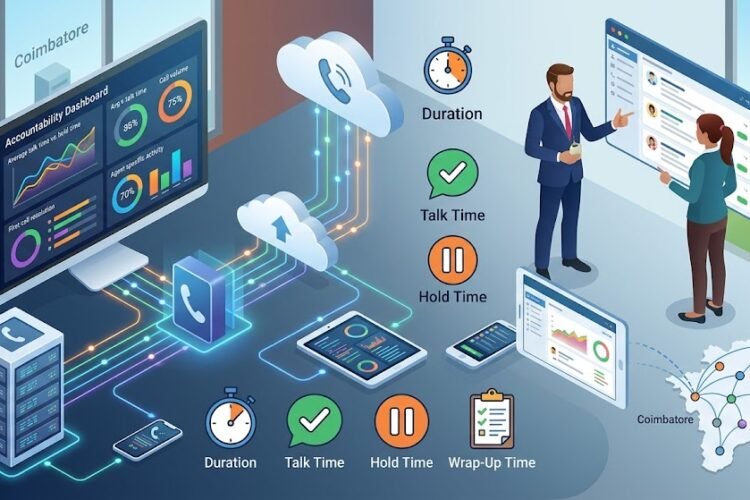
When your IP PBX has automatic call recording built in, training your team becomes dramatically easier. Managers can review actual customer interactions, identify gaps in communication, and coach employees with real examples rather than generic feedback.
More importantly, your team knows calls are recorded. This alone raises the quality and professionalism of every interaction. Disputes with customers are resolved faster. Escalations drop. Resolution time shrinks.
CRM Integration: Customer Context Before the Call Ends Ringing
Imagine your sales executive picks up the phone and their screen instantly shows who is calling, what they last enquired about, and whether their previous issue was resolved. That is not a fantasy — it is what IP PBX with CRM integration delivers.
When employees have context before they even say “hello,” calls are shorter, more productive, and end with higher customer satisfaction. No time wasted asking “can I get your name and account number again.”
Remote Extensions: Your Team Works From Anywhere
With a modern IP EPABX, remote extensions for work-from-home employees are easy to configure. Whether your employee is sitting in your Coimbatore office, working from home in Chennai, or on a business trip to Bangalore — they are on the same phone network, with the same extension, the same call features, and the same accountability.
This means hybrid work does not mean communication chaos. Your operations stay unified even when your team is distributed.
Real-Time Call Dashboards for Management Visibility
Modern systems give supervisors a live dashboard showing call volumes, agent availability, queue wait times, and call durations. If the support queue is building up, the manager can see it in real time and redeploy agents. If one employee is handling three times the call load of everyone else, that becomes visible immediately.
This kind of visibility was simply not possible with traditional EPABX. Now it is standard.
The Cost Savings That Free Up Budget for Growth
Productivity is not just about speed — it is also about reducing unnecessary cost. Modern VoIP-based systems offer significant monthly phone bill reductions compared to traditional landline setups.
Internal calls between your branches, between your office and your warehouse, or between your city offices and remote teams — all of these become free over IP. International calling costs drop dramatically. One Coimbatore-based textile exporter, for example, managed to cut international calling costs substantially using IP PBX after switching from a traditional PSTN setup.
That savings can be redirected into employee training, better tools, or expansion — all of which feed back into productivity.
Unified Communications: One Platform for Everything
The biggest productivity leap comes not from any single feature, but from the idea of Unified Communications — where your phone system, messaging, video conferencing, and collaboration tools all work from a single platform.
Instead of employees juggling three different apps for calls, WhatsApp for internal chats, and email for documentation — everything flows through one system. Switching between communication modes is seamless. No context is lost. No messages slip through the cracks.
Businesses that embrace unified communications consistently report faster internal decision-making, fewer missed follow-ups, and lower employee frustration with communication tools.
Real-World Scenarios: Where the Productivity Impact Is Most Visible
Customer support teams see it in reduced average handle time. With IVR routing, CRM integration, and call recording, each support interaction becomes more efficient.
Sales teams see it in faster follow-up. With automatic call logs and CRM sync, no lead falls through the cracks. Managers can track exactly how many calls are being made and set realistic targets.
Multi-branch businesses see it in coordination. Whether you run a manufacturing plant and a head office, or multiple retail locations, internal extensions over IP keep all your teams connected without per-call costs.
Healthcare and hospitality see it in patient or guest experience. Fast, accurate call routing means no caller is stuck on hold waiting to reach the right department.
Choosing the Right System for Your Business Size
Not every business needs the same solution. The good news is that modern IP EPABX systems scale precisely to your requirement.
For a small office of 5 to 20 users, a small business phone system under ₹50,000 is entirely realistic and delivers all the core productivity features discussed above. For growing businesses that already have analog wiring, a hybrid IP EPABX lets you upgrade gradually without ripping out existing infrastructure.
For larger enterprises, cloud-based IP PBX removes the need for on-premise hardware maintenance entirely, while on-premise systems offer full control for businesses with strict data or compliance requirements.
The Installation and Transition Process Is Easier Than You Think
One of the most common reasons businesses delay upgrading is the fear of disruption during the transition. In reality, a professional IP EPABX installation typically takes one to two days for a small to mid-sized office, with minimal downtime.
Modern systems also allow you to connect existing analog extensions using FXS gateways, which means you do not necessarily need to replace all your existing phones on day one. Migration can be phased, budget-friendly, and structured to cause zero interruption to your daily operations.
FAQs: Increasing Employee Productivity with Modern Phone Systems
How quickly will we see productivity improvements after switching to an IP EPABX?
Most businesses notice immediate improvements within the first week — especially in call routing accuracy, missed call reduction, and employee response time. CRM integration benefits compound over the first month as call history builds up.
Do remote employees get the same phone features as office staff?
Yes. With properly configured remote extensions on an IP EPABX, home-based employees have the same extension, call transfer, hold, and conferencing capabilities as their in-office counterparts.
Is a modern phone system expensive for a small business?
Not at all. Entry-level IP EPABX systems for small offices are available well under ₹50,000 in Coimbatore and Chennai, with monthly VoIP running costs significantly lower than traditional landlines. The system typically pays for itself within 6 to 12 months through call cost savings alone.
What happens if our internet goes down?
A well-planned IP PBX setup includes backup routing — calls can be automatically forwarded to mobile numbers if the internet connection drops. This ensures business continuity without any manual intervention.
Can we record calls for training and compliance purposes?
Yes. Automatic call recording is a standard feature in modern IP EPABX systems and is particularly valuable for customer support, sales coaching, and regulatory compliance.
How is a modern IP EPABX different from just using WhatsApp or mobile phones for business?
WhatsApp and mobile phones are personal tools with no management layer. You cannot route calls, record them, set up IVR, integrate with CRM, monitor queue depths, or generate call reports. An IP EPABX is a professional business communication platform with accountability and analytics built in.
Which brands are best suited for offices in Coimbatore and Chennai?
For this region, Matrix EPABX, Grandstream, Panasonic EPABX, and NEC EPABX are among the most widely deployed and supported, with local service infrastructure readily available.
The Bottom Line
Increasing employee productivity with modern phone systems is not about adding features for the sake of it. It is about removing the friction that silently costs your business hours every day — missed calls, wrong transfers, lack of visibility, disconnected remote teams, and zero integration with the tools your business already uses.
A modern IP EPABX or VoIP phone system addresses every one of these friction points. The result is a team that spends more time doing meaningful work and less time fighting their own communication tools.
If you are based in Coimbatore or Chennai and want to understand what a modern phone system would actually look like for your office size and budget, the right next step is a consultation with a local IP EPABX specialist who can assess your current setup and recommend a solution that fits — without over-engineering or over-spending.
The technology exists. The cost is lower than you expect. The productivity gains are real.