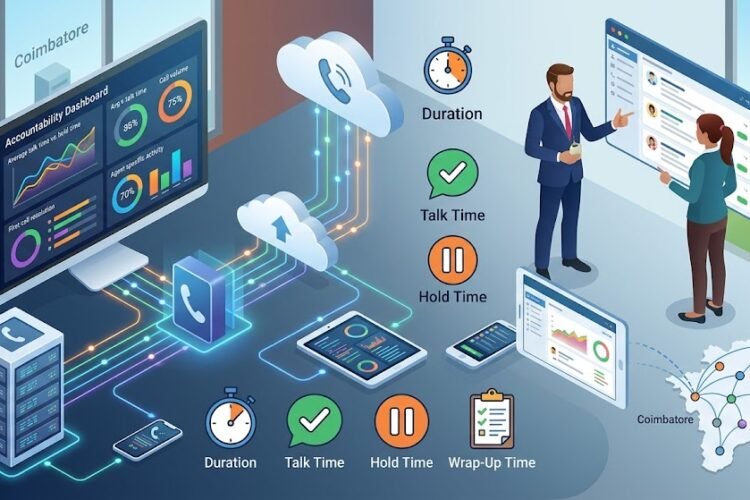
Picture this: it’s Monday morning, your sales team just landed three big clients, and HR is hiring five new reps by Friday. You need phone extensions, voicemail boxes, call routing rules, and CRM hooks — today. If you’re running a traditional PBX, that kind of growth means a technician visit, extra line cards, new cabling, and a bill that makes your CFO wince. But if you’re running a modern IP PBX, you simply log in, click “add extension,” and you’re done before your coffee gets cold.
That single contrast is the heart of today’s topic — how scalable IP PBX solutions grow with your business without the friction, delays, and ballooning costs of legacy telephony. Whether you run a 10-person startup in Chennai, a manufacturing unit in Coimbatore, or a multi-branch operation across Tamil Nadu, your phone system should be the engine of growth, never the brake.
Let’s break down exactly how scalability works, why it matters, and how to make sure your business never outgrows its communication backbone.
What “Scalable” Really Means in a Phone System
A lot of vendors throw the word “scalable” around like it’s a feature. It isn’t a checkbox — it’s a behavior. A truly scalable IP PBX lets you add users, locations, features, and call capacity on demand, without ripping out hardware or paying for capacity you don’t yet need.
Think of it like renting office space. A legacy PBX is like buying a building: you pay for 50 desks even when you only have 12 employees. A scalable IP PBX is more like a coworking membership — you scale up or down as the week demands.
If you’re new to the concept, our beginner’s guide to IP EPABX systems walks through the fundamentals before we go deeper here.
Why Traditional Phone Systems Hold Growing Businesses Back
Before we talk about the fix, let’s name the problem. Most businesses don’t realize how much their old phone system is costing them until they switch. Here are the pain points we hear again and again:
- Rigid capacity. Every new employee means a physical line card, a truck roll, and a waiting period.
- Hidden costs. Maintenance, AMC charges, and legacy line rentals quietly drain your budget. (We dig into this in the hidden costs of sticking with legacy phone infrastructure.)
- No remote support. Hybrid and remote teams simply can’t plug into an analog system.
- Fragmented customer experience. Calls get dropped, transfers fail, and your IVR sounds like it belongs to 2005.
- Zero future-proofing. Want AI chatbots, CRM sync, or mobile apps? Not on a legacy box.
These aren’t minor annoyances. For a growing business, they’re growth blockers. If any of this sounds familiar, scan our list of 10 signs you should upgrade your traditional PBX to IP EPABX.
How Scalable IP PBX Solutions Grow with Your Business
Here’s where it gets exciting. This is the core question every business owner asks before investing: will this system still fit me in three years? The answer with a well-designed IP PBX is an emphatic yes — and here’s the mechanics of how.
Start Small, Expand Without Rewiring
A scalable IP PBX is software-defined. You don’t buy a 200-user box on day one. You start with what you need — say, 15 extensions for a small office — and the system is licensed to grow. When employee 16 joins, you provision a new extension in minutes.
This is why IP EPABX is one of the best investments for small startups: you protect cash flow today while keeping the door wide open for tomorrow. There’s a reason budget-conscious owners look at small business phone systems under 50k in Coimbatore — the entry point is low, but the ceiling is high.
Add Users Without Touching a Single Cable
On a legacy system, adding a user means pulling cable, punching down to a patch panel, and configuring a port. On an IP PBX, a user is just a SIP credential. New hire? Hand them an IP phone or softphone app, and they’re live on the network. No cabling crews, no downtime.
For offices that move desks around frequently or embrace hot-desking, this flexibility is transformative. Our guide on scalable communication with Grandstream IP phones covers hardware choices that support this model beautifully.
Multi-Location and Remote Expansion Becomes Seamless
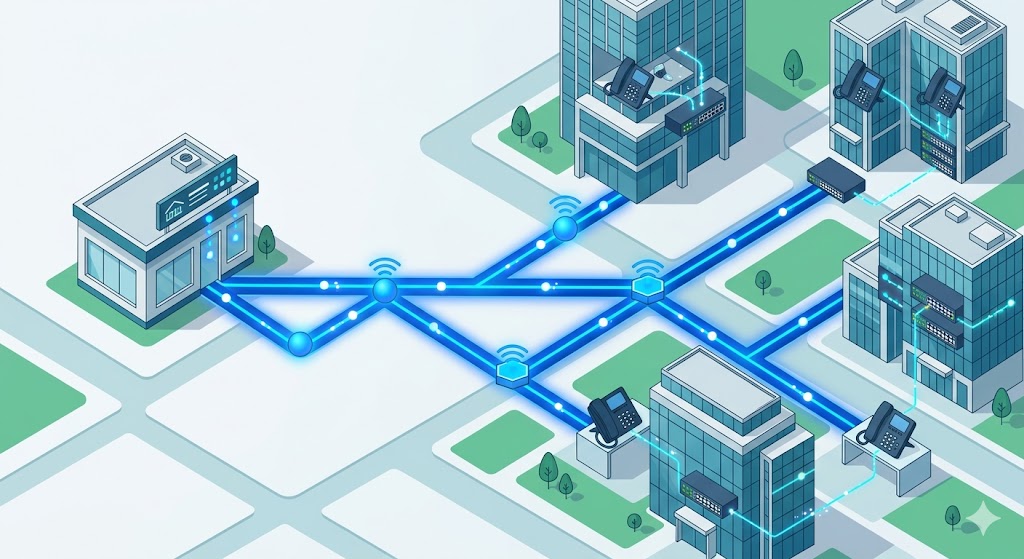
Growth rarely stays in one building. Maybe you open a branch in Coimbatore while HQ stays in Chennai. Maybe half your team works from home. A scalable IP PBX treats every location as part of one unified system — same dial plan, same extensions, same features.
Need to onboard remote staff? Our tutorial on setting up remote extensions on IP EPABX for work-from-home shows how painless it is. And if hybrid work is your long-term model, modern IP PBX systems for hybrid work success lays out the full playbook.
The Pain Points a Scalable IP PBX Eliminates
Let’s translate scalability into the things that actually keep business owners awake.
Skyrocketing Communication Costs
Growth usually means more calls — more customers, more vendors, more international conversations. Legacy per-line billing punishes that. IP PBX with SIP trunking and VoIP slashes those bills dramatically. Read how businesses reduce monthly phone bills using IP EPABX and VoIP integration, or see the broader strategy in how to significantly reduce monthly phone bills with IP PBX.
Disrupted Service During Expansion
The worst time to rewire a phone system is when you’re busiest. Scalable IP PBX grows online — no service interruption, no “please bear with us” messages to callers. Your customers never feel the upgrade.
Fragmented, Inconsistent Customer Experience
As teams grow, so does the risk of dropped handoffs and missed context. A scalable IP PBX pairs with CRM integration so every caller’s history follows them. Explore the possibilities in our IP PBX system with CRM guide.
Features That Power Seamless Scalability
Not all IP PBX systems scale the same way. Look for these capabilities when you choose yours.
Cloud vs. On-Premise Flexibility
The biggest scalability decision is where your PBX lives. On-premise gives you control; cloud gives you instant elasticity and zero hardware management. The right choice depends on your growth trajectory — our cloud vs. on-premise IP PBX comparison breaks down the trade-offs. For multi-branch offices specifically, see on-premise IP PBX vs. cloud PBX for multi-branch operations.
SIP Trunking for Instant Capacity
Need 20 more concurrent call paths for a seasonal rush? SIP trunks provision in minutes, not weeks. Non-technical owners will appreciate our plain-English SIP trunking guide.
CRM and App Integration
Scalability isn’t only about call volume — it’s about workflow volume. As your sales team doubles, integration with CRM, helpdesk, and mobile apps keeps everyone productive. This ties into a broader unified communications strategy.
Real Growth Scenarios Where IP PBX Shines
From 10 Employees to 100
This is the classic trajectory, and it’s exactly where scalability pays off. What cost a few thousand rupees at 10 users costs proportionally little more at 100 — because you’re scaling licenses and trunks, not buying a second PBX. Curious about pricing? Our breakdown of IP PBX pricing for 20 users in Coimbatore gives a realistic starting point.
Branch Offices and Distributed Teams
When growth means geography, the IP PBX truly flexes. Branch-to-branch calls become free internal extensions. A receptionist in Chennai can answer for Coimbatore. One admin panel manages everything. For the full setup story, read our complete EPABX installation guide for business setup.
How to Choose a Scalable IP PBX That Won’t Box You In
A practical checklist for buyers:
- License model — Can you add users in increments, or are you forced into big jumps?
- Hybrid deployment — Can you start on-premise and move partially to cloud later?
- Standards-based — SIP-compliant phones and gateways mean you’re never locked into one vendor.
- Remote-friendly — Does it support softphones and mobile apps out of the box?
- Maintenance roadmap — Scalable systems still need upkeep; our IP PBX maintenance guide covers what to expect.
When you compare options, the ultimate IP PBX vs. traditional EPABX comparison makes the long-term math obvious.
The Bottom Line: Growth Shouldn’t Hurt
Here’s the truth every business owner learns eventually: communication systems either accelerate your growth or quietly throttle it. Legacy PBX throttles. Scalable IP PBX accelerates.
When you understand how scalable IP PBX solutions grow with your business, the investment decision becomes simple. You’re not buying a phone system for today — you’re building a communication platform that bends and expands with every new client, every new hire, and every new branch. You protect your current budget while removing every ceiling on your future.
The businesses that win the next decade in Chennai, Coimbatore, and beyond will be the ones whose tools never said “no” to growth. Make sure your phone system is one of them.
Frequently Asked Questions
What does a scalable IP PBX actually mean?
A scalable IP PBX is a phone system designed to grow — or shrink — with your business by adding or removing users, locations, and call capacity through software, without major hardware changes or downtime.
How many users can an IP PBX system support?
It depends on the platform. Entry-level systems handle 10–50 users comfortably, while enterprise IP PBX deployments scale to thousands. The key is choosing a system whose licensing and architecture match your growth runway.
Is IP PBX cheaper to scale than a traditional PBX?
Yes, dramatically. Adding a user on a legacy PBX involves hardware, cabling, and labor. On an IP PBX, it’s typically a software license and a few minutes of configuration. Learn more in our guide to reducing monthly phone bills with IP PBX.
Can I start with on-premise IP PBX and move to the cloud later?
Absolutely. Many businesses begin on-premise for control and migrate workloads to the cloud as they expand. Our cloud vs. on-premise comparison explains the migration path.
Do scalable IP PBX systems support remote and hybrid teams?
Yes — this is one of their biggest advantages. Softphones, mobile apps, and secure SIP registration let employees work from anywhere. See our guide to remote extensions for work-from-home.
How quickly can I add a new employee’s extension?
In most modern IP PBX systems, provisioning a new extension takes a few minutes through the admin portal — no technician visit required.
Will scaling disrupt my existing service?
No. Properly designed IP PBX platforms add capacity online without interrupting active calls, so your customers never feel the change.