Every sales team has felt this pain at least once. A hot lead calls in, the sales rep scrambles for a notepad, scribbles down half the details, and promises to “add it to the system later.” Later never comes on time. By the time the lead is logged, the prospect has already spoken to two competitors and made up their mind. This is the silent revenue leak that happens inside businesses across Chennai and Coimbatore every single day — not because sales teams aren’t working hard, but because their phone systems and CRM software are operating in two completely separate worlds.
Better lead management through phone and CRM synergy is the fix for exactly this problem. When your IP PBX system and your CRM talk to each other in real time, every call becomes data, every data point becomes context, and every context becomes a faster, smarter follow-up. This isn’t a futuristic concept reserved for large enterprises with dedicated IT departments. It’s a practical, achievable upgrade for small and mid-sized businesses right here in Tamil Nadu, and it’s already reshaping how local companies convert inquiries into paying customers.
Why Disconnected Phones and CRMs Are Costing You Leads
Most businesses don’t realize how much revenue slips through the cracks until they actually sit down and trace a lead’s journey. A call comes in, gets answered by whoever’s free, gets scribbled on a sticky note or typed into a random spreadsheet tab, and then depends entirely on someone remembering to transfer that information into the CRM. Multiply this by dozens of calls a day, and you get duplicate entries, missing details, forgotten callbacks, and leads that simply vanish from the pipeline.
The Real Cost of Manual Data Entry
Manual entry doesn’t just waste time — it introduces errors that compound over weeks. A wrong phone number here, a missed budget detail there, and suddenly your sales team is chasing the wrong priorities. Studies on sales productivity consistently point to administrative work as one of the biggest drains on selling time, and phone-to-CRM disconnection is one of the most common culprits.
Lost Context Means Lost Trust
When a prospect calls back and has to repeat their entire requirement from scratch because the previous conversation wasn’t logged anywhere, it sends a subtle but damaging signal: this business isn’t organized enough to remember me. In competitive markets like Coimbatore’s textile and manufacturing sector, or Chennai’s IT and services corridor, that impression alone can be enough to lose the deal.
What Phone and CRM Synergy Actually Looks Like
Synergy between your phone system and CRM isn’t a single feature — it’s a set of connected capabilities that work together so no lead information ever depends on human memory alone.
Screen Pop: Instant Context on Every Call
The moment a known number calls in, the agent’s screen automatically displays the caller’s full profile — past interactions, open deals, previous complaints, and notes from the last conversation. There’s no fumbling, no “can you remind me what we discussed last time.” Our detailed breakdown on how screen pop functionality can transform your sales team’s efficiency explains exactly how this feature shortens call handling time while making every conversation feel personal and prepared.
Automated Call Logging: No Lead Left Behind
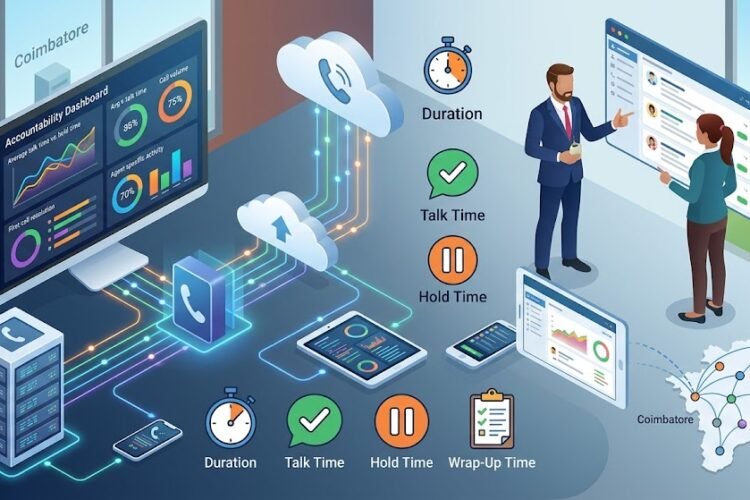
Instead of relying on someone to manually note down call outcomes, every call — inbound or outbound — gets logged automatically against the correct CRM record, complete with timestamp, duration, and disposition. This alone eliminates one of the most common reasons manual entry hurts sales performance, a topic we’ve explored in depth in our piece on why automating call logging matters when manual entry is hurting your sales.
Intelligent Call Routing Based on CRM Data
Not every lead deserves the same treatment. A returning customer with a pending high-value quote shouldn’t wait in the same queue as a first-time cold caller. When your IP PBX pulls data directly from the CRM, calls can be routed based on lead score, deal stage, or account history, sending your best opportunities straight to your most experienced closers. We cover this in detail in our article on using CRM data for intelligent call routing.
Building the Connection: Zoho, Salesforce, and Beyond
For businesses already invested in a CRM platform, the good news is that integration doesn’t mean starting over. Modern IP PBX systems are built to connect with the tools you already use.
Zoho CRM Integration for Growing Businesses
Zoho remains one of the most popular CRM choices among small and mid-sized businesses in Tamil Nadu, largely because of its affordability and flexibility. Connecting Zoho to your IP PBX system means every call automatically creates or updates a contact record, logs call notes, and triggers follow-up tasks without anyone lifting a finger outside the actual conversation. Our step-by-step walkthrough on integrating IP PBX with Zoho CRM is a practical starting point if you’re considering this setup.
Salesforce Integration for Scaling Support Teams
Larger sales and support operations often lean on Salesforce for its depth of customization and reporting. When Salesforce is connected to your phone system, support and sales teams gain a single source of truth for every customer interaction, which directly improves resolution times and customer satisfaction scores. We go deeper into this in our guide on how Salesforce integration enhances customer support.
One Unified View Across the Sales Funnel
The real magic happens when this integration extends across your entire sales funnel — not just the first call, but every touchpoint from initial inquiry to closed deal to post-sale support. This creates a genuinely unified communication strategy rather than a patchwork of disconnected tools, a concept we unpack fully in streamlining your sales funnel with unified communication.
The Business Case: Why This Matters More in 2026
Buyer expectations have shifted. Prospects comparing vendors — whether it’s a manufacturing unit sourcing IP PBX systems in Coimbatore or a retail chain scaling operations in Chennai — expect fast, informed responses. A business that can pick up the phone and immediately reference a prior conversation projects competence. A business that asks “sorry, can you tell me again what you were looking for?” projects the opposite.
Productivity Gains Beyond the Sales Team
It isn’t just sales reps who benefit. Support staff resolve tickets faster when call history is visible instantly, and management gets accurate reporting on call volumes, conversion rates, and response times without manually cross-referencing spreadsheets. This broader productivity lift is something we detail in our article on how modern phone systems increase employee productivity.
Measurable Return on Investment
Businesses considering this upgrade often want to know the numbers before committing. Reduced call handling time, fewer missed follow-ups, and improved lead conversion rates all contribute to a calculable ROI, something we break down further in our guide on measuring ROI when upgrading IP telephony.
Practical Steps to Get Started
Moving from a disconnected setup to a fully synced phone-and-CRM environment doesn’t have to happen overnight, and it doesn’t require ripping out your existing infrastructure.
Step One: Audit Your Current Call Handling Process
Start by tracking where lead information currently gets lost. Is it during the initial call? During handoff between departments? During follow-up scheduling? Identifying the exact leak point makes the fix far more targeted.
Step Two: Choose an IP PBX Built for Integration
Not every phone system supports CRM integration out of the box. Look for a system specifically designed with API-level connectivity to platforms like Zoho and Salesforce, rather than one that requires expensive custom middleware.
Step Three: Train Your Team on the New Workflow
Technology alone doesn’t fix lead management — habits do. Once screen pop, automated logging, and intelligent routing are in place, your team needs a short training cycle to fully trust and use the new context available to them on every call.
Frequently Asked Questions
Does phone and CRM integration work with any CRM software?
Most modern IP PBX systems support integration with widely used platforms like Zoho and Salesforce through APIs. If you’re using a lesser-known or heavily customized CRM, it’s worth confirming compatibility with your provider before committing.
Will this integration slow down our existing phone system?
No. When set up correctly, CRM integration runs in the background and doesn’t add noticeable latency to call handling. In fact, most businesses report faster call resolution because agents spend less time searching for information.
Is this only useful for large sales teams?
Not at all. Small businesses with even two or three sales staff benefit significantly, since missed follow-ups and lost lead details tend to hurt smaller teams proportionally more — there’s less redundancy to catch the gaps.
How long does it typically take to set up CRM integration with an IP PBX?
Depending on the complexity of your existing CRM setup, integration can often be completed within a few days to a couple of weeks, including testing and staff training.
Can this help with lead management for businesses outside Chennai and Coimbatore?
Yes, the underlying principles apply to any business that handles inbound and outbound sales calls, regardless of location. That said, local support and on-site setup assistance make execution smoother for businesses based in Tamil Nadu.